
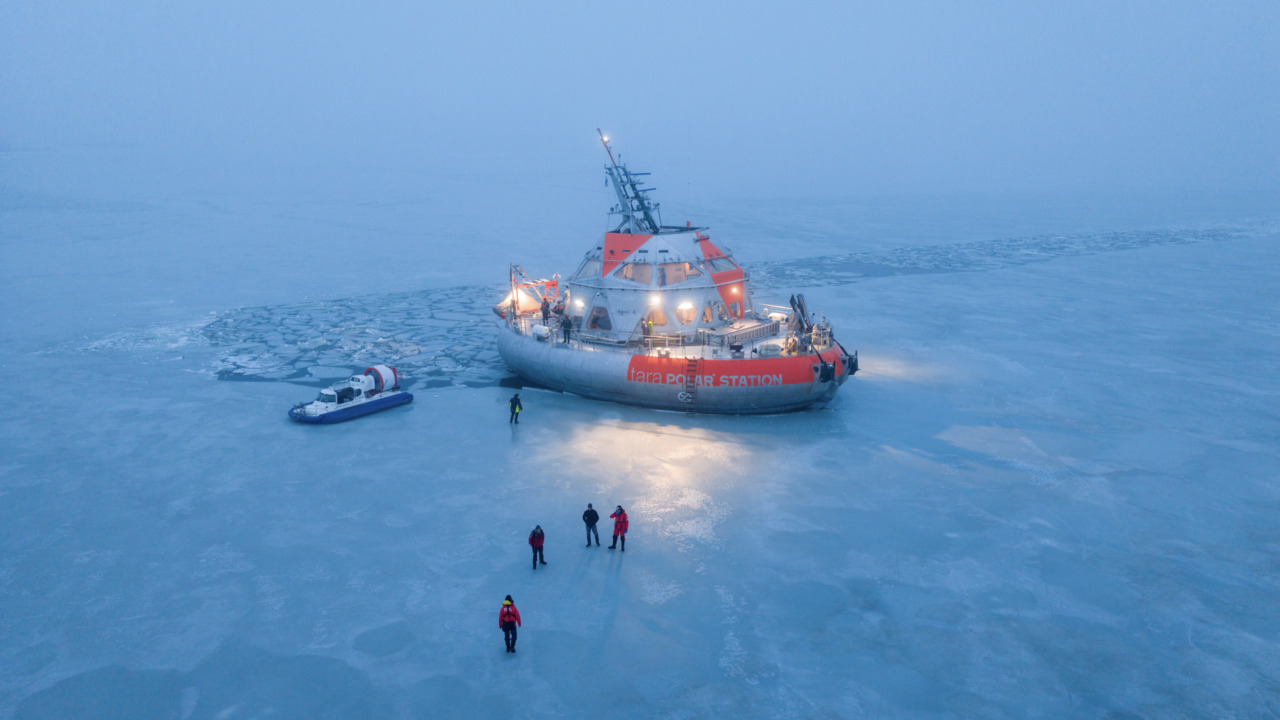
A floating laboratory has begun drifting through Arctic sea ice on a mission set to last until late 2027, carrying scientists into one of the most isolated places on Earth. Built in France, the Tara Polar Station is carrying a crew of 12 to study biodiversity and the effects of climate change, as well as a dog to alert them to polar bears – and no one knows exactly where the ice will take them. Named Tara Polaris I, the mission will carry the igloo-shaped station through the central Arctic Ocean, where it is now drifting with the sea ice. Part boat, part research station, the Tara Polar Station was built in Cherbourg and set out from its home port of Lorient on 19 July on its first expedition to the North Pole. It is the second vessel operated by the private Tara Ocean Foundation. Its journey north took it first to Rotterdam in the Netherlands to take on HVO fuel, a hydrotreated vegetable oil dubbed "renewable diesel", before continuing to Tromso and Kirkenes in Norway on its way towards the transpolar current, which carries sea ice across the Arctic Ocean. The vessel then travelled along the Northeast Passage, a sea route along Russia's Arctic coast that gradually opens up during summer. In early September, it met Chinese icebreaker Xuelong 2, which cleared a path through the final few dozen kilometres. The Tara Polar Station then became trapped in the ice and began drifting with it. At last report, those aboard were in the same time zone as Japan. French research ship Tara sets sail to study secrets of heat-resistant corals Life in a floating igloo The first crew of 12 – eight men and four women – will live together on the ice until replacements arrive by plane in April. Their Arctic winter will include five months of polar night, while the mission as a whole is expected to last between 400 and 500 days. Life aboard will be a closed world, Romain Troublé, director-general of the Tara Ocean Foundation, told RFI. “Each of them can retreat to their cabin, to be isolated within the isolation. I think it's important to have a little private space,” Troublé said. The Tara Polar Station can comfortably accommodate almost 20 people inside its 26-metre oval hull, which is 20 millimetres thick and designed to rise under pressure from the sea ice. The vessel has a raised wheelhouse and can travel at 15 kilometres an hour, or eight knots, but is now drifting with its engines switched off. A Finnish Lapphund named Orkki is also part of life on board, with the job of raising the alarm if polar bears approach. “We have a captain, a first mate, a chief engineer, a cook, a doctor and an onboard correspondent,” Troublé added. “The other six are engineers and scientists – specialists in ice, biology and genomics – who will work for all the laboratories involved in the project, a bit like on the International Space Station.” The Tara Polar Station during winter testing in Finland on 10 January 2026, ahead of its first expedition into the central Arctic Ocean. © Tara Ocean Foundation A touch of Jules Verne Scientists aboard the Tara Polar Station are trying to understand what lives in the central Arctic Ocean and how climate change is affecting it. The region is warming three to four times faster than the rest of the planet. Leading the scientific team is Canadian polar oceanographer Marcel Babin, a former research director with France's National Centre for Scientific Research (CNRS) at the Takuvik International Research Laboratory. Takuvik is jointly overseen by the CNRS, Laval University in Quebec and Sorbonne University, while around 30 research centres from 12 countries are involved in the expedition. Much of what the scientists have come to study lies directly beneath their feet. A central well runs through the lower, wet part of the station's hull, giving them direct access to the water beneath the sea ice and allowing them to observe species there. The project has a touch of Jules Verne. The station was designed specifically for this kind of research, and this is the first time it has been placed in the ice for an entire winter. French European Space Agency astronaut Thomas Pesquet is a patron and inaugurated the station alongside French fashion designer Agnès b, a founder of the Tara Ocean Foundation. Pesquet would have happily joined the expedition himself, Troublé said. “There are similarities with space. This experience of doing science remotely is interesting for us. A lot of what the European Space Agency does is important to us,” Troublé said. The Tara Polaris I mission also coincides with the 20th anniversary of the Tara Arctic expedition, when a schooner spent 507 days drifting through Arctic sea ice between September 2006 and January 2008. Indigenous knowledge steers new protections for the high seas Ready for surprises For all the planning that has gone into the expedition, once the Tara Polar Station is locked in the ice, its crew will have to deal with whatever the Arctic throws at them. “We're ready for anything, but not everything we've planned for will happen, and anything we haven't planned for can happen,” Troublé said. “It's a way of thinking. You have to take surprises as they come.” The hull itself is solid and the team is well prepared. Troublé is more concerned about the station's weak point – its rudder. “The crew has just locked it in place, and it wasn't easy,” he said. “It's the part of the boat that will need their attention when the ice moves.” But the greater worry is not necessarily the ice or the vessel. It is what Troublé called “the plain, stupid accident of everyday domestic life”. The risks are the same as the crew face anywhere else, he explained, “except that out there, it's more complicated to go and rescue them”. The expedition is also intended to look beyond this one journey. Tara Ocean and its research partners want to document the North Pole and assess the health of the central Arctic Ocean, while Troublé hopes the foundation can eventually return to the sea ice every two years over the next two decades. The big blue blindspot: why the ocean floor is still an unmapped mystery Into the polar night Polar night will begin in the coming weeks, leaving the Tara Polar Station to continue its drift through five months of Arctic darkness. During the first months of next year, it is expected to move closer to the centre of the Arctic Ocean and the North Pole before eventually drifting back towards northern Europe, somewhere around Greenland, Svalbard or Iceland. Along the way, researchers hope to learn more about Arctic biodiversity, species found only in the region and the processes taking place in the sea ice. They also want to understand what its disappearance could mean for fisheries and other processes important to people further south. The findings could ultimately reach far beyond the expedition itself. Protecting the Arctic and deciding how it should be governed are also part of the project, including through the Arctic Council forum, with Troublé hoping its scientific data can help inform future political decisions on protecting polar regions. But for all the research plans, there is one thing no one aboard can know: exactly where or when the ice will release the station. “We don't know – it's a journey,” Troublé said. “We've put the boat in the ice, and we'll see where it comes out of the ice, and when.” That uncertainty offers “a certain poetry in today's world, where everything is planned”. This article was adapted from the original version in French by Igor Gauquelin.
Locked in Arctic ice, the floating lab studying climate and wildlife
Full Article
Original Source
Read the full article at Rfi →KhanList aggregates and links to publicly available news content. We do not host full articles from third-party sources. Always verify important information with original sources.