
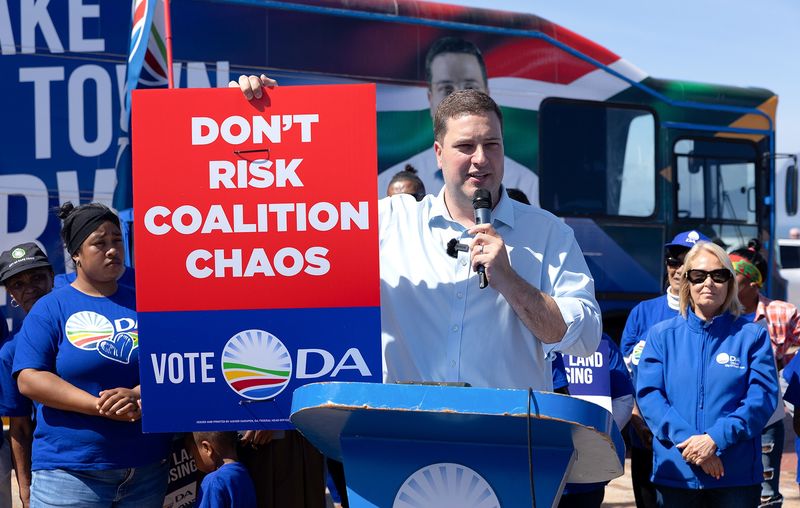
With seven days until the 4 November local government elections, Cape Town Mayor and Democratic Alliance (DA) leader Geordin Hill-Lewis has made “coalition chaos” the centrepiece of the Democratic Alliance’s final campaign push.The message was reinforced by the DA’s latest campaign poster, which Hill-Lewis personally unveiled on Tuesday, 27 October, by climbing a ladder to hang the first placard.The posters, bearing the warning, “Don’t risk coalition chaos”, are being rolled out across the metro as the party seeks to shore up its majority and discourage voters from splitting their support among smaller parties.“We’ve got seven days to go before the 4 November election, and we win Cape Town again,” said Hill-Lewis.The DA is expected to maintain its majority in the city. The recent eNCA and MarkData poll put it at 52.6%, while News24 and Sabi Strategy Group placed it at 56.1%.However, the DA’s vote declined from 66.6% in 2016 to 58.3% in 2021. In the 2024 provincial election, it won 53% of the vote in the metro.In September, Ipsos polled the DA at 46% in the city, but said it “could potentially exceed 50% support as campaigning continues”.Hill-Lewis said the DA’s own polling put it at 51% to 52%, conceding that this was “too close for comfort”.Addressing supporters, he said: “If voters just vote for [opposition parties], 1% each, what they can do is throw the city into the risk of having a coalition government. If you are thinking of voting for one of those smaller parties, let me tell you what you actually do is open the door for the ANC and EFF to sneak in and take over Cape Town.”Battle for the coloured voteSome smaller parties have campaigned hard in a bid to win voters from the DA, particularly in coloured communities. The Patriotic Alliance (PA), the National Coloured Congress (NCC), the Good party, ActionSA and newer political formations are seeking to convert voter dissatisfaction into electoral gains.Responding to Daily Maverick’s question about the coloured vote’s potential to sway the election, Hill-Lewis reiterated that smaller parties could erode the DA’s majority.“None of these parties [is] going to do very well, but you might have so many of them each getting 1% or 2% of the vote that they end up eroding an outright majority for the DA,” he said. Geordin Hill-Lewis at the unveiling of a new election billboard in District Six, Cape Town, on 19 October 2026. (Photo: Gallo Images / Misha Jordaan) He pointed to coalition-governed municipalities, including Tshwane, as examples of political instability undermining service delivery. He cited the Bronkhorstspruit water contamination, where more than 800 cases of illness have been reported.“This is just a symptom of coalition chaos. When you are spending more time arguing about who gets to fill what seat, you spend less time serving the public,” Hill-Lewis said.Hill-Lewis also pledged safer streets, jobs, reliable electricity and better public spaces, and said his administration had added 1,300 metro police officers and a new SWAT and drone unit.He underlined that in Cape Town, the DA had created 418,000 jobs in five years and promised another 500,000, alongside affordable housing and informal settlement upgrades. “The people of Cape Town should not assume that this election is already won. Do not assume that your neighbours will turn out in sufficient numbers,” the mayor told supporters.Rivals make electoral inroadsThe PA has won wards from established parties across the Western Cape, including the DA in Drakenstein and Stellenbosch in April 2026 and Good in George. It also won Cape Town’s Ward 56, covering Kensington, Maitland and Factreton, in 2023.The PA is fielding councillor Cheslyn Daniels as its mayoral candidate. It only won 0.2% of the vote in 2021, but this is expected to rise.NCC Leader Fadiel Adams appears at Pinetown Magistrates’ Court on 15 May 2026 for a bail application linked to a pending criminal case. He is also under scrutiny over issues linked to the Madlanga Commission. (Photo: Gallo Images / Darren Stewart) The NCC has established a foothold, too. In 2021, when it was known as the Cape Coloured Congress, it won seven Cape Town council seats and one in Saldanha Bay.In 2024, it secured 2.38% of the provincial vote and a seat in the Western Cape legislature. It came second in a November 2024 Manenberg by-election with 21%, up from 4% in 2021, but failed to win a 2026 Cederberg by-election.For NCC leader Fadiel Adams, scrutiny linked to the Madlanga Commission and a pending criminal case in Durban present additional challenges to the party’s credibility.The NCC and PA in particular could draw voters away from the DA. eNCA/Markdata polled the PA at 4.9% and the NCC at 2.7% ahead of the elections, with populist appeals over crime, safety and community representation drawing support from working-class coloured communities. No party owns the coloured vote While the idea of a unified coloured vote has long shaped political calculations in the Western Cape, Professor Cherrel Africa, an associate professor at the University of the Western Cape’s Department of Political Studies, argued in 2019 that the concept was often overstated, allowing parties to blame voters’ racial identity rather than confront their own political failures.The province’s electoral history demonstrates how loyalties shift. The National Party won the Western Cape with 53% in 1994, before the ANC overtook it with 42% in 1999. The DA captured the province in 2009 with 51%, increasing its share to 59% in 2014.Veteran politician Peter Marais, who served in parties including the National Party, DA and Freedom Front Plus, has witnessed this shifting political landscape, moving through several parties during a career spanning apartheid-era politics and the post-1994 democratic dispensation. He served as Cape Town mayor from 2000 to 2001 and Western Cape premier from December 2001 to June 2002.Describing himself as “a pragmatic radical”, Marais argues that coloured voters remained politically fragmented. “For the coloured person, any party comes first – all the various parties. We lack direction,” he claimed.Low trust poses a challenge for all partiesSanusha Naidu, senior research associate at the Institute for Global Dialogue, says coloured voters remain strategically important in Western Cape politics, but should not be treated as a homogeneous bloc.Citing the IEC’s voter participation survey, Naidu points to a crisis of political trust: only 11% of respondents trusted political parties and 9% trusted politicians.“The question is: what is the level of trust in political parties, and how are parties such as the DA, PA and NCC responding to that?” she asks.She cautions against assuming voters will support parties based on identity alone, questioning whether the PA and NCC have delivered tangible results where they hold representation.The army conducts joint patrols and operations on 13 April 2026 in gang-ridden areas in Vrygrond, Cape Town as part of a year-long Operation Prosper. (Photo: Gallo Images / Brenton Geach) For the DA, service delivery failures, stagnant livelihoods and limited economic opportunities could cost it wards in November, despite retaining control of Cape Town and the province.Naidu identifies gang violence and entrenched criminality as key sources of frustration. Figures such as NCC leader Fadiel Adams address the lived experiences of coloured communities, she says, but representation must deliver results.She describes the wider mood as a “politics of rage”, fuelled by stagnation, exclusion and declining confidence in the political system. The deeper challenge for every party is to address the material conditions behind public anger, rebuild trust and demonstrate that campaign promises deliver results, she said.Election analyst Wayne Sussman argues that the DA’s grip on the coloured vote began loosening after 2016, with the 2021 and 2024 elections creating space for rivals. ActionSA’s decision to bring Gauteng politician Dereleen James to the Western Cape further illustrated the intensifying contest. DM
LOCAL ELECTIONS 2026: Hill-Lewis warns small parties could force a coalition government in Cape Town
Full Article
Original Source
Read the full article at Dailymaverick →KhanList aggregates and links to publicly available news content. We do not host full articles from third-party sources. Always verify important information with original sources.