
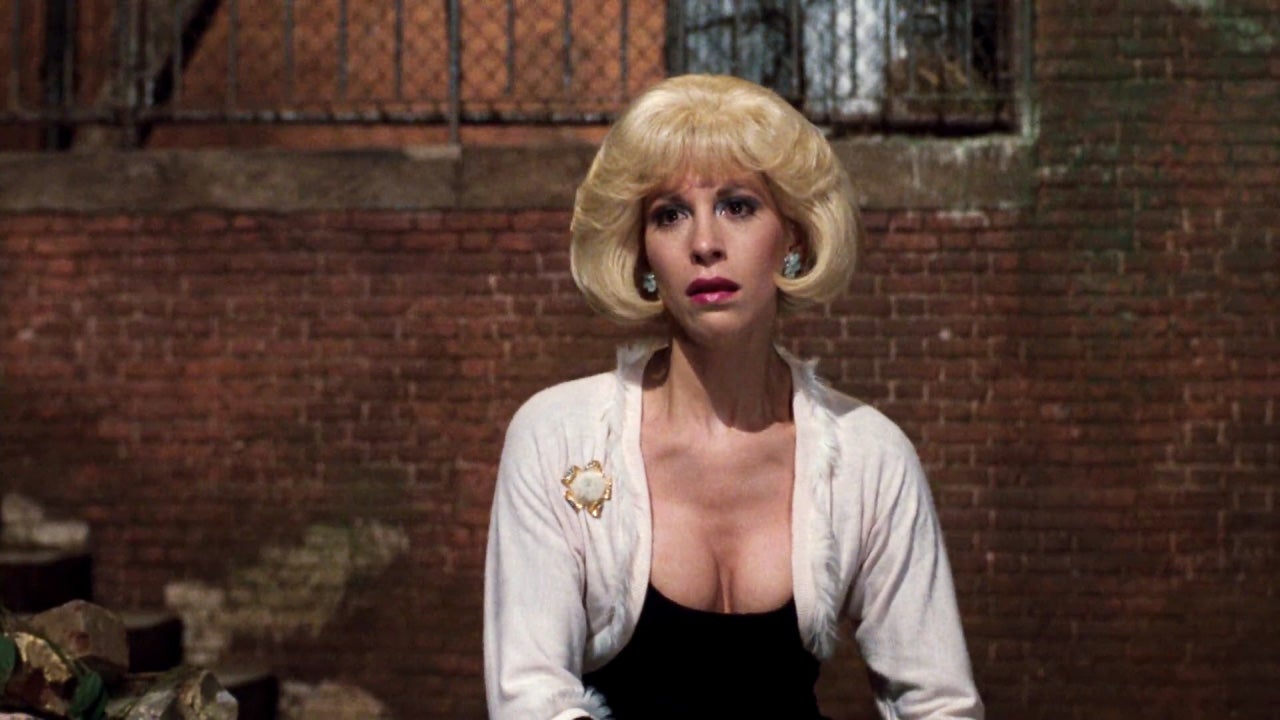
In honor of its 40th anniversary and timed to Halloween, Warner Bros. Home Entertainment has released a deluxe 4K UHD Blu-ray edition of the film, which looks and sounds better than ever. Based on the off-Broadway musical by Alan Menken and Howard Ashman, itself inspired by Roger Corman’s marginal 1960 black-and-white horror movie, “Little Shop of Horrors” remains one of the best movies of the 1980s and one of the best movie musicals, period. Snappily directed by Frank Oz, the film features a razor-sharp script by Ashman that is by turns hilarious, deeply moving and, yes, occasionally horrifying. Part of what makes the movie work so well is its cast, which includes Rick Moranis as a meek flower shop employee who gets seduced by an alien plant voiced by Four Tops member Levi Stubbs; Vincent Gardenia as the shop owner; and Steve Martin as a sadistic dentist. (Bill Murray, John Candy, Christopher Guest and James Belushi all pop up in brief supporting roles.) But the heart of “Little Shop of Horrors” belongs to Ellen Greene’s Audrey. She’s dating the sadistic dentist but longs for a sweet guy like Moranis’ Seymour. All Seymour wants is a happy life with Audrey. That longing is captured in “Somewhere That’s Green,” a sweet, hilarious song that serves as the movie’s emotional and thematic centerpiece. Greene had been living with the character long before she was cast in the movie. She has been with the musical since it was an off-off-Broadway oddball. Greene remembered that she was in line for unemployment in New York when she was listening to a tape of the demos (most likely sung by Ashman). She had been reluctant to even take the tape; as she put it, she had a strong stance that “I don’t want to be in a camp musical.” When she heard “Somewhere That’s Green,” any conception that the musical was somehow lesser melted away. “I started to cry, and I knew I had an Audrey deep inside of me waiting to be born. It just happened. It was automatic,” Greene said. At the audition, the distinctive Audrey voice just escaped out of Greene (“I had nothing to do with that”). By the time she finished her audition, “Howard and Alan and I were in tears at the end, and we were bonded for life.” The first theater they performed in was a tiny black box theater, with a massage parlor above it. The original version of the play had, as Greene called it, “an S&M number” that she encouraged Menken and Ashman to cut. “You’ve got a classic play here,” she told Ashman. He listened. “He immediately — he wasn’t precious with his material. He got it, got rid of it, and he also let me change lines,” Greene said. One song had a line about a “nightclub.” Greene didn’t think that was funny enough. She thought for a minute and changed it to “night spot,” which is indeed funnier. “I wanted her to be a peach ripe enough to fall off the tree,” Greene explained. She also helped design her character’s look. Greene was the one who put Audrey in a tight cocktail dress, figuring that the character would think it was classy. Greene did her own makeup. “I was brunette at the time. And I said, ‘This is too hard. I need a soft crown,’” Greene recalled. She found a blonde wig and had the stage manager help her cut it. She brought the look to Ashman. “I came out totally presentational. And he went, ‘I love her,’ and that was it,” Greene said. Audrey was born. Later, while they were negotiating her contract, she realized that Ashman had given half-a-point in profits for the musical. He had never told her about the back-end participation but she knew it was because she had helped make Audrey. As for the movie version of “Little Shop of Horrors,” the idea of Greene reprising her role on the big screen was first floated by John Landis, who was initially attached to direct. She had lunch at the Russian Tea Room with Landis and Marty Robinson, who operated the plant puppet in the off-Broadway production, which played in a venue slightly bigger than the massage parlor-adjacent theater. “I was just there as a girlfriend, and at the end of the lunch, he turns to me and says, ‘Oh, you’re Audrey,’ and I went, ‘What?’ And I literally got up from the table, went to the ladies’ room and totally lost my whole fabulous lunch,” Greene said. She said Landis ultimately didn’t direct the project because of “the horrible accident” on the set of “Twilight Zone: The Movie,” which led to a criminal trial in which Landis was charged with involuntary manslaughter. He was acquitted. Greene said it was actually her idea to have Frank Oz direct the movie. She knew Oz through her relationship with Robinson, who played Mr. Snuffleupagus on “Sesame Street” (Robinson still plays the character today!). At the time, Oz was directing “The Muppets Take Manhattan,” and he and Greene had lunch one day. “You should direct this film,” Greene told him. “He doesn’t remember this at all,” she added. Greene stayed connected to Audrey for years after the film, too. She performed in an Encores! Off-Center production in 2015 with Jake Gyllenhaal as Seymour and took part in a national anniversary tour this year, which included screenings and performances by Greene. “It’s been so many different things and times that Audrey has come up, and now again I’m on tour, and it’s very exciting because Warner Bros. for the first time is putting out this 4K new HD for the very first time,” Greene said. She pointed out that the actual anniversary is Dec. 19. Not that it matters.“It is very exciting because it’s like another rebirth, and every time it loved Howard Ashman lives, and I’m grateful and humbled by that and very excited,” she said. One of the best things about the excellent new 4K disc is that you can watch both the original theatrical cut and the director’s cut, which restores the ending in which Audrey and Seymour die and the plants take over the world, in stunning 4K. To recap briefly, the filmmakers had shot the original ending at a cost of more than $5 million. Oz has been quoted as saying it was the most expensive ending Warner Bros. had produced at the time. Producer David Geffen was opposed to the ending, but he let them shoot it. After a disastrous test screening of a nearly finished version of the film in San Jose, the filmmakers hastily reshot and re-edited the ending. The changes led to Christopher Guest being cast in a role originally played by Paul Dooley, who couldn’t return for the reshoots. For years, it was the stuff of legend: Did you hear about the version where the plants take over the world? In 1998, a DVD of the movie was released with unfinished footage of the original ending, much of it in black and white and without finished music, sound effects or visual effects. It offered a fascinating peek at a version of the movie few thought they would ever see. Sadly, the DVD was recalled after producer David Geffen was reportedly horrified by the inclusion of the ending and re-released without the footage. In 2012, the film was released on Blu-ray with the original ending, initially labeled “the intended cut” and later “the director’s cut.” This version was screened as part of the 50th New York Film Festival in the “Masterwork” category. But the question remains – which is the definitive version of “Little Shop of Horrors” – is it the theatrical or the director’s cut, as originally intended by Oz? “I love them both personally because I’m proud of Howard and Alan. In a short few weeks they wrote another ending. I do love them both, but of course,” Greene said. “I did more drama than comedy in my life and I’m a Frank Oz girl. So I’d say that. Frank is very proud of his cut.” She said she leans towards the director’s cut. “It’s a good death, don’t get me wrong,” Greene said. “Little Shop of Horrors” is on 4K UHD right now from Warner Bros. Home Entertainment. Add it to your Halloween watch list.
‘Little Shop of Horrors’ Star Ellen Greene Settles the Theatrical Cut vs. Director’s Cut Debate
Full Article
Original Source
Read the full article at Thewrap →KhanList aggregates and links to publicly available news content. We do not host full articles from third-party sources. Always verify important information with original sources.