
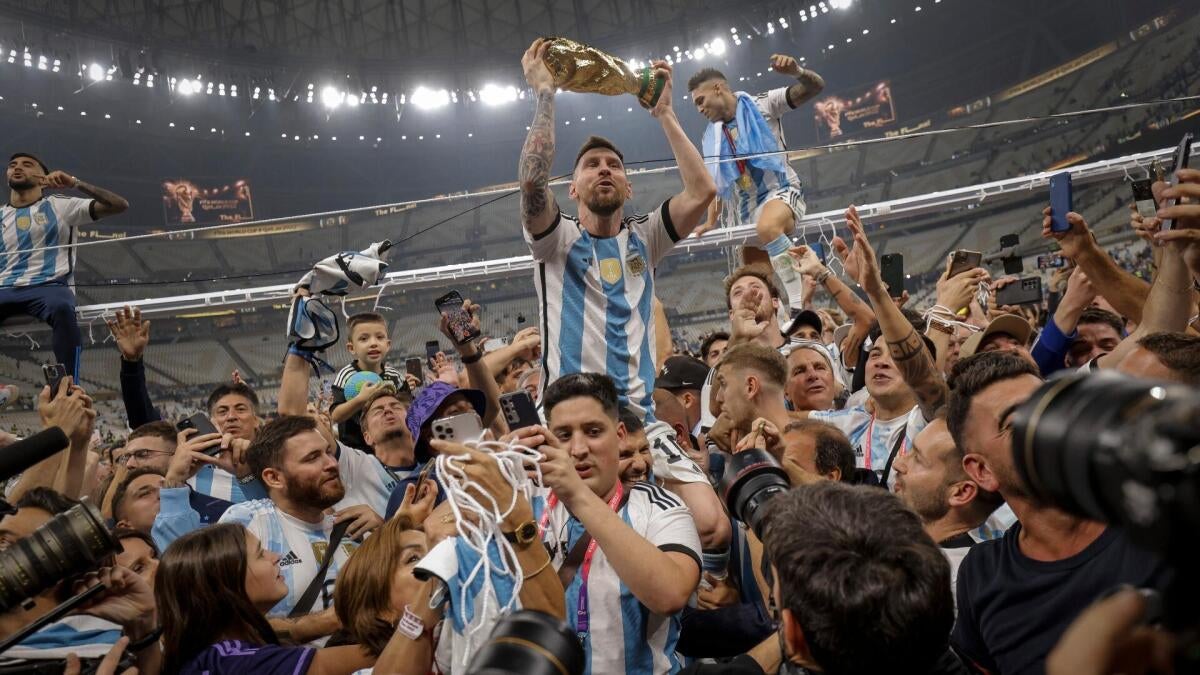
Lionel Messi, one of the best players in the history of the sport, has announced his retirement from the national team Aug 31, 2026 at 3:17 pm ET • 6 min read Lionel Messi and Argentina -- one of the greatest legacies in the history of sport comes to an end. The Inter Miami striker has announced his decision to leave the Albiceleste and retire from international football. The news, perhaps unexpected given the timing, shocked the world and the players who had shared the dressing room with Messi during his final years with the national team. In 2022, Argentina won the World Cup for the first time since 1986, but things weren't always great between Messi and the national team. In 2016, he announced his retirement from international football for the first time after a heartbreaking penalty shootout defeat vs. Chile in the Copa America final before changing his mind, a decision that would go on to define the most successful chapter of his career. Until the 2022 World Cup, the international career of Messi was deeply affected by the comparison with Diego Armando Maradona, who won the 1986 World Cup with Argentina in Mexico and also led Messi and his teammates as manager at the 2010 World Cup in South Africa. The parallels were obvious, but being compared to his childhood idol was a burden few could have carried. Messi struggled, suffered, failed but then bounced back and changed the whole story by winning one World Cup and two Copa America titles in the last five years. He leaves the national team as a hero, having earned the status of a national icon. Let's go back to 2006, his first World Cup with Argentina and take a glance at all the memories of his career with Argentina. 2005-06: Debut and first World CupMessi's story with Argentina starts one year before the 2006 World Cup when he's part of the roster that wins the 2005 Under-20 World Cup with Argentina, a tournament where he shines, scoring six goals in seven games, winning the Golden Ball of the tournament and the Golden Boot. The first team manager, Jose Pekerman, called him to make his debut but Messi was sent off just minutes after coming on following an altercation with Hungarian defender Vilmos Vanczak. The following summer, things were much different. The world was beginning to discover him as he made his first appearances for Barcelona's first team, and it was the 2006 World Cup that truly marked the moment when the world began to recognize that a world-class player was emerging. Despite an injury that affected his preparation for the World Cup, Messi made his debut in the second match of the group stage, officially becoming the youngest ever player to wear the Argentinian jersey at the World Cup. Coming on in the 74th minute against Serbia and Montenegro, he needed just a few moments to make his mark, providing the assist for Hernan Crespo's goal in Argentina's 6–0 victory. In the stands that day, Maradona could be seen smiling and applauding the player who was already being hailed as his successor. Little did either of them know that, just four years later, Maradona would be coaching Messi at the World Cup in South Africa. 2009-19: The years of struggleWhat seemed to be a promising career started off in a challenging way. Argentina lost the 2007 Copa America final to Brazil but in the summer of 2008 Messi won the gold medal at the 2008 Olympic games in Beijing, though it was with the U-23 team and not recognized as a senior national team title. At the 2010 World Cup, with Maradona as coach, Messi failed to score a single goal as Argentina were eliminated by Germany in the quarterfinals, suffering a heavy 4–0 defeat. The result also brought an end to Maradona's tenure as national team coach. A partnership that, sadly, didn't work out. At the 2011 Copa America tournament, Argentina, hosts, were eliminated in the quarterfinals by Uruguay with Messi failing again to score in the tournament. Things seemed better at the 2014 World Cup under manager Alejandro Sabella: Messi's Argentina made it to the final but it ended with Germany winning the World Cup. Another huge disappointment in his international career. The following year, at the 2015 Copa America, Argentina suffered another heartbreak, losing the final to Chile on penalties. Messi was named the tournament's MVP, but chose not to collect the award. However, the challenges were not over yet. 2016: The first retirementThings got even worse and in the summer of 2016 at the centenary edition of the Copa America played in the United States, where Messi also became the Argentinian player with most goals scored in the national team. In the final, Argentina once again lost to Chile on penalties, with Messi missing Argentina's first penalty. At the final whistle, he was left speechless, devastated and disappointed. Speaking to the media, Messi announced his retirement from international football, only to change his mind a few weeks later. Thankfully. However, once again, the struggles were not over yet. At the 2018 World Cup, Argentina were eliminated by France in the round of 16. After the World Cup played in Russia, the Argentinian federation hired Lionel Scaloni as caretaker manager but ended up confirming him as the first team manager until the Copa America of the following year. However, at the 2019 Copa America, they suffered another setback, finishing third after defeating Chile in the third-place play-off. Messi was sent off in that match following a confrontation with Chilean Gary Medel. However, after years of heartbreak, redemption was finally coming. Despite the disappointing end of the tournament, the Argentinian federation agreed on a new deal with Scaloni until the 2022 World Cup. A smart decision. 2021-2024: RedemptionFrom that moment on, everything changed for Messi and the national team. In 2021, Argentina won the Copa America in Brazil, beating the hosts in the final and ending years of heartbreak. It was Messi's first senior international trophy with Argentina and the beginning of a new era of glory. At the 2022 World Cup, Messi scored seven goals, won the World Cup and is named player of the tournament before also winning his last Ballon d'Or in 2023. In 2024, he wins another Copa America, beating Colombia in the final, marking one of the greatest cycles in the history of Argentinian soccer. 2026: The endThe 2026 World Cup was considered his last major tournament with Argentina, but nothing was official yet. Messi delivered some incredible performances, such as the one in the semifinal against England when, thanks to his two assists to Enzo Fernandez and Lautaro Martinez, Argentina made a late comeback and qualified for the final, only to lose to Spain. At the end of the match, he broke down in tears. We all thought it was for his last ever World Cup match. It wasn't the case. Messi knew his father was not doing well, and that this would be the last time he would ever watch his son play soccer. Jorge Messi passed away on Aug. 8, just weeks after the World Cup final. On August 31, Messi announced his retirement from international soccer, posting a picture of the letter he wrote himself two days after the final, on July 21. He wrote that the passing of his father had only strengthened such a difficult decision. He would never wear that jersey again, apart from the farewell game everyone expects now, without his father there to watch him. This is why Messi is one of the greatest of all time.
Lionel Messi's Argentina career timeline: Two retirements, years of struggle and redemption at 2022 World Cup
Full Article
Original Source
Read the full article at Cbssports →KhanList aggregates and links to publicly available news content. We do not host full articles from third-party sources. Always verify important information with original sources.