
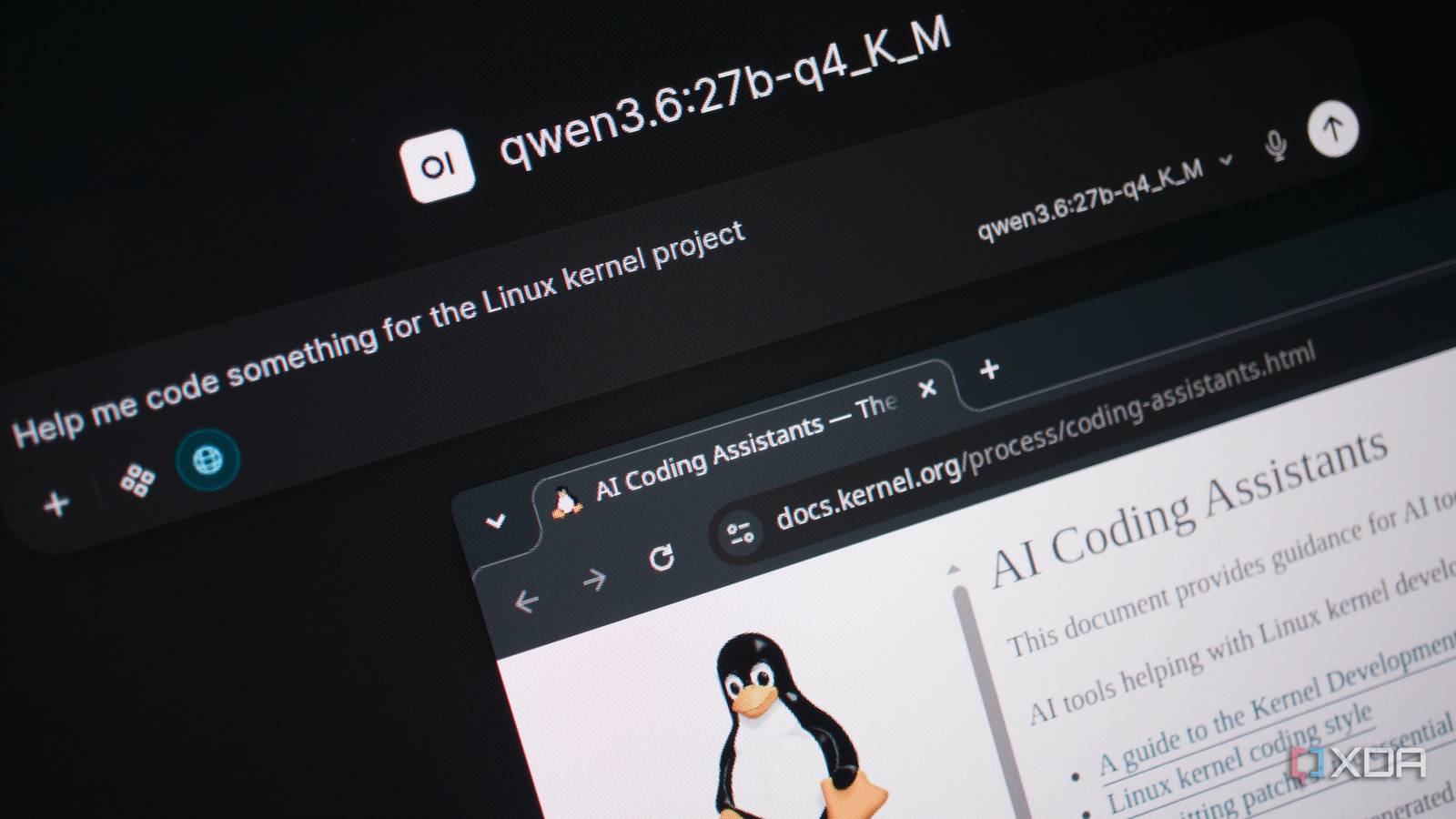
Published Sep 29, 2026, 2:01 PM EDT Richard is the PC Hardware Lead at XDA and has been covering the technology industry for almost two decades. He's been building PCs since young, and when not creating content, you can often find him inside a chassis somewhere. Artificial intelligence (AI) is all the rave these days. You can visit any website or use apps without coming across some mention of the term, which is why it's all the more frustrating for code reviewing. Chatbots like Claude, ChatGPT, and others are readily available to help humans out with just about anything. From creating a new app from scratch to aiding with home renovation, large language models (LLMs) are providing useful tools to countless applications, and coding is one of the highlights. But this leads to AI-generated "slop," requiring human code reviewers to check over submissions and work out what the LLM is attempting to achieve. This is why rules and guidelines are being hammered out for various projects and the Linux kernel is no exception. After reading through, it's one of the best guides to coding agents I've read to-date. It focuses on the process Making sure agent-assisted coding follows development guidelines Almost immediately, the kernel guide on AI coding focuses on the existing development process. It's simple for one to ask a chatbot to "Create an app for me," but it's an entirely different kettle of fish to produce an update or fix for an existing app or system. The agent may not have the full rundown of precisely what's expected of a submission, which turns it from simply giving an agent an issue and asking for it to solve it to allowing it to understand the system in which the changes need to be applied. The AI should read the entire process documentation, as well as other relevant documentation, rather than being tasked with searching keywords. This is helped through providing the materials from the start so it has everything available within the context window. The repository for a project isn't simply files full of code. It also contains the architecture, conventions, testing rules, release procedures, submission guidelines, ownership boundaries, and much more. If an AI doesn't have the full scope in mind, it may not fully understand the full context. Simply prompting an AI with the bug report is not enough. An LLM could produce a plausible explanation of something that doesn't exist. It could believe something is causing the bug that has no relation to what's present in the error logs. The kernel guide states that the agent should produce evidence and not simply report on what it believes to be causing the problem. Taking ownership of the AI work Handling bug finding, fixing, and testing before submission The same AI agent that handles the bug discovery should be the one to make the necessary edits or recommendations. It's then down to the one handling the prompting and eventual submission to actually check to make sure the bug is actually fixed. The same goes for making changes where they need to be confirmed working and not cause any issues elsewhere. Earlier agents would typically stop at generating code, but modern options can observe and even revise on request. Through testing and revising within the context window, an AI can refine and perfect the fix or change, even before a human takes a look at the underlying code. It's vital this is handled within a local loop before even considering a submission to the repository. This is to limit the impact of AI-backed coding on human resources. Because behind each submission is a reviewer to check each one. AI has made it possible for anyone to write code, but it hasn't helped increase container management bandwidth. It's what we covered with the Open Home Foundation struggling under the weight of submissions from people using AI. It's all well and good putting together code within an agent window, but someone eventually has to check it over, and if one considers just how many submissions are now possible thanks to coding agents, one can see how much of a strain this can put on volunteers who help to keep repositories like the Linux kernel free from slop or bad code that can cause serious problems for end users. Taking ownership of AI code That's also what makes the Linux kernel guidelines rather interesting to read and follow since it puts more on the provided evidence for each submission. Maintainers may request additional testing, scrutinize AI-assisted submissions more, or even ask submiters to explain changes in detail. It's a clear sign to the maintainers if someone who has submitted changes to the repository can't explain what the code does. The documentation goes as far as to cover provenance. This could aid the engineering effort through showing what files were inspected by the agent, what task was set upon it, what documentation was added to the context window, and what tests passed and failed. Most importantly, all sign-off certification must be from humans, which forces the submitter to take full ownership of the code, even if an agent created it. It provides a source of responsibility and puts ownership on submissions to be of higher quality to be approved and committed.
Linux kernel maintainers just wrote the playbook for shipping AI-generated code without drowning in slop
Full Article
Original Source
Read the full article at Xda-developers →KhanList aggregates and links to publicly available news content. We do not host full articles from third-party sources. Always verify important information with original sources.