
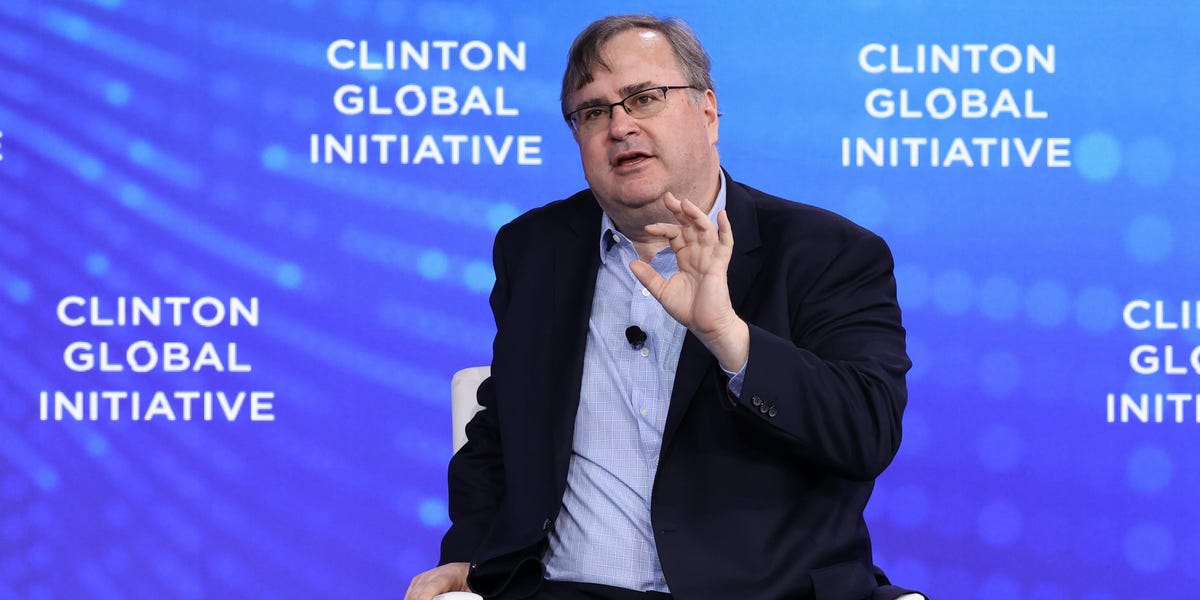
LinkedIn cofounder says AI infrastructure is the 'only reason we're not in a recession' Reid Hoffman says he's thankful for the data center buildout. JP Yim/Getty Images for Clinton Global Initiative Many Americans are bristling over the data center buildout. Reid Hoffman says he's thankful for it.The LinkedIn cofounder said so during an appearance on the "Newcomer" podcast that was released Friday. Hoffman credited the huge amount of capital behind the AI infrastructure buildout for being "the only reason we're not in a recession."He said "most of that capital" doesn't go to the areas where data centers are being built."Most of that's more distributed across the country," he said. "That's great."Hoffman said that in addition to powering the AI boom, data center construction also provides work for construction workers, electricians, carpenters, real estate agents, and lawyers."All of this capital infusion, people think, 'Oh, that's just going to the tech companies,'" he said, adding that a "massive percentage of it is going towards data center construction."Data centers have recently emerged as a source of bipartisan fury as midterm elections approach. Both Republican and Democratic governors have recently moved to curtail or restrict construction.In a poll released last week by the Pew Research Center, which surveyed people in August, half of rural Americans said data centers "are mostly bad for the environment" — a figure substantially higher than in January, when it sat at 32%.At the same time, US investors have mind-boggling amounts of money riding on the hope that AI will soon become profitable. Data centers will play a key role in that. And for AI companies like OpenAI, Anthropic, Meta, Google, and others, the issue is existential. Without AI data centers, they can't power the products they sell. OpenAI CEO Sam Altman has recently suggested that new data centers could be built far from where people live, such as in the desert.For Hoffman, the issue is simple: Data center builders need to work fairly with local communities to ensure that both sides get a good deal, he said.As for his recession statements, the US economy is still on solid ground, even outside the blistering pace of tech capital expenditures.Despite a disappointing September jobs report, unemployment remained low, suggesting a middling rather than a recessionary labor market. And, overall, economic growth is still strong. Real gross domestic product grew at a 2.2% annual rate in the second quarter; that measure typically declines during recessions. Real personal income minus transfers, another recession indicator, is also up from a year ago, and consumer spending is still growing. Read next Truman Dickerson is the Weekend News Fellow at Business Insider, based in New York City. He covers trending tech and business news. He previously reported for The Boston Globe's Express Desk. He graduated from Boston University, where he served as editor in chief of The Daily Free Press, BU's student-run newspaper.Contact him at Tdickerson@insider.com Madison Hoff is a reporter on Business Insider’s economy team. She covers the labor market, inflation, spending, and other data. In addition to covering new estimates and trends, her workforce reporting includes career pivots, job searching, and side hustles.She also covers downsizing, particularly people selling their houses to pursue RV living. She has also reported on how much teachers spend out of pocket and what it’s like being a caregiver.Her stories often cover the state of the economy, what experts are saying, and how people are navigating the workplace or their careers.Previously, she was a junior reporter and data editorial fellow on the Strategy team. LinkedIn Data Centers Anthropic More OpenAI
LinkedIn cofounder says AI infrastructure is the 'only reason we're not in a recession'
Full Article
Original Source
Read the full article at Businessinsider →KhanList aggregates and links to publicly available news content. We do not host full articles from third-party sources. Always verify important information with original sources.