
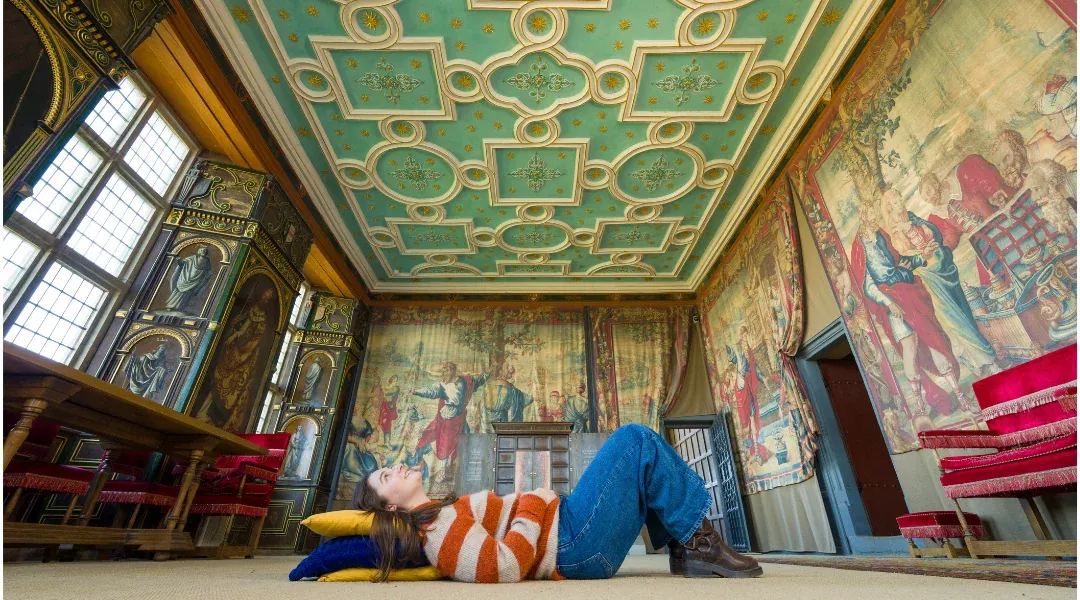
A new campaign encourages visitors to take in the lavish art above their heads at five historic sites across England. There are even cushions for maximum comfort while you gaze October 28, 2026 2:19 p.m. The Star Chamber inside Bolsover Castle English Heritage Historic buildings across England are encouraging visitors to spend some time considering what often goes over their heads: the oft-forgotten art of ceilings. The conservation charity English Heritage's “Lie Down and Look Up” campaign, which runs through November 1, highlights five distinctive ceilings across the country. In each room, space has been created and cushions provided to help visitors get as comfortable as possible while looking up—supine if they like—and experience details and craftsmanship they otherwise may have neglected. “Ceilings are often the crowning glory of a historic building. Designed to inspire awe, they can be wonderfully distinctive—with decoration that survives remarkably well,” Jeremy Ashbee, head curator of properties at English Heritage, says in a statement. “But when visiting a historic place, there’s not always the opportunity to enjoy a splendid ceiling to the fullest,” he adds. “We’re inviting visitors to put formality to one side, make themselves at home, linger, even lie down and enjoy the view up above.” One brilliant room, the Star Chamber inside Bolsover Castle in Derbyshire, may give visitors the feeling that they’re actually gazing up at the night sky. The room’s name derives from the 254 sparkling gold-leaf stars adoring its teal ceiling, which was originally painted dark blue. Painted wall panels and tapestries depict biblical stories playing out beneath the ceiling’s constellations. The castle’s creator, William Cavendish, clearly had an eye for decadent ceilings. Painted in 1619, the ceiling of a letter-writing room affectionately called the Heaven Closet shows a swirling scene of Christ’s ascension into heaven surrounded by dozens of cherubs. The star-gazing effect is also evident at Northumberland’s Belsay Hall, both a medieval castle and Greek Revival mansion, which was inspired by designer Sir Charles Monck’s time in Greece. A ceiling painting of Venus and Cupid in the Drawing Room of Wrest Park DeFacto via Wikimedia Commons under CC BY-SA-4.0 Built in the early 19th century, Belsay’s New Hall evokes Greek marble temples and offers a connection to the outdoors via a rectangular glass roof. “Obviously our weather isn’t as kind as that of the Mediterranean so [Monck] decided to build a covered courtyard,” Charlotte Woolley, Belsay Hall’s cluster manager, tells the BBC’s Dan Hall. Compared to the four other sites featured by English Heritage, which have “quite ornate ceilings,” Woolley says, Belsay is unique for its “stark” design. “Rather than looking at the plasterwork or the paintings, you’re really looking at the architecture,” she explains. How have visitors found lying down and looking up at Belsay? “It was a bit of a struggle for me,” David Turner, a 66-year-old visitor to Belsay, tells the BBC. “But once I got down it was just like stargazing.” Osborne's Durbar Room English Heritage Plasterwork is the central feature of the Durbar Room at Osborne, the luxurious seaside retreat of Queen Victoria and Prince Albert on the Isle of Wight. The room was originally designed by Rudyard Kipling’s father, Lockwood Kipling, as a banquet hall to honor Victoria’s status as Empress of India. The room’s walls and ceiling feature ornate plaster designs, overseen by Bhai Ram Singh, a master craftsman at India’s Mayo School of Art. The massive peacock mantlepiece alone took 26 craftsmen some 500 hours of labor to create. The bright white room is framed by dark teak wood accents and features ornate objects gifted to Victoria. Closer to London, ceiling gazers can view two other distinct artistic styles and epochs. Built in the 1830s, Bedfordshire’s Wrest Park is a French chateau-inspired mansion that was used to film scenes in the Netflix period drama “Bridgerton.” Its drawing room is home to an elaborate ceiling painting of Venus and Cupid flying through the sky. And in southeast London, there is Eltham Palace, a manor with medieval roots that was converted into an “art deco party palace” in the 1930s, according to English Heritage. Eltham was a residence of Edward IV, who oversaw the construction of the site’s Great Hall in the 1470s. There, visitors can lay back and take in its upward-channeling oak hammerbeam roof, which was restored in the early 20th century. During different stages of its history, the wooden space was an indoor tennis court, banquet room and music hall. Did you know? Haunted hall Eltham Palace’s Great Hall is supposedly haunted by a former staff member who died a week after retiring. As the Telegraph’s Nick Trend points out, there are far more than just five spectacular ceilings in Britain “in need of a few cushions or bean bags.” Until then, however, visitors will have to crane their necks to enjoy the nave ceiling of Peterborough Cathedral or the iron and glass roof that spans St. Pancras Station. “Ceilings in historic places are a vital part of the story of the people who lived there and of the buildings themselves,” per the statement. “They might demonstrate the architecture fashions of the period, the wealth and power of the owner or the finest craftsmanship. They are a crucial puzzle piece in the story of the past.” You Might Also Like Get the latest stories in your inbox every weekday. More about: Architects Architecture British History Cultural Travel Designers England History London Medieval Ages Royal Family Tourism Tudors
'Lie Down and Look Up' at England's Most Ornate Ceilings, From Sparkling Gold-Leaf Stars to Intricate Plaster Designs at Queen Victoria's Seaside Retreat
Full Article
Original Source
Read the full article at Smithsonianmag →KhanList aggregates and links to publicly available news content. We do not host full articles from third-party sources. Always verify important information with original sources.