
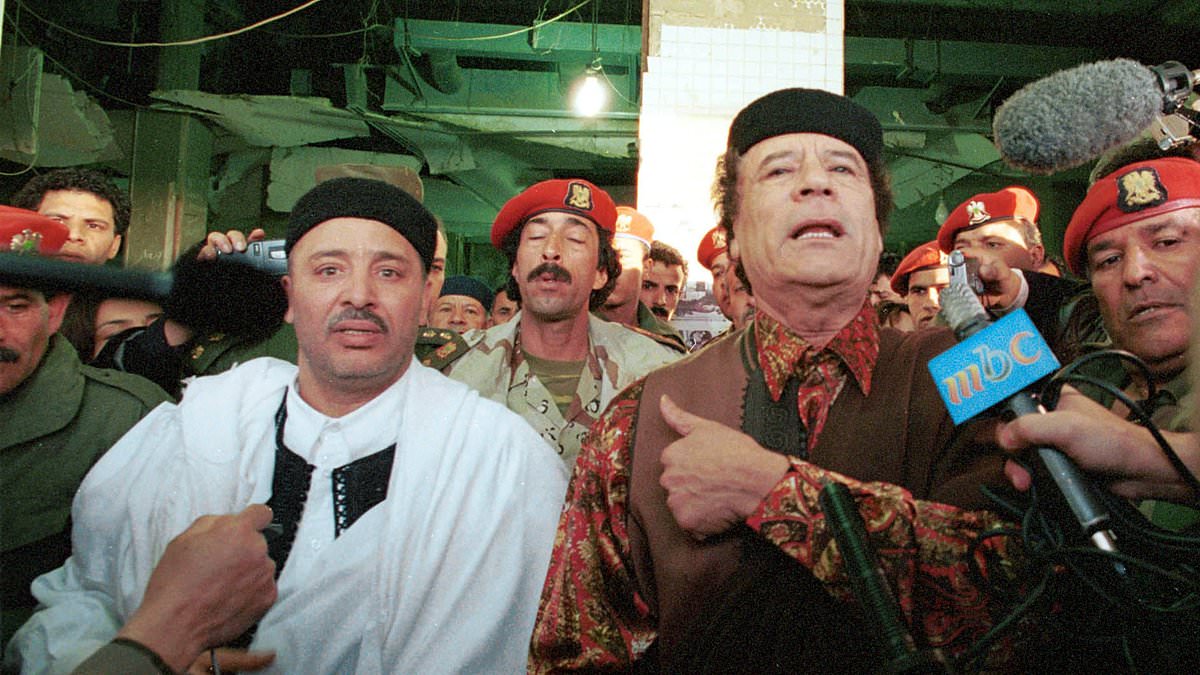
A Libyan man acquitted after standing trial over the Lockerbie bombing has died, according to his former employer.Al Amin Khalifa Fhimah, also known as Lamin, was cleared of involvement in the bombing which killed 270 people when Pan Am Flight 103 exploded above Lockerbie on December 21 1988.His co-accused, the late Abdelbaset al-Megrahi, is the only man convicted in relation to the bombing, after being found guilty of 270 counts of murder by a panel of three Scottish judges sitting at a special court in the Netherlands n 2001. His death was announced by Libyan Airlines, for whom he had worked as a station manager at Luqa Airport in Malta at the time of the bombing.'With deep sorrow and profound grief, and on behalf of the Board of Directors, the General Manager, and all employees of the Libyan Air Lines, we mourn the late, may Allah have mercy on him,' the airline said in a statement on social media.'We extend our heartfelt condolences and sincere sympathy to his noble family and all his colleagues and loved ones.'Funeral prayers were expected to be held today in the Libyan capital of Tripoli. Mr Fhimah worked in Malta for Libyan Airlines where he was station manager for several years, and left just before the bombing.He was indicted on charges of murder in 1991, but Libya refused to hand over either suspect for eight years, instead keeping them under arrest in Tripoli. But the country eventually acquiesced and handed Mr Fhimah and Megrahi to Scottish authorities in 1999 so they could stand trial at a specially convened court at a disused US Air Force base in the Netherlands. Al Amin Khalifa Fhimah (left) is pictured with Libyan leader Muammar al Gaddafi in Libya after he was cleared of any involvement in the Lockerbie bombing The Locierbie bombing remains the deadliest terror attack on British soil, having killed all 259 people on board the plane and 11 people on the groundProsecutors suspected him of being involved in the bombing while pursuing their theory, accepted by the courts, that a brown suitcase containing the bomb was loaded onto an Air Malta flight bound for Frankfurt before being transferred onto the Pan Am plane.They relied on Mr Fhimah's diary and the testimony of a double agent called Abdul Majid Giaka, who worked for Libya's intelligence outfit the JSO but ultimately answered to the CIA.But Mr Giaka's evidence undermined Mr Fhimah's alleged involvement. His claims that the airport worker had shown him orange-coloured TNT in the summer of 1986 did little to advance the prosecution case, as the Pan Am jet had been blown up using Semtex, a type of plastic explosive.And while Mr Fhimah's own diary featured an entry on getting Air Malta tags for Megrahi, prosecutors did not prove that this meant he helped the bomber to smuggle a suitcase on board, or that he knew of his eventual plan.Mr Fhimah did not give evidence, and was ultimately acquitted in light of evidence that he was in Sweden at the time of the bombing.In their 2001 judgment, a panel of Scottish judges sitting in the Netherlands ruled: 'There is insufficient other acceptable evidence to support or confirm... an inference that [Fhimah] was aware that any assistance he was giving to [Megrahi] was in connection with a plan to destroy an aircraft by the planting of an explosive device.'Maltese officials have consistently denied the claim that an explosive device could have been sent to Germany via Luqa Airport, and the Malta theory remains heavily contested by independent investigators.Some, including Lockerbie campaigner Jim Swire – whose daughter Flora died in the attack – believe the bomb was planted at Heathrow not by Libya, but by Palestinian extremists working for Iran.In 2002, Libya paid some $2.7billion in compensation to victims of the Lockerbie bombing in exchange for an easing of UN sanctions. It accepted responsibility for the actions of JSO officials connected to the attack and renounced terrorism. It did not, however, accept direct responsibility for the bombing itself.Megrahi was sent to prison in Scotland but was controversially granted compassionate release in 2009 after being diagnosed with terminal cancer, returning home to Libya where he died in 2012. He remains the only person convicted of any involvement in the bombing. However, another man charged over the explosion is due to stand trial in the US.Jury selection had been due to begin this week in the trial of Abu Agila Masud, who is charged with making the bomb that destroyed the plane. Masud is also alleged to have delivered it to Malta from Tripoli. He denies the charges.The trial has now been postponed, with a further hearing scheduled to take place in Washington next month to discuss the status of the case.
Libyan who was cleared over Lockerbie bombing dies aged 70
Full Article
Original Source
Read the full article at Dailymail →KhanList aggregates and links to publicly available news content. We do not host full articles from third-party sources. Always verify important information with original sources.