
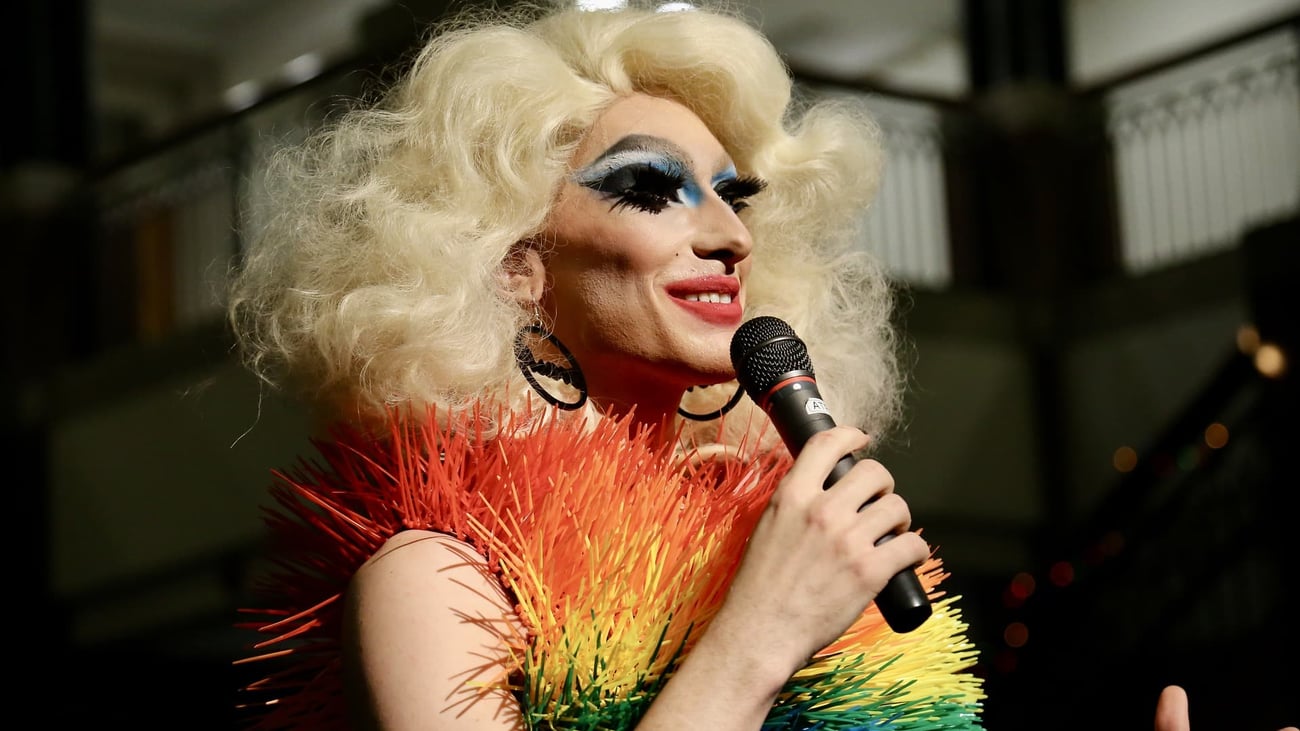
The groups are asking the Fifth Circuit to rule policies prohibiting drag shows at university venues violate the First Amendment.(CN) — A pair of LGBTQ student groups asked the full Fifth Circuit on Wednesday to block Texas A&M policies prohibiting them from holding drag shows at university venues.The appeals court heard arguments in a pair of cases challenging rulings by two Texas federal judges who each came to opposite conclusions on the constitutionality of drag show bans at public universities. Senior U.S. District Judge Lee Rosenthal, a George H.W. Bush appointee, ruled last year that the Texas A&M Queer Empowerment Council was likely to succeed on its claim that a policy enacted by the Texas A&M Board of Regents banning drag shows at on-campus venues in the Texas A&M system violates the First Amendment.Meanwhile, U.S. District Judge Matthew Kacsmaryk, a Donald Trump appointee, upheld a separate decision by the president of West Texas A&M University to block the LGBTQ student group Spectrum WT from hosting a drag show at a university venue known as Legacy Hall. Kacsmaryk found that drag shows are likely not expressive conduct protected by the First Amendment, as they do not communicate a clear message. And even if the First Amendment protected drag shows, Kacsmaryk ruled, Legacy Hall is a limited public forum, where university officials have broader authority to restrict the content of speech, as administrators screen and approve events held in Legacy Hall.But JT Morris, an attorney with the Foundation for Individual Rights and Expression, a free-speech advocacy group that represents the student groups in both cases, told the Fifth Circuit Wednesday that even if the venues at issue are limited public forums, which the plaintiffs dispute, the drag show bans would still be unconstitutional, as even in limited public forums the government cannot restrict speech based on viewpoint. He pointed to the university’s stated rationales for the bans — that drag shows demean women and could risk federal funding for the university system by potentially running afoul of an executive order by President Donald Trump prohibiting the use of federal funds for the promotion of “gender ideology.”Morris said these rationales show Texas A&M is targeting drag shows because of viewpoints it believes they convey.“If public university officials can ban drag performances because they disagree with the ideology or because they believe they send offensive messages, no viewpoint on campus is safe,” he said. “Administrators could just as easily, for example, ban a faith-based performance on flimsy concerns that it might offend others on campus, or a university president could disinvite a political speaker because the speaker’s ideology doesn’t match his preferred one.”But Texas Principal Deputy Solicitor General Billy Cole, representing Texas A&M in both cases, argued the drag show bans target discriminatory conduct, not viewpoint, comparing the policies to prohibiting employers from putting a “whites only” sign in their window. He said the cases should be decided based on the U.S. Supreme Court’s 2010 decision in Christian Legal Society v. Martinez, where the majority ruled a law school had not violated the First Amendment by denying a Christian student group official recognition due to the group’s failure to comply with a university policy requiring student groups to accept any student as a member regardless of status or beliefs.“The Supreme Court explained that university administrative decisions regarding access to a campus forum are deemed reasonable and due decent respect by federal courts to the extent that they represent efforts to enforce university non-discrimination policies and state law proscriptions on discrimination, at least when those access decisions are made within the context of a limited public forum and when they are viewpoint neutral,” Cole said. “That principle resolves both of these appeals and warrants affirmance of the university’s decisions in each.”U.S. Circuit Judge Dana Douglas, a Joe Biden appointee, asked Cole whether any women had actually complained they felt harassed by on-campus drag shows. While Cole acknowledged there hadn’t been any complaints, he said that doesn’t matter, as in CLS there weren’t any students complaining they’d been excluded from the Christian Legal Society, but the Supreme Court found the law school’s determination that discrimination was occurring was sufficient.U.S. Circuit Judge Kyle Duncan, a Donald Trump appointee, and Chief U.S. Circuit Judge Jennifer Walker Elrod, a George W. Bush appointee, asked Morris whether the First Amendment would require Texas A&M to allow other potentially offensive performances in its venues, such as a striptease, a political demonstration where ICE agents rape the Statue of Liberty or a blackface minstrel show.Morris responded that the First Amendment would indeed prevent university administrators from prohibiting a blackface performance.“I have no doubts that most, if not everyone, on a college campus, and probably all of us in this courtroom, find a blackface minstrel show highly offensive,” he said. “But the reason we’ve all come to that conclusion is because of the First Amendment, because of its mandate for viewpoint neutrality. It’s that same mandate for viewpoint neutrality that, yes, would prohibit a college, a public university, from banning a blackface performance because of its offensive message; that protects all of our abilities to stand up and say, ‘No, that’s wrong.’”Subscribe to our free newslettersOur weekly newsletter Closing Arguments offers the latest about ongoing trials, major litigation and rulings in courthouses around the U.S. and the world, while the monthly Under the Lights dishes the legal dirt from Hollywood, sports, Big Tech and the arts.Additional Reads
LGBTQ student groups challenge Texas A&M bans on campus drag shows
Full Article
Original Source
Read the full article at Courthousenews →KhanList aggregates and links to publicly available news content. We do not host full articles from third-party sources. Always verify important information with original sources.