
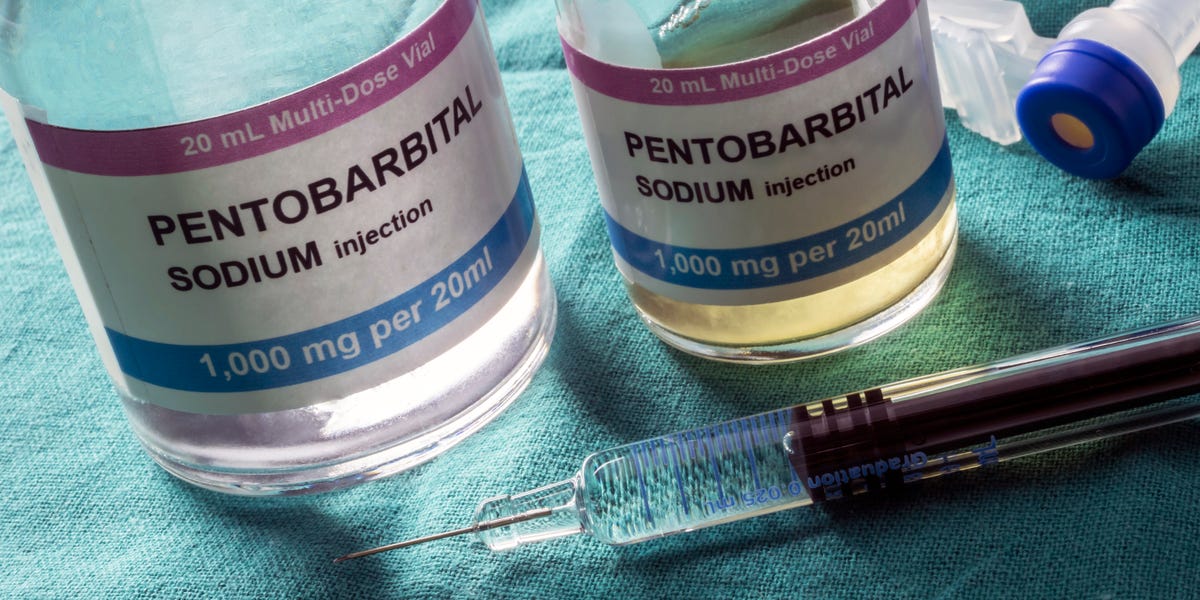
4 min readHere’s what you’ll learn when you read this story:Although lethal injection is considered the most humane form of capital punishment, it’s also the method most prone to failure. On September 30, the state of Tennessee failed to execute prisoner Christa Pike after two botched attempts to administer pentobarbital, a drug often used for euthanizing animals. Experts question whether the drug was improperly prepared, or whether it seeped into tissue near the injection point instead of entering the bloodstream.On December 7, 1982, Texas executed Charles Brooks Jr., a man convicted of murdering an auto mechanic. Neither the U.S. nor Texas, which would go on to execute more people than any other state, was new to killing prisoners. But this method was new. The three-drug protocol—the first of which was sodium thiopental in Brooks’ case—rendered the condemned unconscious, relaxed the muscles, and then stopped the heart. Compared with hanging or electrocution, experts considered it the most humane way for the state to take a life.But in the decades following Texas’ entry into this new era of executions, one trend became disturbingly clear: The percentage of botched executions was relatively high. Austin Sarat, a political scientist at Amherst College who’s cataloged more than a century of American executions, found that lethal injection fails more often than any other method—roughly 7 percent of attempts.The latest addition to that statistic came on September 30, 2026, when Christa Pike survived two separate lethal injection attempts in Nashville, Tennessee. Pike was convicted of the 1995 torture-murder of 19-year-old Colleen Slemmer and was the youngest woman sentenced to death in the modern era. In the days after the attempted execution, Pike regained consciousness and developed pneumonia; she is now able to walk, her attorneys say.Although botched lethal injections have occurred before, Pike’s case is arguably the worst because the drug was actually administered twice and she survived with injuries. Speaking with the BBC, retired Associated Press reporter Michael Graczyk, who’s written about nearly 500 executions in his career, said he’d never seen anything quite like what occurred in Tennessee. But he acknowledged that such an event seemed likely to happen eventually. “It was just a matter of time,” he said.Lethal injection may be regarded as the most humane way to end a life, but the legal and ethical fights surrounding it have made the procedure remarkably hard to carry out correctly. The issues begin long before someone is tried, convicted, and sentenced to death, because the very manufacture of the drugs can itself be a fraught process prone to error and miscalculation. In Pike’s case, the state of Tennessee administered pentobarbital, a drug commonly used to treat seizures (in significantly smaller doses) and to euthanize animals. In 2011, the lone U.S. manufacturer of sodium thiopental stopped making it, and months later Danish drugmaker Lundbeck barred sales of its pentobarbital for executions.Those withdrawals left states dependent on chemical companies and compounding pharmacies, which operate under looser federal rules. That gap in oversight, one expert told The New York Times, raises the possibility that the pentobarbital used on Pike was improperly “constituted.”Participating in an execution also violates a physician’s ethical obligation not to use medical expertise to cause harm, so states typically assign the task to prison staff instead. That lack of training may explain the “IV infiltration” in Pike’s case, in which the drug spilled into surrounding tissue rather than entering her bloodstream, leaving the dose below lethal levels. A clinician would likely have recognized the telltale signs, but no clinician was in the room. A sublethal dose can cause permanent brain damage. And because Pike survived, the attempt itself may qualify as the “cruel and unusual punishment” barred by the Eighth Amendment.The difficulties with lethal injection have revived interest in an older method: the firing squad. Five states now authorize it, and South Carolina used it twice in 2025. The second of those executions, of Mikal Mahdi in April, drew scrutiny after a pathologist hired by his attorneys concluded that the shots had struck low, missing most of his heart and leaving him conscious longer than intended (the state disputed the finding). The method is also unavoidably bloody, which is part of why it fell out of favor in the first place.Federal policy is shifting as well. The Trump administration has cleared the way for the firing-squad execution of Nidal Hasan, the Army psychiatrist convicted of killing 13 people in the 2009 Fort Hood shooting. It would be the first military execution by firing squad since 1945, and the first military execution of any kind since 1961. The Pentagon has said the execution will be livestreamed, and it’s scheduled for December 3 at Fort Hood. The U.N. human rights office has called livestreaming the event a form of torture.Watch Our Science VideosDarren lives in Portland, has a cat, and writes/edits about sci-fi and how our world works. You can find his previous stuff at Gizmodo and Paste if you look hard enough.
Lethal Injection Was Sold as Painless. Tennessee’s Failed Execution Just Shattered That Claim.
Full Article
Original Source
Read the full article at Popularmechanics →KhanList aggregates and links to publicly available news content. We do not host full articles from third-party sources. Always verify important information with original sources.