
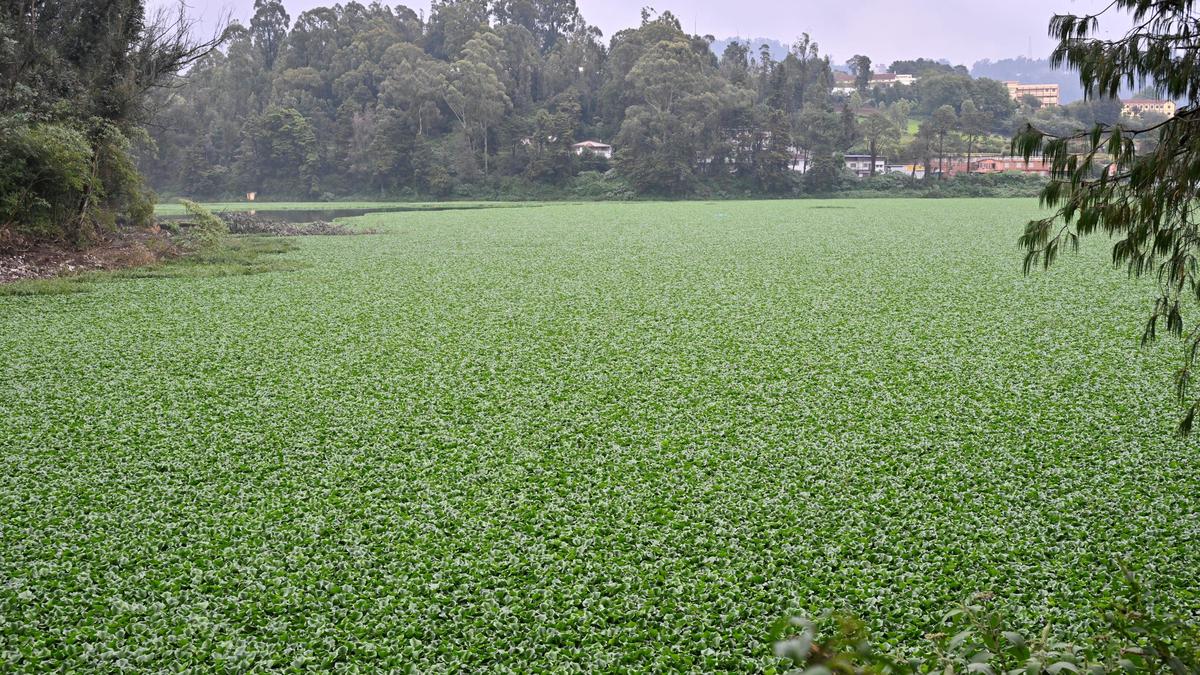
Water hyacinth covers the Ooty lake | Photo Credit: M. Sathyamoorthy Less than two years after ₹7.51 crore was spent on desilting and “cleaning” the Ooty lake in the Nilgiris, pollution in the waterbody remains rampant, leading to a vast tract of the lake being taken over by water hyacinth – a telltale sign of eutrophication.In addition to the ineffectual exercise, local bird watchers have noted a drastic reduction in the bird population in the lake due to the unscientific clean-up that led to the destruction of sand banks and reed beds on which the birds had become dependent.Clean-up of lakeThe project to clean the lake was inaugurated in October 2024, with ₹7.51 crore being sanctioned for the exercise across 24 hectares, as well as to modernise the sewage treatment plant with additions to keep debris, including solid waste, from entering the waterbody. However, less than two years after the work began and less than a year after it was completed, pollution in the lake remains comparable to previous levels, leading to the proliferation of water hyacinth across a substantial portion of the waterbody. Conservationists said that the presence of water hyacinth is a telltale sign of eutrophication or ‘nutrient-pollution’ caused by the uncontrolled runoff of pollutants, including fertilisers, manure, and untreated sewage that leads to the rapid growth of plant life, choking whatever little aquatic life that remains.N. Mohanraj, a Nilgiris-based conservationist, said that until the 1980s, the Ooty lake hosted a rich array of biodiversity due to its high water quality, but the continued discharge of untreated waste has severely polluted it. He said that the proliferation of water hyacinth soon after the desilting of the lake has showcased a lack of understanding of the lake ecosystem, with the clean-up also completely ridding the lake of its reed beds and sand banks that helped filter out a portion of the toxins entering the waterbody.Mr. Mohanraj said that the problem is most visible in the Ooty lake and Thalakundha, while the Sandynallah Reservoir, which lies between the two, is relatively clear of water hyacinth due to reed beds that still exist in some form, though highly degraded, in Khandal. Decline in bird populationThe “cleaning” of the lake has also led to a drastic reduction in the lake’s bird population, especially among wetland species, said bird watchers. In 2023, prior to the desilting work, more than 600 birds across 25 different wetland species were recorded, the highest in the Nilgiris, while the numbers fell drastically in 2025, with only 13 species and 270 birds being recorded. Local birdwatchers said that the numbers have remained the same in 2026.“The birds had been dependent on sand banks around the lake for food and for the surrounding foliage to nest. However, due to the unscientific and destructive clean-up operation across the lake, much of these areas were destroyed,” said a wildlife researcher who spoke to The Hindu. He said that the government had wasted money trying to clean up the lake when the causes of the pollution remained unaddressed. “The main cause of pollution of the lake is the illegal dumping of sewage and agricultural runoff into the Kodappamund channel. Any clean-up plan that failed to address the underlying, fundamental cause of pollution of the channel is doomed to fail,” he said.“We have also been calling for the setting up of a lake protection committee that can work with the district administration and the myriad agencies that have some jurisdiction over the lake, so that we can educate them about wildlife and biodiversity and projects such as the lake’s cleanup can be conducted without affecting the local wildlife. However, our repeated pleas have consistently been ignored,” he said.Mr. Mohanraj also said that the district administration or local NGOs must conduct regular, yearly tests of the water quality in the lake to scan for heavy metals and toxins, as water from the lake flows downstream into the ecologically-sensitive Mudumalai Tiger Reserve (MTR). Published - October 05, 2026 05:37 pm IST
Less than two years after massive clean-up, water hyacinth takes over large swathes of Ooty lake
Full Article
Original Source
Read the full article at Thehindu →KhanList aggregates and links to publicly available news content. We do not host full articles from third-party sources. Always verify important information with original sources.