
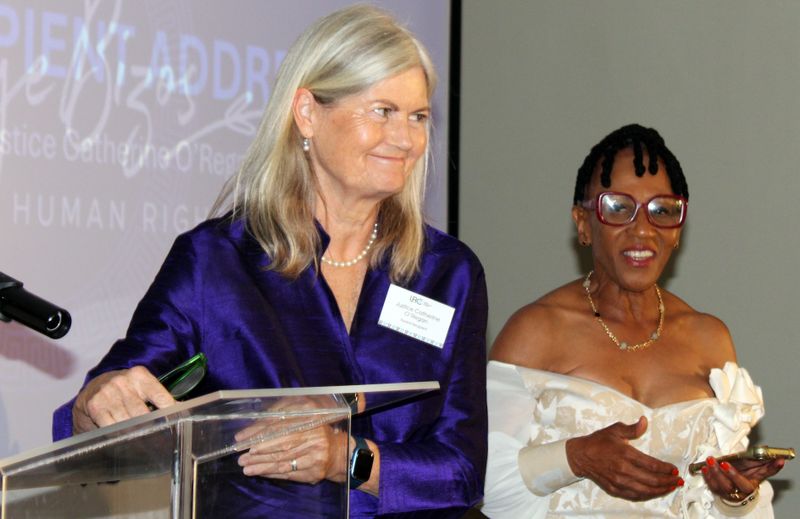
Former Constitutional Court Justice Katherine O’Regan received the fifth George Bizos Human Rights Award from the Legal Resources Centre on Thursday, 15 October. “The George Bizos award was established to recognise individuals whose life’s work reflects the courageous spirit, relentless integrity, and constitutional devotion of George,” said Nersan Govender, the national director of the Legal Resources Centre (LRC), in the opening address. George Bizos fled Nazi-occupied Greece as a 13-year-old, with his father, and arrived in South Africa as a refugee. Bizos served on the defence team during the Rivonia Trial for Nelson Mandela, Walter Sisulu and Govan Mbeki. He represented the families of political activists killed in detention, such as Steve Biko, Ahmed Timol, Neil Aggett and the Cradock Four (Matthew Goniwe, Fort Calata, Sparrow Mkhonto, and Sicelo Mhlauli). He also helped draft South Africa’s interim constitution and the Bill of Rights in the early 1990s. Bizos joined the Legal Resources Centre in 1991. By 1995, he had led the argument that successfully declared the death penalty unconstitutional. He represented families seeking accountability in the Truth and Reconciliation Commission hearings, and during the Marikana Commission of Inquiry. George Bizos at a handover of state records of the Rivonia Trial. (Photo: Felix Dlangamandla / Beeld/ Media 24) O’Regan was a cub reporter at the Cape Argus in the summer of 1976, a turbulent time in apartheid, when other journalists – including her editor – suggested a law degree would aid her work. She left to go study further, and just kept going, she told Daily Maverick. She received a PhD from the London School of Economics, and thereafter practised as an attorney in Johannesburg in labour law and land rights law, representing trade unions and communities facing evictions. In the early 1990s, she was a founding member of the University of Cape Town’s Law, Race and Gender Research Unit and moved from being a senior lecturer at UCT’s Faculty of Law to an associate professor. In 1994, at age 37, she was appointed by Nelson Mandela to the newly formed Constitutional Court, and served there for 15 years. From 2010 to 2016, she served as an ad hoc judge of the Supreme Court of Namibia. Since 2016, she has been a director of the Bonavero Institute of Human Rights at Oxford University. “I do feel very privileged to have been able to see different aspects of working as a lawyer, so both as a practitioner, as an academic, on the Bench, and then [the] range of advisory, board work, mediation and arbitration. It has given me a perspective of a legal career which not every lawyer gets.” Reflecting back on her career, she told Daily Maverick that working with extraordinary senior lawyers as a junior lawyer, and then a young judge, and now working with much younger lawyers had been wonderful. “This intergenerational exchange, which I think is characteristic of the legal profession, is one of its enormously rewarding aspects. I think you continue learning as you get older, and you continue building strong, mutually valuable relationships across generations.” Advocate Thandi Orleyn (left), former Justice Katherine O’Regan, South African judge and former Deputy Chief Justice of South Africa Dikgang Moseneke, and Nersan Govender (right), National Director of the Legal Resources Centre in Johannesburg. (Photo: Lillian Roberts) “We’ve come an enormously long way,” she said to Daily Maverick, about transformation within the judiciary. “When South Africa transitioned to democracy in 1994, we had about 150 senior court judges, of whom one was a woman, and three were people of colour. Today we probably have closer to 300 senior court judges, and we have more than 30% of those women, and 75% or more are people of colour.”South Africa’s first female Chief Justice, Mandisa Maya, appointed in 2024, was an important milestone for the country, O’Regan told Daily Maverick. “It is important to remember that in a sense, the Constitution seeks to ensure that there’s diversity on the Bench, not simply because identity itself matters, but because diversity helps in the project of impartiality. People come from different walks of life, have had different experiences, then we’re more likely to notice our biases and prejudices.”Alarming shiftDuring her speech, O’Regan said that globally there was an alarming shift away from democracy towards forms of authoritarian populism on every continent, where “74% of the world (that is 6 billion people) now live in autocracies, and only 7% (that is 0.6 billion) in liberal democracies”.If the tools in the authoritarian playbook were well known, the tools of resistance were less clear, she said, and depended on political and civic organisation, constitutional and legal frameworks, and the level of authoritarian rule established. “There is no off-the-shelf, one-size-fits-all democratic defenders’ playbook. How to resist authoritarianism thus remains by and large a local project,” O’Regan said. Organisations like the Legal Resources Centre had helped democracy withstand some of the buffeting of recent years, she said, using the tools available to render democracy resilient – independent courts, a strong constitutional framework and a vigorous civil society. “The original words coined by the leader of Frelimo [Mozambique Liberation Front/Frente de Libertação de Moçambique], Eduardo Mondlane are, of course, ‘A Luta Continua, vitoria e certo,’ the struggle continues, victory is certain. Perhaps we need to amend it slightly: ‘A Luta Continua, vitoria nunca e permanente.’ The struggle continues, victory is never permanent!” DM
LEGAL EXCELLENCE: Katherine O’Regan receives George Bizos Human Rights Award, warns of shift to authoritarianism
Full Article
Original Source
Read the full article at Dailymaverick →KhanList aggregates and links to publicly available news content. We do not host full articles from third-party sources. Always verify important information with original sources.