
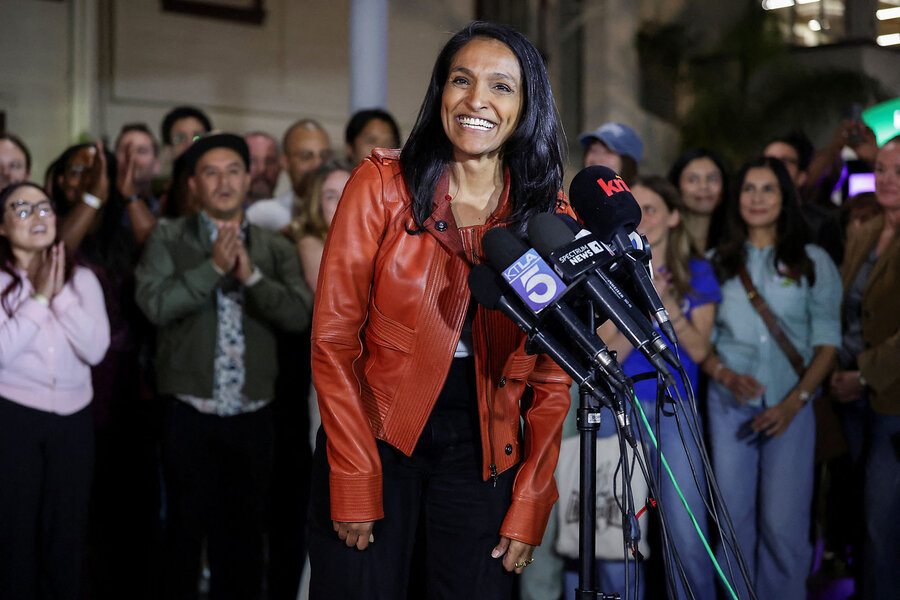
Los Angeles | Nov. 18, 2026, 5:00 a.m. ET | 6 min read On a recent weekday, a handful of families strolled along red-brick Olvera Street within El Pueblo de Los Ángeles Historical Monument, which marks the city’s original 1781 settlement. Most of the stalls and businesses that line the narrow pedestrian-only street were closed because business has been too slow, vendors say.Some diners tucked into beef taquitos brimming with avocado sauce, but the tree-canopied street was nearly empty – a departure from years past when the plaza bustled with life.Olvera Street is emblematic of the broader challenges facing the city that Mayor-elect Nithya Raman will take charge of in December. The historic street’s struggles mirror the economic and social pressures – from sluggish foot traffic to homeless encampments and rising rents – affecting downtown Los Angeles and the city at large. Los Angeles joins New York, Seattle, and Washington in electing a democratic socialist mayor. The LA City Council member’s agenda is progressive, but cities’ demands tend to be more practical than ideological, exerting a moderating pressure on their leaders. Her campaign slogan was “A city that works.” She wants to protect renters, expand housing, and better manage LA’s homeless population. The 2028 Summer Olympics – and their financial demands – are on the horizon.A must campaign stopJust like downtown, Olvera Street has struggled in the wake of the COVID-19 pandemic. Vendors have seen their sales drop by more than half. Several business owners on the street say they are in arrears.Debbie Briano’s family has operated El Rancho Grande restaurant for five generations on Olvera Street – the birthplace of Los Angeles and a beacon of Mexican American heritage in the city. Ever since she can remember, she knew of Olvera Street’s importance – not just to everyday Angelenos, but to the city’s leaders and local politicians.“They all come down here when they’re running for mayor,” she says. “It’s a photo opportunity.” Ms. Briano and her nephew Jesse Salcedo, who helps her run the restaurant, say it was the same for outgoing Los Angeles Mayor Karen Bass. At one point, Ms. Briano hoped that the mayor would turn around the street.“We were thinking she would help us,” she says. “But it never improved. It was very disappointing.”Mr. Salcedo, who lives nearby, says, “We needed something fresh.”He voted for Ms. Raman. Cindy Carcamo/The Christian Science MonitorEdward Flores owns and operates Juanita’s Cafe, which has been open since 1944 on historic Olvera Street in Los Angeles. Edward Flores, the third-generation owner of Juanita’s Cafe, is thankful for the diners he still has. But, he says, business is only half of what it was four years ago. His grandmother Juana Guerrero first opened the food stall in 1944.Mr. Flores says he voted, too, for Ms. Raman, who visited Olvera Street and met with merchants during the campaign. “I’m hopeful the change will be for the better,” Mr. Flores says.A vote against the incumbentMs. Raman becomes the city’s first Asian American mayor. She was one of a number of democratic socialists who won in the 2026 midterm elections. In addition to Ms. Raman’s victory, voters in Washington elected Janeese Lewis George to the mayor’s office, joining New York Mayor Zohran Mamdani, who was elected last year. Democratic Socialists of America also made gains in congressional elections, securing six new seats. California’s 34th District, in Los Angeles County, elected Angela Gonzales-Torres to the U.S. House of Representatives. Cindy Carcamo/The Christian Science MonitorDebbie Briano and her nephew Jesse Salcedo operate El Rancho Grande on Olvera Street, which opened in 1930. Both said they wanted a change. Mr. Salcedo voted for Los Angeles Mayor-elect Nithya Raman. While Ms. Raman and Mr. Mamdani both belong to the Democratic Socialists of America there are differences in their priorities that reflect the cities they serve, Sara Sadhwani, an associate professor of politics at Pomona College, writes in a message.“The differences between Raman and Mamdani are many, but at its heart it may actually be how DSA is operating in these two unique cities,” she says. “The DSA conversation here in Los Angeles continues to predominantly focus on how to approach the homelessness crisis and a desire to defund the police.“Mamdani’s campaign in New York City focused on affordability, and public policy on groceries, childcare, potholes, and other everyday quality of life issues,” Dr. Sadhwani says.Ms. Raman said during her mayoral campaign that she does not want to defund the police. It was a position she supported when she ran for city council six years earlier.Mr. Salcedo and some other merchants on Olvera Street say they were driven toward Ms. Raman mostly by their dislike for Mayor Bass and the status quo she represented. Ms. Bass had a 63% unfavorable rating heading into the election, according to a September poll conducted by the Institute of Governmental Studies at the University of California, Berkeley and co-sponsored by the Los Angeles Times.Ms. Raman’s greatest appeal was that she is the “antithesis” of Mayor Bass, says Matt Lesenyie, an associate professor of political science at California State University, Long Beach who has expertise in California politics.“I think a lot of candidates would have performed well in a head-to-head matchup,” Dr. Lesenyie says.Katherine Lynn, owner of Kitty’s Sno-Cones, where she sells snow cones, popcorn, and other snacks on Olvera Street, says she was aghast at how Mayor Bass avoided questions from members of the press soon after the January 2025 Palisades and Eaton wildfires that destroyed thousands of homes, businesses, and other buildings.“Come on, you’re our leader. Stand up and say something,” Ms. Lynn says.Early optimismMs. Raman’s core platform includes goals for ending homelessness, expanding public transportation, and improving street safety.During her campaign, she said she would reduce the number of people sleeping in tents and encampments by at least half by the Olympics. She would do so through expanded rental subsidies for homeless people and closer case management. Ms. Raman did not respond to an interview request. Dr. Lesenyie says Ms. Raman will have significant challenges to accomplish her campaign promises, mostly because Los Angeles is not a strong mayor city.“Most of the mayor’s limitations come from the City Council,” he says. “They need cooperation and buy-in from the City Council to pass policies that the mayor can enact.”In some ways, Ms. Raman will be more constrained than mayors in other big cities because she needs approval from the City Council to hire or fire department heads. Also, the City Council holds substantial control over the city budget.“She inherited a lot of problems,” Dr. Lesenyie says.Several business owners along Olvera Street told a Monitor reporter that homelessness and crime keep customers away.Ms. Lynn, who has operated her food stand for more than 30 years, says she’s behind on rent and will likely file for bankruptcy soon. “A couple of days last week, I took in just $35,” she says. “What am I going to do with that?”The issue of the homeless population is complicated and reaches beyond Olvera Street and even the city limits, into LA County. Ms. Raman will need support from and coordination with county officials and leaders to even begin to tackle the homelessness issue.“The scale of the problems are gigantic. The time is short,” Dr. Lesenyie says. “The mayor needs power and time to enact something to see the results.”Maria Gribell, a fourth-generation merchant who started working on Olvera Street in 1960, operates a wooden stall selling painted pottery and Mexican and Peruvian folk art.Ms. Gribell says Ms. Raman’s homelessness and crime plans resonated with her, and she appreciated the candidate saying during a campaign stop that she’d help the area even if she lost the race. Deepen your worldviewwith Monitor Highlights.Politics with respectGet political stories with respectful analysis.There‘s a world of new ideas in everyBooks newsletter.There‘s more to life, enrich yours withCulture & Learning weekly.Follow humanity‘s discoveries withScience & Nature stories in your inbox.Gain a spiritual perspectivefrom the stories in your inbox.Want to understand the deeper impact of critical events? Learn the Monitor‘s insight.Already a subscriber? Log in to hide ads. Mr. Salcedo, from El Rancho Grande, visited with Ms. Gribell, who was tending to her shop on a recent sunny morning. They spoke of their hope for Olvera Street.“We have to stay optimistic,” he tells Ms. Gribell. ALREADY A SUBSCRIBER? LoginReal news can be honest, hopeful, credible, constructive.The Christian Science Monitor was founded in 1908 to lift the standard of journalism and uplift humanity. We aim to “speak the truth in love.” Our goal is not to tell you what to think, but to give you the essential knowledge and understanding to come to your own intelligent conclusions. Join us in this mission by subscribing.
LA’s complex demands await democratic socialist Mayor-elect Nithya Raman
Full Article
Original Source
Read the full article at Csmonitor →KhanList aggregates and links to publicly available news content. We do not host full articles from third-party sources. Always verify important information with original sources.