
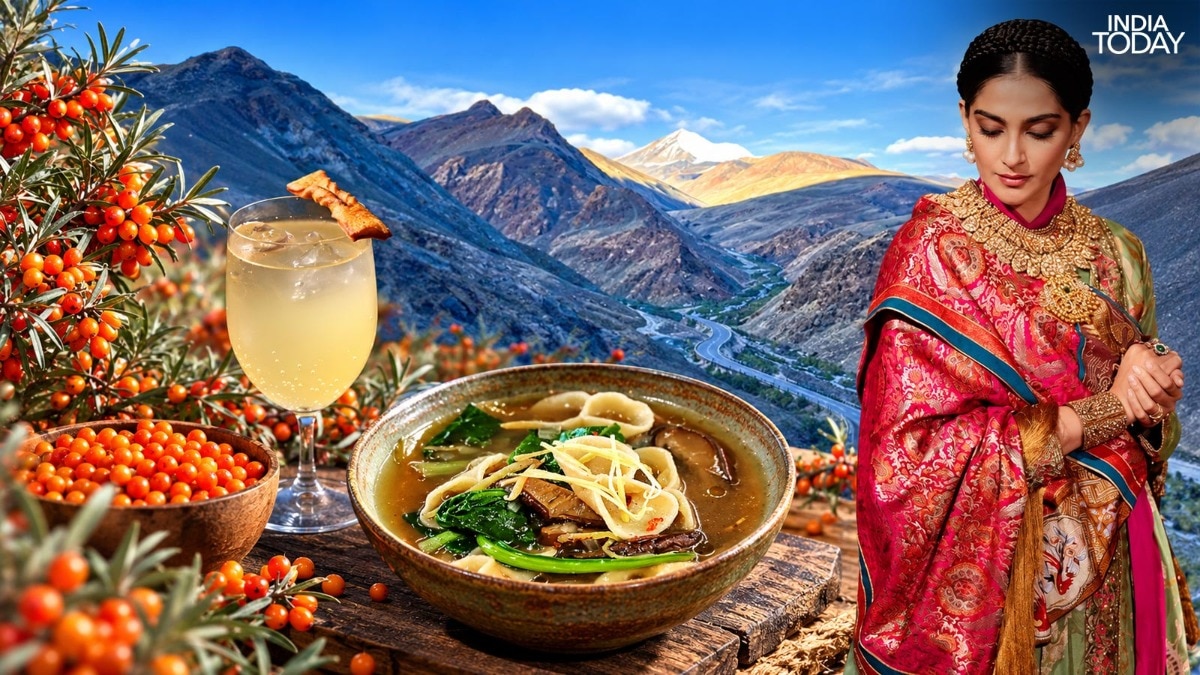
Ladakh. The word instantly brings to mind dramatic mountain landscapes, winding roads cutting through rugged terrain, crystal-clear lakes, a sky heavily embellished with sparkling stars, and, for some, the not-so-pleasant tales of acclimatisation struggles.Lately, Ladakh has been making a lot of headlines too. Tourist arrivals have surged by 60 per cent compared to the same period last year (January to September). India’s first high-altitude snow leopard safari has recently been launched. Prime Minister Narendra Modi has inaugurated Rs 3,350-crore Ladakh projects to boost infrastructure and connectivity.But some headlines also go beyond its tourism appeal. Sometimes, it is the food (remember the recent dinner hosted by President Droupadi Murmu for the Swiss President? Yep, Ladakhi dishes were on the menu!). Other times, it is a celebrity stepping out in a label rooted in the region. And then, there is the growing buzz around Ladakhi ingredients finding their way into our drinks. Essentially, Ladakh is finally now on our plates, in our drinks and in our wardrobes too.And it is a story worth relishing.Ladakh food gains popularity across India Ladakh’s food is moving from a high-altitude regional cuisine to a national fine-dining and hospitality language - one that prizes barley, sea buckthorn, apricot, wild greens, yak and chhurpi cheeses, and resourceful mountain cooking. Its presence at a Rashtrapati Bhavan state banquet now marks a new level of culinary visibility.On October 5, President Droupadi Murmu hosted Swiss Confederation President Guy Parmelin and First Lady Caroline Parmelin for a special dinner that celebrated the culinary traditions of Jammu and Kashmir and Ladakh. President Droupadi Murmu hosted a banquet dinner in the honour of Guy Parmelin, President of the Swiss Confederation, and the First Lady Caroline Parmelin at Rashtrapati Bhavan last night. Pictures from the banquet dinner. https://t.co/1s8et2esJo— ANI (@ANI) October 6, 2026The region’s ingredients and lesser-known dishes took centre stage, from Za Thuk, a nourishing wild nettle soup served with winter peas and roasted millet pearls, to Phorok Nangka, a charcoal-roasted whole-wheat dumpling stuffed with turnip greens and caper leaves.The dessert course featured Phaymer, a traditional preparation of roasted barley, jaggery and butter served with soft cheese. Even the beverage menu stayed true to the region, with Gur Gur Chai, Ladakh's traditional butter tea.But Ladakh's culinary moment isn't limited to a state dinner. Across India, restaurants are increasingly looking towards the region for ingredients that bring something distinctive to their menus.Restaurant Naar, led by chef Prateek Sadhu, is perhaps the clearest example of this movement. Its food is organised around the Himalayas’ seasonal cycles, and Ladakhi elements appear not as garnishes but as structural ingredients - such as chutagi, the region’s buckwheat pasta, and khambir, its traditional bread. The team even makes its own liqueurs and oils using Ladakhi apricots, also known locally as chulli. Chef Prateek Sadhu has been foraging ingredients from Ladakh for nearly a decade. Seen here are sea buckthorn and wild Himalayan cumin, locally known as konyot in Ladakh. (Photos: Instagram/restaurantnaar) “Naar’s team also works with sharjen, a traditional method of preserving meat and vegetables. It’s about understanding the ingredients and how they have traditionally been used, then finding new ways to work with them while staying connected to the region,” says Vikram Achanta, CEO of Tulleeho and co-founder of 30BestBarsIndia.At Delhi-NCR’s The Brook and Sidecar, both co-founded by Yangdup Lama, a pioneer in the restaurant and alco-bev industry, Ladakhi ingredients not only satiate hunger pangs but also quench cocktail lovers’ thirst for experimental drinks.“We haven’t necessarily taken traditional Ladakhi dishes and reproduced them exactly on our menu. Instead, we have drawn inspiration from the region’s food culture, flavours and cooking techniques,” says Lama. The Brook and Sidecar reinterpret dishes such as thukpa, momo and tingmo to suit their guests, with tangier achars and occasional specials featuring yak cheese in momo fillings. Khawa Chan, a cocktail from The Brook’s Ladakh-special menu, featuring yak (dimo) cheese. The experimentation extends to cocktails, too. Last year, The Brook collaborated with Leh-based Tsas by Dolkhar on a cocktail programme featuring yak cheese, wild rhubarb bitters, sea buckthorn puree and mulberry liqueur.Lama attributes the growing interest in Ladakhi ingredients to bartenders’ desire to create experiences that tell deeper stories. “To tell a story through a cocktail, you first need to connect with the place, its people, and their way of life,” he says.And who better than Ladakhi chefs themselves to take these flavours to the rest of the country? Chefs such as Jigmet Mingyur are taking Ladakhi cooking to restaurant and hotel pop-ups in cities such as Bengaluru, Kolkata and Delhi, showcasing dishes shaped by local grains, foraged greens, preserved fruits and mountain dairy. Chutagi by Chef Jigmet Mingyur, featuring shiitake and ginger cooked in miso broth, finished with spinach and apricot oil. (Photo: Instagram/ladakhichef) At The Oberoi Bengaluru’s Decked Out at Lapis, Mingyur served morel dumplings with apricot and walnut chutney, mutton sausages with dried fruit, fermented bread with wild-chive butter, chutagi and o’skyu, a traditional soup. His winter menu at The Leela Palace in Delhi, meanwhile, spotlighted sea buckthorn, wild caraway, stinging nettle and barley, ingredients that reflect Ladakh’s short growing season and age-old preservation traditions.Achanta believes the spotlight on Ladakhi cuisine is part of a wider shift towards exploring regional food cultures and introducing them to audiences who may not have encountered them before.“Ladakh isn't an isolated case. Meghalaya is another region whose local ingredients and culinary traditions are increasingly becoming part of the conversation around regional Indian cuisine,” Achanta tells India Today. Tsilma Gyuma, a traditional Ladakhi sausage filled with ground mutton and flavoured with traditional spices served with local bread (khambir). (Photo: Instagram/NamzaDining) For Padma Yangchan, fashion designer and founder of Namza Couture and NAMZA Dining, the growing interest in Ladakhi cuisine is also an opportunity to preserve culinary traditions that risk being forgotten. At NAMZA Dining, she works to revive lesser-known recipes using local produce, traditional cooking methods and seasonal ingredients.Yangchan believes dishes such as drapu, dough balls served with a rich sauce often featuring walnuts or apricot kernels, gyuma, a traditional sausage, and phating-e-baley, a dessert made with dried apricots, deserve greater recognition. Za thuk, a traditional nettle soup, is another example of how the cuisine draws on local ingredients and the surrounding landscape. Za thuk, a traditional Ladakhi dish made with wild nettle (Zatso), local barley flour (Namphey). (Photo: Instagram/Tsas by Dolkhar) Ladakh, a fashion storyWhen we spoke to Yangchan, she was busy with last-minute preparations for a Ladakh-special showcase at Lakme Fashion Week 2026 in New Delhi. Featuring Zilzom, Namza Couture and women-led artisanal enterprises Changra Ladakh and Charkha Ladakh, the showcase celebrates the region’s indigenous textiles and craftsmanship.The showcase is significant because it places Ladakhi makers at the centre of the story rather than treating the region as an exotic backdrop. Changra Ladakh highlights handwoven pashmina and nomadic craft traditions, while Charkha Ladakh presents Himalayan woollen textiles; Zilzom opens the show with a contemporary reading of Ladakhi textile vocabulary, and Namza closes it. Sonam Kapoor and Kangana Ranaut in Namza Couture creations. Founded in 2016, Namza Couture set out with a clear brief: to revive Ladakh’s traditional art, craft, textiles and silhouettes before they disappeared from everyday life. For Yangchan, the aim was never simply to make clothes for Ladakhi women or take a regional aesthetic to a wider audience. It was to let heritage evolve while helping Ladakhi women take pride in their identity.That vision has found its way into celebrity wardrobes, too. Sonam Kapoor has worn a Namza mogos, a Ladakhi robe in Banarasi silk, with a contrasting pink bok cape; Kareena Kapoor Khan has been seen in a mustard shirt; and Kangana Ranaut wore a green goncha layered with a mustard bok shawl.But celebrity visibility is only one part of the story. Yangchan wants that interest to translate into sustained opportunities for artisans and a future for the traditions behind each garment. Kareena Kapoor Khan in a Namza Couture shirt. She says her clientele has evolved over the years, with more people discovering the label despite having no direct connection to Ladakh.“Earlier, much of the interest came from people who were already familiar with Ladakh, its culture or its textiles. Over the years, we have seen a wider audience discover Namza. Our clientele includes people who are looking for distinctive occasion wear, collectors who value handmade textiles, and customers who want something personal rather than mass-produced,” she tells us.“There is also a growing appreciation for the provenance of what people wear: who made it, where the material came from and what the craft represents,” she adds.And there is plenty to discover. Ladakhi pashmina, sourced from Changthang, is among the region’s most distinctive textiles, alongside nambu, or local sheep wool, and khullu, or yak wool. Beyond the fibres, Yangchan believes traditional silhouettes such as the Mogo, associated with the Brokpa community, and the Bok, a distinctive cape, also deserve greater recognition, along with their embroidery, floral motifs, headgear and regional variations.For her, these are not merely beautiful materials. They form a design vocabulary shaped by geography, history and centuries of exchange along the Silk Route.This heritage is finding expression in both traditional silhouettes that preserve cultural knowledge and more wearable pieces, including jackets, shawls, separates and reinterpreted forms that can move beyond ceremonial use. The idea, Yangchan explains, is not to strip a garment of its identity in the name of modernity, but to make Ladakhi design fit naturally into contemporary life.And Ladakhi clothing is not just about keeping warm in the mountains.Yangchan wants to challenge the stereotype that it is always heavy, traditional or suited only to extreme cold. She also rejects the idea that indigenous craft must remain unchanged to be authentic. “Preservation and evolution can coexist,” she says, especially if younger generations are to wear, use and carry forward their heritage.So, the next time you come across a Ladakh headline, remember that the region isn’t just waiting for you to travel to it. It is travelling to you, too. Through its food on your plate, its ingredients in your drinks and its textiles in your wardrobe.- Ends
Ladakh... on your plates, in your drinks, in your wardrobes
Full Article
Original Source
Read the full article at Indiatoday →KhanList aggregates and links to publicly available news content. We do not host full articles from third-party sources. Always verify important information with original sources.