
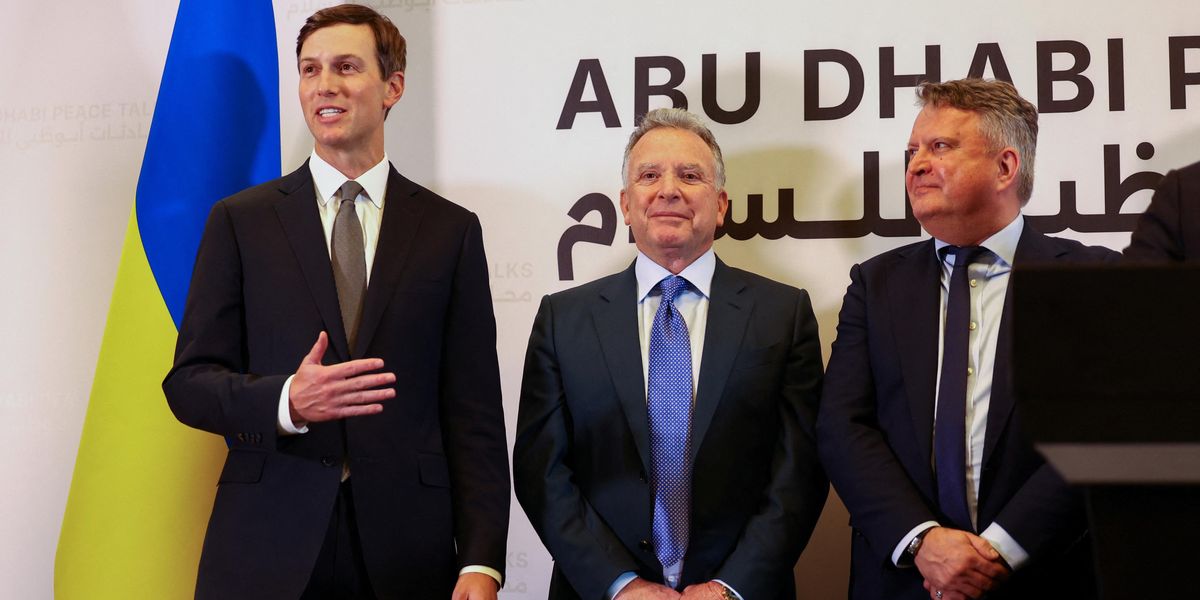
The talks in Abu Dhabi demonstrate that the Ukraine peace process is finally moving in the right direction. Whether it will reach its goal is of course another matter.Firstly, the U.S. negotiating team has introduced to the talks the critical issue of a future European security architecture. President Trump has written of the need for a "very big, beautiful agreement that might involve all of Europe." As Jared Kushner wrote before the talks,“For more than 30 years, Europe and Russia have struggled to establish a sustainable security framework. Decades of mistrust, competing security concerns, and the devastating consequences of this war make this an extraordinarily difficult challenge, but one that is essential to lasting peace.Our objective is to develop practical arrangements that address the security concerns of all sides, reduce the risk of future conflict, and create a more stable and predictable security environment.We are exploring five principal goals: permanent security consultations, reliable crisis communications, greater military transparency, reciprocal measures to reduce escalation risks, and an enduring framework for long-term European security and stability.”These words produced a neuralgic reaction among many Europeans, but in fact Kushner followed them up with a qualification which, if insisted upon, will also be categorically rejected by Moscow:“Any arrangements must fully respect the sovereignty, territorial integrity, and independent decision-making of every nation. Each country will retain authority over its own security and alliances, and no country would have a veto over another’s sovereign choices. NATO will remain central to European collective defense, and this initiative would build upon existing institutions and commitments.” The need for a new European security architecture is an issue that the Russians have been raising since 2008; and as the Quincy Institute has long argued, it is only by addressing Russian concerns about European security that the West has any chance of getting Moscow to abandon its more radical demands vis-a-vis Ukraine. As a Russian official told Reuters:"The Ukrainian settlement, while it is a matter of critical importance, is just one aspect of this wide-ranging discussion and is subordinate to the main objective — the creation of a comprehensive and indivisible security architecture for the entire continent." However, it is very unlikely that the Russians will agree to a new security architecture if this simply involves Kushner’s idea of a revival of the NATO-Russia Council (suspended since 2014), which as far as the Russians are concerned was simply a vehicle for NATO countries to agree a common position and then present it to Russia as a fait accompli, and which wholly failed to prevent the crises of 2008 with Georgia and Ukraine in 2014.Moreover, as Steve Witkoff and Jared Kushner have recognized, talks on an agreement concerning wider European security have by definition to include the Europeans. European representatives were present in Abu Dhabi, but the Russians refused to allow them to take part in the meeting itself.This may seem both illegitimate and absurd if they wish to discuss European security architecture, but the Russians have a point. There are two huge problems with a common European approach to a peace settlement. They don’t have one, and if they did have one, it might very well make peace impossible.As Italian prime minister Giorgia Meloni complained earlier this month:“I’m convinced that we all realize how, by projecting the image of a Europe that’s all over the place, we’re doing nothing but serving the interests of those who want this war to continue, and I think this is unacceptable, given that human lives and the future of our security are at stake…Proceeding in a disorganized manner, with initiatives that chase one another and overlap, will not help us — neither with our partners nor with those we must convince to stop this senseless aggression.”But is a common European position even possible, given the deep hostility of certain European governments to any compromise whatsoever with Russia? Certainly a European strategy presided over by EU foreign policy chief (and former Estonian prime minister) Kaja Kallas looks like a non-starter, given her pathological hostility toward Russia. More hopeful might be a process conducted by the “E3” of Germany, France and Britain; but would an agreement negotiated with them be considered binding by all the other EU and NATO member states, every one of which has a veto over any formal agreement with Russia?Moreover, insofar as there is a common European position, it appears to be to reject any serious talks on European security, by insisting that these can only take place after Russia agrees to a ceasefire. This position is either utterly stupid or utterly insincere. Of course Russia is not going to stop the war and abandon its only source of leverage for a quasi-promise to maybe talk about European security later, with no guarantee at all that in the end the Europeans would agree to anything. Why on earth should Moscow trust the Europeans to negotiate seriously about this in future, given that German Foreign Minister Johann Wadephul said this week that "Europe does not need a new security architecture, as Russia wants us to believe, but rather the simple restoration of the existing security architecture." If Moscow is to be incentivised to end the war, then talks on European security have to be part of the peace negotiations, and agreement on this has to be part of the final peace settlement.As Kushner has acknowledged, the other chief barrier to progress at present is the question of Russia’s demand for control over the whole Donbas region, meaning Ukrainian withdrawal from the approximately 2,000 square miles of that region that they still control. Most Ukrainians regard such withdrawal as militarily and morally impossible.On this, the U.S. team proposed a commonsensical solution that is in fact the only way that this issue can be resolved peacefully: namely, that Ukraine and Russia agree to redraw the borders of the two Donbas provinces so that the territory still held by Ukraine is transferred to adjacent Ukrainian provinces that Russia does not claim.The Russian response to this is not yet clear. It should be noted however, that Russia may have already in effect accepted this solution for the other two provinces of Ukraine (Kherson and Zaporizhia) that it claims as Russian territory but has only partially occupied; since Moscow is no longer demanding Ukrainian withdrawal from these provinces as a condition of peace. On the other side, a “Ukrainian source” told the British Daily Telegraph newspaper that the Ukrainian side had promptly rejected the U.S. proposal:“Ukraine’s delegation never discussed any concessions on any territories which Russia occupies…Ukraine will never recognise it, neither de facto nor de jure. And this has always been our position at the table.” If rejection of even de facto Russian control of these territories is in fact the official Ukrainian position, then it would render any agreement with Moscow completely impossible, and commit Ukraine — and its Western supporters — to an unending war for the impossible goal of reconquering all the land held by Russia. So we are still far from getting answers to the issues frustrating progress towards an end to the Ukraine War. At least however, as the talks in Abu Dhabi demonstrate, the U.S. side has begun to ask the right questions.
Kushner & Witkoff do the Abu Dhabi shuffle: Ukraine peace ahead?
Full Article
Original Source
Read the full article at Responsiblestatecraft →KhanList aggregates and links to publicly available news content. We do not host full articles from third-party sources. Always verify important information with original sources.