
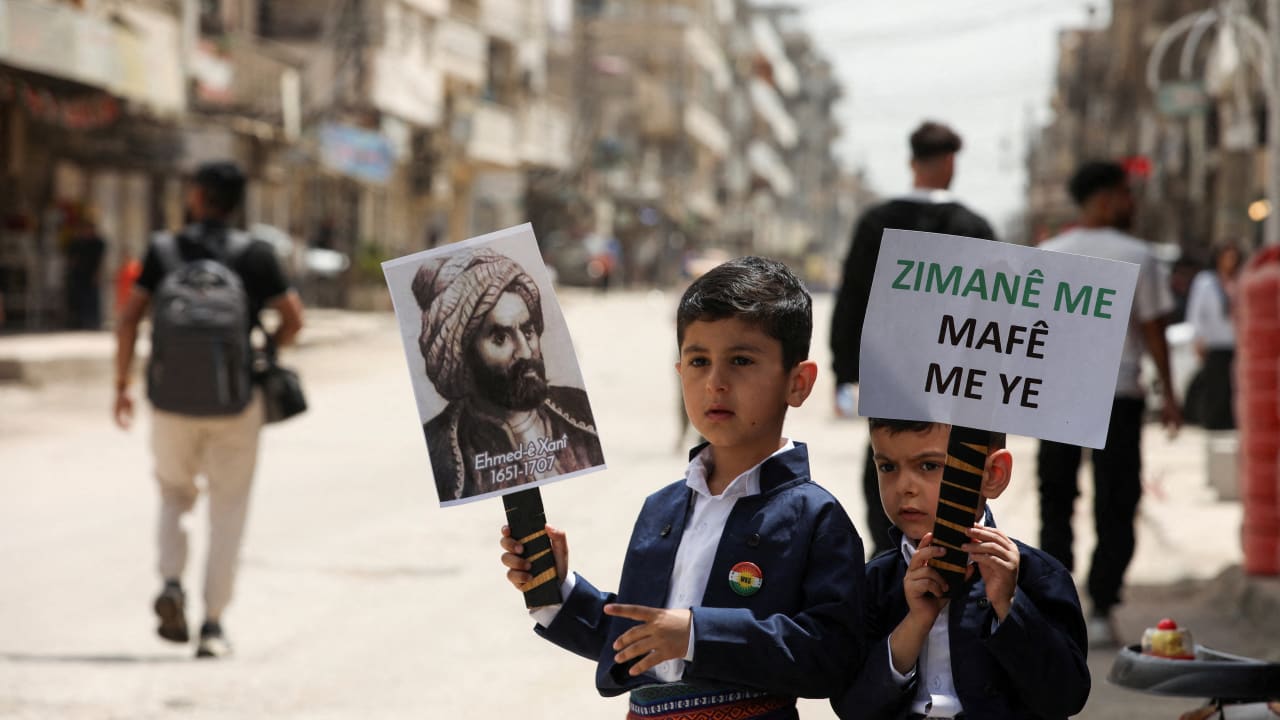
SEPTEMBER 1, 2026 10:31Kurds in Syria are concerned that changes in the country may erode Kurdish language education that has been common in eastern Syria for more than a decade.Meanwhile, in Iraq, a Kurdistan Regional Government (KRG) official on Monday warned of demographic changes in the disputed Kurdish-majority city of Khanaqin in eastern Diyala province. According to Rudaw, a Kurdish media outlet, he called the changes a “clear constitutional violation.”In both countries, Kurdish political parties will need to tackle these issues.Syrian Kurds adapting to last six months of changesThe issue in Syria relates to changes over the past six months. During the long Syrian civil war, the Kurdish regions of what Kurds call Rojava were largely cut off from Damascus. The local authorities instituted Kurdish language instruction in schools, something that the Assad regime had suppressed. As such, what developed since 2012 was more freedom for Kurds, and a generation of young people was raised with their language being taught in school.Now, the area of eastern Syria, which had been governed by the Democratic Autonomous Administration of North and East Syria (DAANES) with the Syrian Democratic Forces (SDF) defending it, will be governed by Damascus.Syrian Kurds demonstrate to mark Kurdish Language Day, demanding constitutional recognition of the Kurdish language by the Syrian government, in Qamishli, Syria, May 14, 2026. (credit: REUTERS/Orhan Qereman)A deal between the SDF and the new Syrian government has led to the Kurdish forces being dissolved. Rudaw media noted that “Kurdish students, parents and teachers rallied in northeast Syria's Rojava region on Monday against a Syrian government decision to end full Kurdish-medium schooling, arguing it falls short of their demands for language rights.”The issue at stake is clear: Kurds who have been learning in Kurdish may find advancing in the education system difficult without Arabic language skills, while reducing Kurdish education will be seen as reducing the rights of Kurds.It’s not a zero-sum game; there are many ways to have language instruction in both Arabic and Kurdish. Kurds are a minority in Syria, perhaps around ten percent of the country’s population. Education appears to be an issue that affects not only the Kurdish region. A dispute over where people from the Druze area of Suwayda are allowed to travel to take national tests has also created a crisis in this area.The issue is not a simple one. Local people may want locally tailored instruction. However, if they can’t progress to national levels via testing and language, then how will they enter university in Syria or abroad? What the Kurdistan Region of Iraq shows is that one can establish an autonomous system with education tailored for locals, but also create success via universities and avenues for growth for young people. In eastern Syria, this remains to be seen.North Press Agency in Syria notes that “Presidential Decree No. (13) of 2026, concerning the cultural and linguistic rights of the Kurds in Syria, has reopened the debate about the future of education in the Kurdish language, amid a dispute between the Syrian government and the educational institutions affiliated with the Autonomous Administration regarding the mechanism for implementing these rights in schools.”It adds that “while the government is moving towards teaching the Kurdish language as a subject within the official curriculum with two lessons per week, the Kurdish side is demanding that its teaching be expanded to become a language of education alongside Arabic, especially in predominantly Kurdish areas.”In many ways, the new decree is important. It changes the old Assad-era discriminatory laws that were rooted in a census dating to 1962. The report quotes Dr. Samar Habib, a faculty member at the Higher Institute for Population Research, as saying “she believes that the decree, from the perspective of educational and social sciences, represents a shift from policies of exclusion and forced Arabization to a context of legal recognition and national symbolism, but at the same time she points to a gap between symbolic recognition and educational empowerment.”It notes that “Habib proposes a three-track educational model, which can be implemented gradually over a period of three to five years, to overcome the limitations of the two-weekly lesson model. She explains that the first path is parallel bilingual education, through teaching science and social studies in Kurdish and Arabic in areas of high concentration, including Hasakah, Qamishli, Afrin and Kobani.”In contrast, the report also quotes Ibrahim Khalil, a Kurdish writer and linguist residing in Germany. “He adds that teaching two optional classes per week cannot be considered a national gain or a correct step towards solving the Kurdish issue in Syria, but rather, in his opinion, it represents ‘a step in the wrong direction on the path of national assimilation and Arabization of what remains of the Kurds.’” It notes that “Khalil believes that the national solution lies in recognizing the Kurdish language as a second official language, and opening official primary schools in Kurdish areas where instruction is only in Kurdish, with a daily lesson allocated to the Arabic language.”Another concern in Syria is the issue of official names for towns and areas. This dispute is most clear in Kobani, which has also been called Ayn al Arab. Kobani is the Kurdish name for the city. In “predominantly Kurdish areas, particularly in the east and north of the country, the issue of place names has been linked over the past decades to a broader conflict over language and identity,” North Press notes.“Most of those areas acquired dual names, one official Arabic name which is the one used in government records, and another Kurdish name used by the residents among themselves.” The concern is that Kurdish names of areas will continue to be “Arabized” in official documents. This was common during the Assad era, as the Assad regime was an Arab nationalist regime, similar to the Saddam regime in Iraq.Kurds can't speak their language in government officesIn Iraq, Kurds continue to struggle for their rights. “A blacksmith in the Kurdish-majority city of Khanaqin in the eastern Diyala province was arrested Monday over what his family says was his addition of Kurdish to his shop's billboard - an incident that has further stoked tensions in a region already fraught with demographic manipulation concerns,” Rudaw noted this week.According to the KRG official, speaking to Rudaw, “Kurdish-speaking residents of Khanaqin are being prevented from using Kurdish in government offices, calling it "’a dangerous indicator.’ He further noted that ‘the issue is not entirely on Baghdad's shoulders - we share in it, too,’ criticizing Kurdish parties representing Khanaqin in federal institutions for falling short.”As Kurds demonstrate in Rojava for their language rights, in Khanaqin in Iraq the issue relates to demographics. There are disputed areas between the KRG and Baghdad, including Khanaqin and parts of Diyala, Kirkuk, Nineveh, and Salahaddin provinces. The Kurds have long been concerned about attempts to change the demographics in these regions, often by government authorities trying to increase the number of Arabs in the regions.This demographic change goes back to the Saddam era and attempts at mass movement of people and even collectivizing areas into various villages while moving Bedouin and other tribes into areas to link them more closely with Baghdad.Rudaw says that Kurds have put off a planned mass demonstration in Khanaqin. However, there have been “arrest warrants against activists, political figures, and youths who had intended to take part.” Follow us on Google
Kurds in Syria, Iraq fight against 'Arabization' with language, but might need to push harder
Full Article
Original Source
Read the full article at Jpost →KhanList aggregates and links to publicly available news content. We do not host full articles from third-party sources. Always verify important information with original sources.