
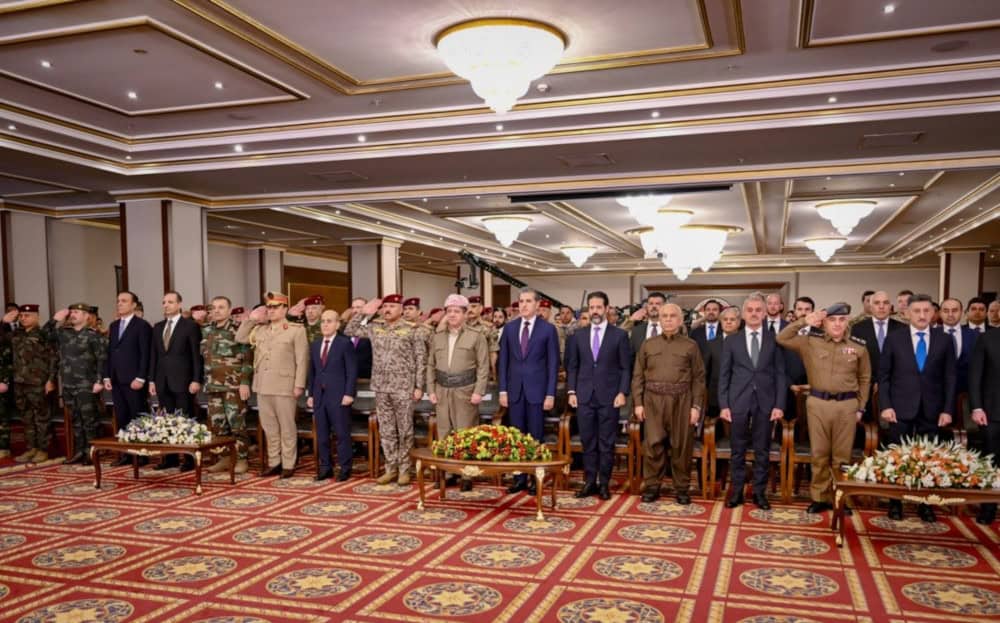
The Kurdistan Regional Government (KRG) of northern Iraq announced on September 21 that its Peshmerga armed forces had completed unification. The announcement follows years of attempts to reform and consolidate the Kurdish forces, which have historically been divided along party lines. The announcement comes as US forces that are part of the anti-Islamic State coalition are leaving Iraq, and the Iraqi government is aiming to rein in and disarm armed groups in Iraq. The Kurdistan Regional Government held a ceremony to announce the “unification of the Peshmerga forces,” attended by KRG Prime Minister Masrour Barzani, President Nechirvan Barzani, and Deputy Prime Minister Qubad Talabani. The Barzanis and Talabani are members of Iraq’s two largest Kurdish political parties, the Kurdistan Democratic Party (KDP) and the Patriotic Union of Kurdistan (PUK), respectively. Their families have historically played a key role in the two parties’ leadership. “We have reached the stage where we can announce the unification of the Peshmerga forces today,” Prime Minister Barzani said, also stating that the unification process has taken place over the last four years and has been supported by the United States and the anti-Islamic State coalition. He added that the Peshmerga would now enter a new phase that focuses on “strengthening military capabilities, providing advanced weapons and air defense systems, developing capabilities, and comprehensively advancing the Peshmerga forces, particularly their human capabilities.” The goal of the unification process is to reduce the role of the KDP and PUK party structures within Peshmerga units. Lack of unity in the Kurdish forces dates back to the 1990s, when there was a civil war in the Kurdistan Region, even as the region was seeking autonomy from Baghdad. The PUK has controlled Iraq’s Sulaymaniyah Governorate since then, while the KDP controls Erbil and Dohuk Governorates. The 100,000-plus Peshmerga are drawn from these two regions, and two large units have dominated the forces: Forces 70 and 80. Force 70 was linked to the PUK and Force 80 to the KDP. Now, the Peshmerga forces will be grouped into the First and Second regional commands. However, The National Context pointed out that the new commands seem to replicate the former system. Second Command will be led by the former commander of Force 70, and the First Command will be led by a Force 80 commander. The Peshmerga Ministry is supposed to oversee the two new regional commands. “We have a memorandum of understanding with the US Department of Defense,” Bakhtyar Mohammed, secretary-general of the Ministry of Peshmerga Affairs, told Rudaw Media Network in May 2026. He added that “all Peshmerga forces must be brought under the umbrella of the Peshmerga ministry by September this year, which is the final deadline.” Peshmerga Minister Shoresh Ismail told Rudaw on September 22 that the unification process will strengthen the force. “He said unification would help the Peshmerga obtain its financial entitlements from the Iraqi state. An Iraqi soldier receives twice the pay of a Peshmerga member, according to Ismail, who said that disparity should now be addressed,” Rudaw noted. “We hope the federal government will cooperate with and support us in safeguarding the rights of the Peshmerga and ensuring that their salaries and financial entitlements are equal to those of their counterparts in the Iraqi Army, with the same rights,” Masrour Barzani said on September 21. Peshmerga commander Sirwan Barzani also said he hoped the announcement would increase the Kurdish military’s capabilities, including air defenses. The Kurdistan Region has sought stronger defenses against hundreds of attacks from Iran. Iraqi Prime Minister Ali al Zaidi praised the Kurdistan Region on the unification announcement. “We congratulate the sons of our people in the Kurdistan Region of Iraq, and the heroes of the Peshmerga, on the completion of the unification of their formations under the umbrella of the Ministry of Peshmerga Affairs, which strengthens national security and consolidates institutional work,” Zaidi wrote on X. He linked the unification to other processes in Iraq aimed at “solidifying our national security and the unity of our defense decision.” Although the Iraqi president didn’t mention recent pressure to disarm Iranian-backed militias in Iraq, his statement appeared linked to this process as well as a recent announcement that a Yazidi armed group would disarm. The Peshmerga announcement also comes as the Kurdistan Region works to break another political deadlock. “Around two years after the elections, the tenth cabinet of the Kurdistan Regional Government (KRG) has yet to be formed, and the Kurdistan Parliament has remained unseated,” Rudaw noted on September 22. The KDP and PUK cannot agree on forming a new government, and it remains to be seen if the political gaps can be bridged. Reporting from Israel, Seth J. Frantzman is an adjunct fellow at FDD and a contributor to FDD’s Long War Journal. He is the senior Middle East correspondent and analyst at The Jerusalem Post, and author of The October 7 War: Israel’s Battle for Security in Gaza (2024).
Kurdistan Region of Iraq announces Peshmerga unification
Full Article
Original Source
Read the full article at Fdd →KhanList aggregates and links to publicly available news content. We do not host full articles from third-party sources. Always verify important information with original sources.