
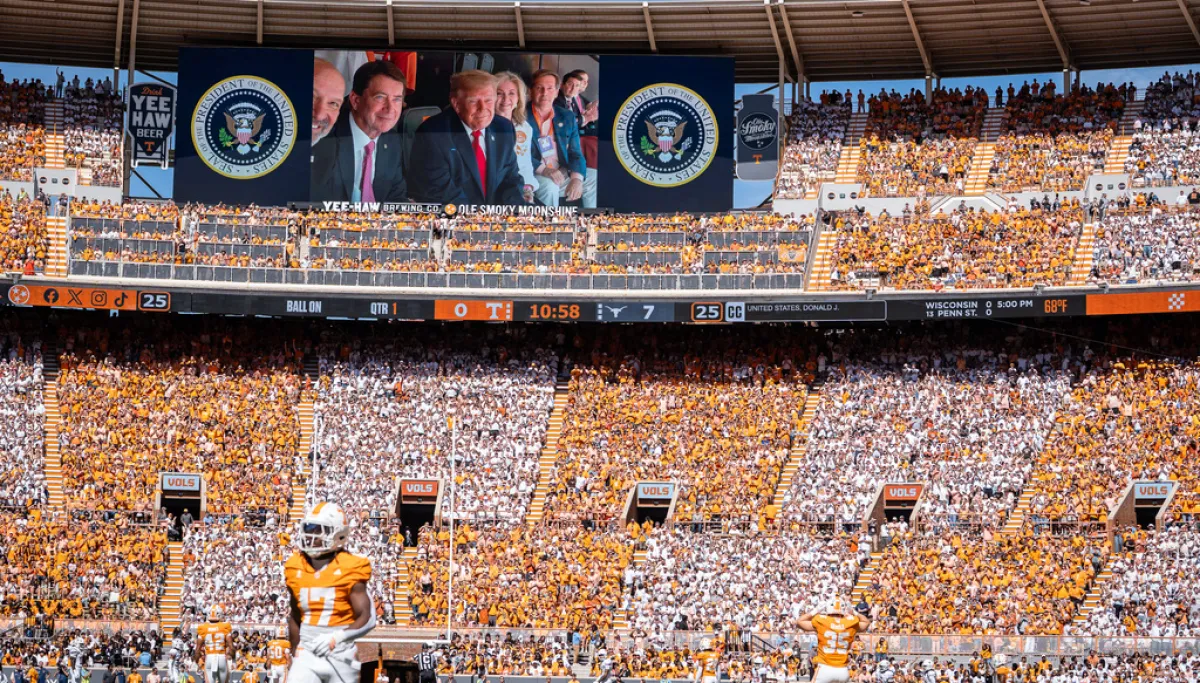
When Sen. Eric Schmitt (R-MO) stumbled into a sports gaffe, confusing the Atlanta Hawks for the Iowa Hawkeyes during a congressional hearing with former special counsel Jack Smith in September, millions viewed the moment on social media.As she pieced together the blunder in real time, Sen. Amy Klobuchar (D-MN), who is running for governor in Minnesota, took the opportunity to flex her Midwestern sports knowledge.“For a U.S. senator to have false information and imply, based on a confusion about the name of a team — which I knew, knowing my Midwestern sports — and imply that you were in another city, that you were somehow involved that day in what was happening in Georgia, and then call you a dirtbag is something that deserves an apology,” Klobuchar said. Klobuchar took to the airwaves afterward, talking about the moment in appearances on MS Now and CNN as she emphasized how her Midwestern sports fandom helped her assess what was happening in the moment.The Minnesota senator has been one of many 2026 candidates to lean on their sports knowledge in an effort to build up their own profile, connect to voters in a nonpolitical way, seem authentic to their constituents, and, in some cases, simply tear down their opponents.American politics professor at the University of Cincinnati David Niven spoke with the Washington Examiner about these types of viral sports-related moments in the 2026 elections, and the impact they can have for certain candidates.“They’re moments when political folk can demonstrate that they’re real people, which then makes them important. The converse of that being, when they’re so out of their element, they underscore how much they’re not real and relatable,” Niven said.Niven, who received his PhD from Ohio State University, pointed to another viral moment from Ohio gubernatorial candidate Vivek Ramaswamy as an instance of the latter. Ramaswamy wore what appeared to be a knock-off Ohio State jersey to the school’s home opener in August and took heat from Buckeyes fans in his X comments. Niven called it a moment that “gives the game away that this is not your natural habitat.”“It works when it’s real, and it can look really, really, really awkward when it’s imaginary and forced,” Niven said.In 2026, several candidates in tight races have leaned into running sports-related advertisements to try and boost their bona fides in nonpolitical ways.Sen. Susan Collins (R-ME) ran an advertisement ahead of the Boston Red Sox’s postgame series against the New York Yankees, slamming Senate Majority Leader Chuck Schumer (D-NY) for spending big against her Senate reelection campaign.Former Rep. Mike Rogers (R-MI), Michigan’s Republican Senate candidate, ran an ad featuring him on a football field in his heated race against Democrat Abdul el Sayed. As he walked up and down the field tossing a football between his hands, Rogers mocked an old comment from el Sayed calling football a sport of “toxic masculinity.” Rogers said, “That’s just not who we are in Michigan.”Niven noted that although there’s no concrete evidence for sports-related outreach driving new voters to the polls, the politicians themselves “believe it matters.”“They believe it humanizes them, especially folks who might otherwise come off as living in a rarefied world. It conveys a certain capacity to connect with people and get your hands dirty,” Niven said“I’ve seen people who superficially seem about the least sports-oriented that you could imagine– like Chuck Schumer would run ads with him in the context of the [Buffalo] Bills, with Bills players in the ads. Again, they believe it works,” he continued.In both Michigan and Ohio, college and professional football have been a subplot of the toss-up Senate races in each state.Along with Rogers’s football ad, el Sayed has also flexed his college football knowledge as a University of Michigan alum throughout their race, often referencing Michigan and Ohio State’s rivalry while poking fun at Vice President JD Vance, who went to Ohio State.One particular moment that caught a lot of attention was when el Sayed said he couldn’t wait to “beat Ohio” this football season, as he needled Vance for coming to the Wolverine State. Several football fans outside of the Midwest made fun of el Sayed, calling it a gaffe, but Niven and Midwesterners said it was pointed, as Michigan fans call Ohio State “Ohio” and Ohio State fans call Michigan “that team up north.”“The pundits who have a horse in the race jumped on it and said, ‘Look, this guy doesn’t even know that Michigan’s rival is Ohio State.’ And, in point of fact, it’s exactly the opposite — that, for decades, to needle Ohio State, Michigan football people have referred to Ohio State as Ohio,” Niven said.The moment caught millions of views, with Niven saying it underscored the theme of “if this is your world, then you know the language.”While el Sayed and Vance have traded barbs over college football, Vance and President Donald Trump have been pulling out the sports references while campaigning for incumbent Sen. Jon Husted (R-OH) in his race against Democratic former Sen. Sherrod Brown.Trump first held a rally in Dayton, Ohio, with former NFL coach Jon Gruden, who mentioned at the rally that he played football with Husted and was there to support his former teammate. Husted played college football as a cornerback for the University of Dayton. In subsequent rallies afterward, Trump has fixated on hyping up Husted’s physical stature, calling him a “great athlete” and saying his backside is a “pile of muscle.”“I started examining his body, because I didn’t know he was a great athlete. And I looked, and I watched up and down. I looked at his ass, and I looked at the whole, and then I looked at his hands. Look at his hands — he’s got these like claws. And I got it, you are a great athlete,” Trump said.Vance, who is likely to run for president in 2028, has also been leaning into his sports fandom ahead of the midterm elections while stumping for Husted in his home state. In addition to portraying his fandom online through social media posts, Vance has also visited a Cincinnati Bengals practice with his son, introduced his children to legendary Indiana Hoosiers football coach Curt Cignetti, and celebrated the Buckeyes 2024 national championship win with the team at the White House in 2025.Director of the University of Maryland’s Center for Democracy and Civic Engagement Michael Hamner spoke to the Washington Examiner about what these moments mean and how they can be more than just a viral moment clipped on social media. He also spoke to Trump attending multiple sports games and college football games in the lead-up to the midterm elections.“Where do you go? Well, where the action is. And it has this other benefit of maybe the people that like you feel a deeper connection, and maybe the people that at least don’t hate you, see another side to you and find some way to relate,” Hamner said.TRUMP TAPS ATHLETES TO HELP TURN OUT LOW-PROPENSITY MALE VOTERS FOR GOPHamner emphasized that sports appearances and appeals from politicians have the capacity to move certain voters “in small ways” and are helpful in creating certain spaces of broader support.“Most people are not running around thinking about politics all day, every day. So, when you have these moments that break into other parts of your life– because it’s sports or something related to your workplace – those get, I think, your attention much more strongly,” Hamner said.
‘Knowing my Midwestern sports’: How politicians are using sports in 2026 to build themselves up and connect with voters
Full Article
Original Source
Read the full article at Washingtonexaminer →KhanList aggregates and links to publicly available news content. We do not host full articles from third-party sources. Always verify important information with original sources.