
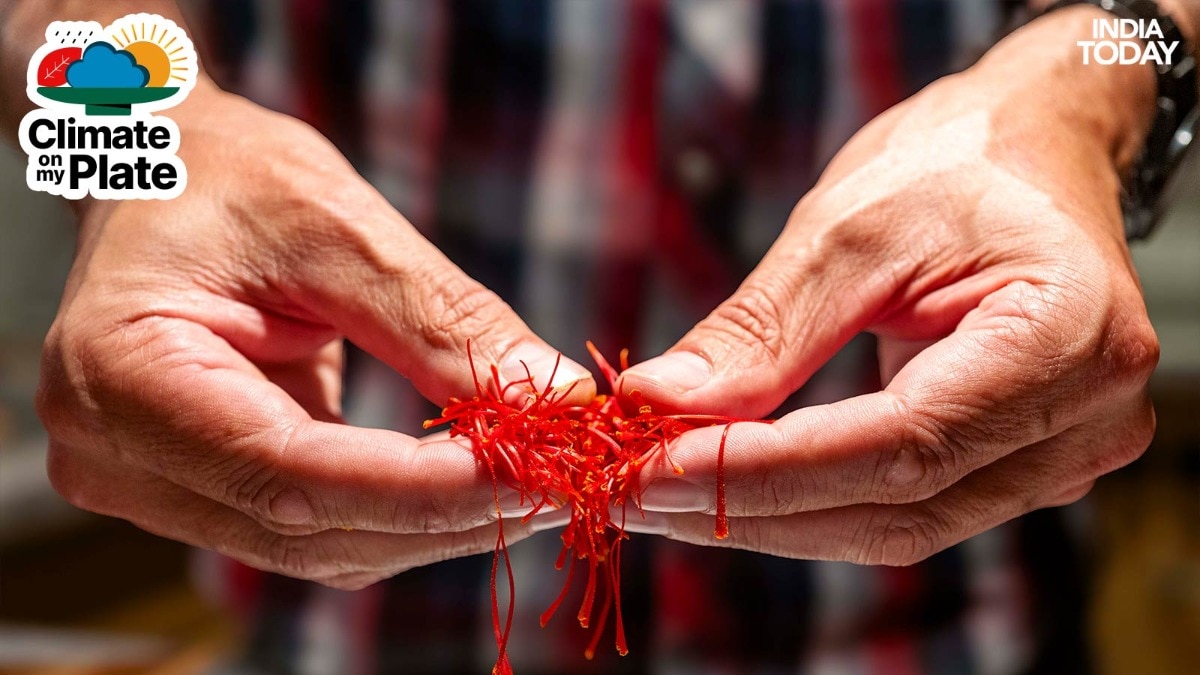
India Today Science's weekly series, Climate On My Plate, explores how the warming planet is putting Kashmir's beloved crop under increasing pressure.A vendor holds a bunch of kesar in his hands. (Photo: Getty)A few strands of kesar, commonly known as saffron, can transform a bowl of kheer, a biryani or a cup of milk.But the spice's journey to your kitchen begins with a crop that demands something increasingly difficult to guarantee; the right weather at the right time. A close up image of saffron strands on showcase at a spice shop. (Photo: Getty) Kashmir's saffron fields have produced India's most prized spice for centuries, but the crop is now under constant pressure.It's constantly battling changing temperatures and rainfall, water stress, shrinking cultivation areas and challenges linked to farming practices. For a crop so dependent on a precise seasonal rhythm, a less predictable climate is making the challenge harder, turning the planetary crisis into an urgent concern.KESAR'S NEED FOR THE RIGHT CLIMATESaffron comes from the red stigmas of the Crocus sativus flower, which blooms in autumn. That makes the weather in the weeks before flowering particularly important. The Crocus sativus flowers are seen. (Photo: Getty) Research has found that saffron's growth and flowering are closely tied to temperature and water availability.Daytime temperatures of around 23–25°C in September are important for corm sprouting, while flowering begins when daytime temperatures fall to around 17°C, with nights close to 10°C.Rainfall, naturally, is just as important.A 2024 study of saffron cultivation in Pampore found that both excessive and deficient precipitation could cause production losses, while the timing of available water also mattered.In other words, saffron does not simply need rain or cold but needs it at the right time. A worker plucks saffron strands from the flower. (Photo: Getty) A WARMER KASHMIRStudies on saffron cultivation in Jammu and Kashmir have linked changes in temperature and rainfall with the crop's productivity.September and October are particularly important, with inadequate rainfall during this period potentially delaying sprouting and flowering.Research has also highlighted saffron's sensitivity to changing temperature and precipitation patterns.The pressure is clearly reflected in production. A worker plucks saffron in a farm field in Kashmir. (Photo: Getty) Data cited by news agency Reuters show Kashmir's saffron output falling from 8 tonnes in 2010-11 to 2.6 tonnes in 2023-24.Around 90% of India's saffron comes from Kashmir, making the region's changing climate especially significant for the spice.CAN KASHMIR'S PRIZED KESAR BE SAVED?The answer to saving the exotic spice may partly lie outside the traditional saffron fields.Farmers and researchers are exploring controlled-environment and indoor cultivation to reduce the crop's dependence on unpredictable weather.Scientists are also studying whether saffron can be grown in new locations by recreating the temperature and moisture conditions it needs. A Kashmiri vendor showcases strands of saffron at his shop. (Photo: Getty) A 2026 study found that rainfall and minimum temperature can influence biological processes linked to saffron quality, further highlighting the spice's close relationship with its growing environment.But technology cannot easily replicate Kashmir's landscape, centuries-old farming knowledge or the identity attached to its kesar.That leaves saffron at a climate crossroads.A crossroads where the challenge is no longer confined to just producing enough kesar, but has evolved into the question of preserving the delicate seasonal balance that allows the tiny red strands to reach our plates.#ClimateOnMyPlate- EndsPublished On: Sep 9, 2026 09:00 IST
Kesar vs climate: Can Kashmir's exotic spice survive a warmer India?
Full Article
Original Source
Read the full article at Indiatoday →KhanList aggregates and links to publicly available news content. We do not host full articles from third-party sources. Always verify important information with original sources.