
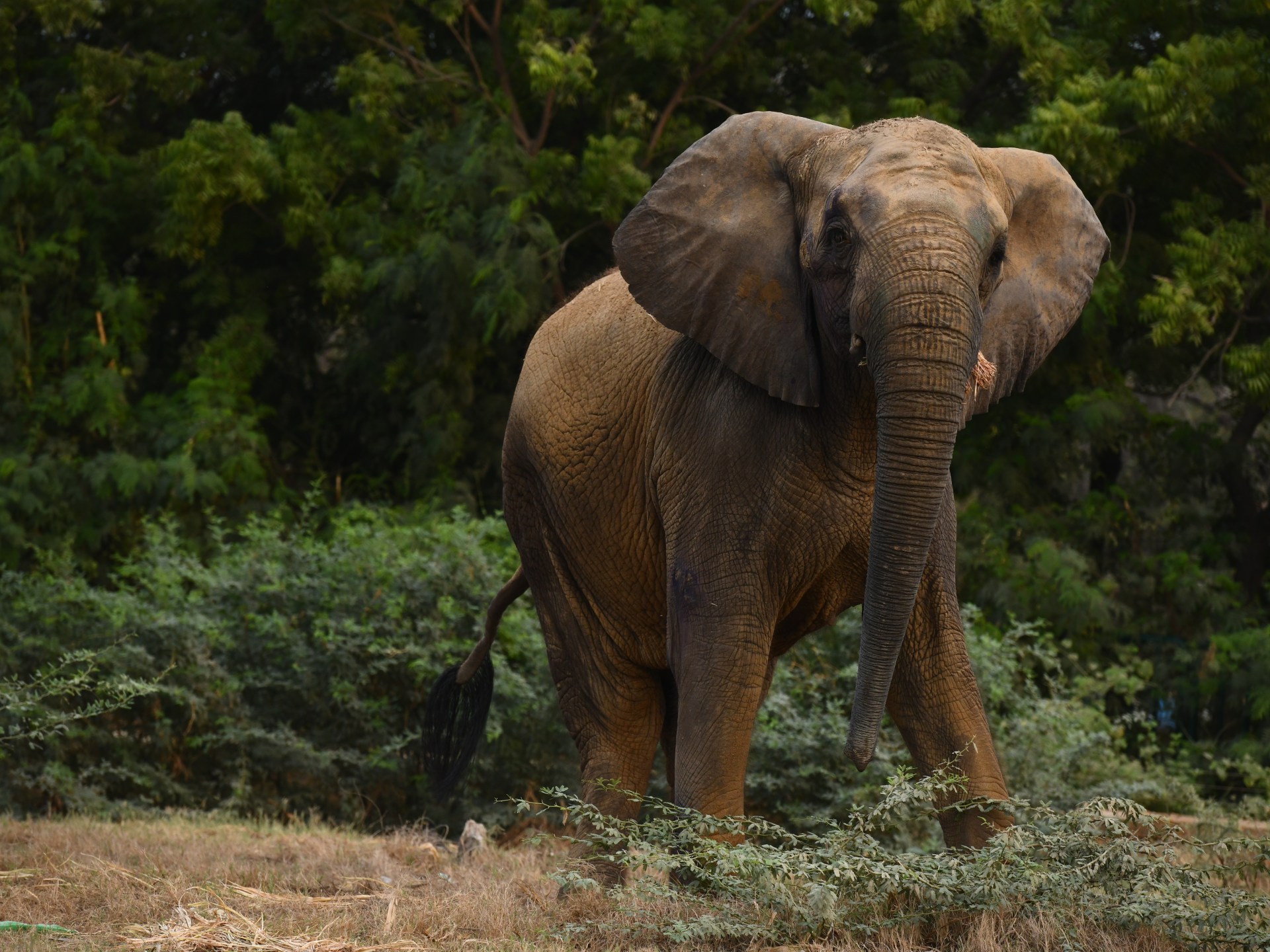
At Karachi Zoo, Jude Allen sang, You Are My Sunshine, to an elephant he could not save.Noor Jehan, the 17-year-old African elephant, was suffering. Allen recalls massaging her legs, nursing her bedsores and spending her final days beside her.She died on April 22, 2023, surrounded by a few activists. Allen, 45, had held various corporate jobs while volunteering as an animal caregiver since an early age.But Noor Jehan changed something in him, he said. “The day this wild African elephant rested her painful forehead on mine, and I hugged her for the first time – it all made sense,” he tells Al Jazeera.“I quit my job without a plan B.”Now three years later, Allen has turned the grief of Noor Jehan’s loss into care for one of her sisters, Madhubala, who also faces major health challenges. He is part of a growing campaign of Pakistani and international activists and doctors trying to save Madhubala, a victim, her carers say, not just of medical conditions, but also of a system that is simply unable to give animals in captivity the attention and facilities they need.African elephants Madhubala, left, and Malika roam with a caretaker inside the premises of Safari Park in Karachi on October 9, 2026 [Rizwan Tabassum/AFP]The elephant sistersIn 2009, four elephant calves captured in Tanzania were brought to Pakistan, allegedly through an animal trader.Two of them, Noor Jehan and Madhubala, were kept at the Karachi Zoo, while their sisters Sonia and Malika were taken to Safari Park, a larger facility also in Pakistan’s largest city that has both a zoo and other viewing spaces for visitors to watch animals up close.Then, in 2020, Pakistan was gripped by the story of Kaavan, an Asian elephant that had spent 35 years in the capital city of Islamabad, eight of them alone after his companion Saheli died. Four Paws, an international animal welfare organisation, helped move Kaavan to an animal sanctuary in Cambodia, where he now lives with other elephants.That episode also shone a light on the Karachi sisters. At the time, Allen was helping a friend with another animal shelter, and came to know Four Paws was in town. He reached out to them, and they led him to Noor Jehan and Madhubala.By 2021, Noor Jehan’s tusk was infected. She suffered from malnutrition and stress, too.Allen and the other activists couldn’t save Noor Jehan, but the campaign had turned into a wider cry, demanding care and justice for captive animals in the urban jungle of Karachi, the coastal home to 20 million people.A mahout feeds elephant Noor Jehan at the Karachi Zoo in Karachi on April 14, 2023 [Asif Hassan/AFP]One animal in particular became the focus of attention.Named after an iconic Indian film actress from the mid-20th century, Madhubala was now the only African elephant at the Karachi Metropolitan Corporation-run zoo. She was alone, banging her head against the gate of her enclosure, Allen recalls. “She didn’t have a friend.”Allen says she needed company – she wanted a friend.Tragic reunion, and a slow recoveryAllen, along with Four Paws, helped prepare her for a move to Safari Park, so she could join her sister elephants, Sonia and Malika.Four Paws assessed the elephants and found that they needed better diets, enrichment and medical treatment. The organisation recommended reuniting them. The reunion came in November 2024. Four Paws documented the meeting between the siblings at Safari Park. Sonia approached Madhubala first. Malika followed. The three touched one another with their trunks and drank together. But days later, on December 8, Sonia died, aged about 19, after collapsing in her enclosure. The park’s director initially described an apparent heart failure. Subsequent findings, reported by Four Paws, identified a severe bacterial infection associated with an advanced abscess on her foot.Amir Khalil, a Four Paws wildlife vet involved in the elephants’ care, told The Associated Press at the time that “such infections don’t spread in one day”. Four Paws linked her death to prolonged unsuitable living conditions and malnutrition.Meanwhile, Madhubala and Malika were both diagnosed with tuberculosis, although recent examinations reported by her veterinarian have indicated that Madhubala is no longer testing positive. Now Madhubala, 22, is recovering after losing more than 200kg (440 pounds) and becoming too weak to get up safely after lying down.Khalil, who has also rescued wild animals from multiple conflict zones, is one of the carers who has taken charge of Madhubala’s recovery. He told Al Jazeera that Madhubala had recovered 85 percent of her ability to walk, and was a good patient: “She really wants to follow the standard operation procedure and to adhere to the programme that I put in,” he says. That includes a “water massage for the leg with high-pressure water”.He says the required medication needs to be administered properly, and treating all the wounds – and they were getting better when he left Pakistan a few days ago.A truck carrying a travel cage for an elephant, Madhubala, passes from a street to be relocated from the Karachi Zoological Garden to a safari park in Karachi on November 26, 2024 [Asif Hassan/AFP]For Allen, the work began with Noor Jehan.While she was unwell, he says he visited the zoo daily, checking that the elephants received their food on time and in the right quantities. During Noor Jehan’s final 10 days, he was a near-permanent presence there, assisting the medical team however he could.Her death became the beginning of the “I Am Noor Jehan” movement, which Allen leads for animals in captivity. The Pakistan Animal Welfare Society (PAWS), with I Am Noor Jehan, held a memorial for Noor Jehan with artists, filmmakers, and other animal activists.Then came Madhubala. Preparing her to enter a transport crate required patience. Allen describes an elephant who could be aggressive and difficult to approach. Four Paws specialists helped him understand her needs.But delays to the relocation disrupted the training, he says. Madhubala became frustrated and bored. Allen tried football.He entered her enclosure, an approach he acknowledges Four Paws did not endorse. The caretakers warned him too: Madhubala wasn’t in a playful mood.But within 20 minutes, he says, Madhubala wanted the ball.She picked it up with her trunk and hid it between her legs. Then she began teasing her caretakers who were trying to retrieve it, offering the ball before concealing it again.The sessions helped him build a relationship with her, he says. Madhubala began responding eagerly to training again.“Earning her trust was the most significant accomplishment.”That trust is especially important to Allen because he believes that Noor Jehan, and then Sonia, could have been saved.When Sonia was unwell, Allen says he had raised concerns with local authorities about her weight loss and a swelling beneath her body. He says those warnings were not adequately acted upon.“I felt I betrayed Sonia.”Amir Khalil and Madhbala [Courtesy of FourPaws]‘What was meant to be a sanctuary became a zoo’The deaths of two of the four African elephants in Karachi raise questions about the resources, expertise and accountability behind keeping wild animals in public institutions, experts say.Karachi Municipal Corporation has not procured any animals in the last 20 years, and the elephants were brought in long before his time, Karachi Mayor Murtaza Wahab said, speaking to Al Jazeera.“I’ve always said that animal welfare should be paramount. Anyone who wants to come join hands, to look after the animal, we would be ready and willing to work with them,” he said.He argued that his team at KMC had done whatever it could to look after Madhubala with Khalil and other doctors.“Madhubala was being treated, and the good thing is, now, Dr Khalil is also saying things are moving in the right direction and we’ve got a third-party perspective endorsing whatever was being done,” Wahab said.But Allen says Safari Park, where Madhubala was moved after Noor Jehan’s death, has been a disappointment. Allen says he helped develop Madhubala’s new enclosure there, working on landscaping and the procedures that caregivers needed to use to help her.Moving her was supposed to change the conditions of her life. But at Safari Park, he says, people come right up to the elephants, feed them, and treat the facility like a zoo.“What was meant to be a sanctuary became a zoo,” he says.Javed Maher, the top wildlife official in the government of Sindh, the province containing Karachi, says elephants and wildlife need to be in their own habitat, and people caring for them need to have knowledge of animals.Currently, the Safari Park enclosure for elephants is about 14 hectares, roughly 35 acres, according to Four Paws.Mahar says he offered hundreds of acres in the rural country for these elephants so they can live freely.“Karachi Zoo, along with the majority of the zoos of the country, is not capable,” he says.But the elephants have remained at Safari Park.Welfare check on elephant Madhubala at the new enclosure in Karachi Safari Park, Pakistan with Amir Khalil, Karachi, Pakistan, October 12, 2026 [Courtesy of Four Paws]The above photo needs a credit -TSLFormer Islamabad High Court Chief Justice Athar Minallah, in a landmark 2020 judgement, declared that animals had rights. It was that ruling that enabled the transfer of Kaavan to Cambodia, and two Himalayan bears to a sanctuary in Jordan. The zoo in Islamabad was closed, and all 878 animals kept there were released or relocated.“That judgement remains the law, as no appeal was filed against it,” says Minallah speaking to Al Jazeera.“Under this jurisprudence, Madhubala has the right to live in an environment where her social, behavioural, and psychological needs can be met,” he says.To be sure, the challenges that officials like those at KMC and elsewhere face are also real.Pakistan already faces profound human hardship. A United Nations account published in March says more than 60 percent of people in the country cannot afford a healthy diet.Acquiring animals that require specialist care creates obligations lasting decades. Once confined, they depend on people for every meal, for movement, companionship and treatment.But that, say analysts, is even more reason to “stop keeping them in our custody”, says Allen.He last saw Madhubala on October 8, when he was assisting the Four Paws team. When there are lots of people, he says, she gets distracted easily.But she can also get jealous for Allen’s attention. “She will literally throw rocks if she can at anyone talking to me,” he smiled.
Keeping Madhubala alive: The fight for Karachi’s captive elephants
Full Article
Original Source
Read the full article at Aljazeera →KhanList aggregates and links to publicly available news content. We do not host full articles from third-party sources. Always verify important information with original sources.