
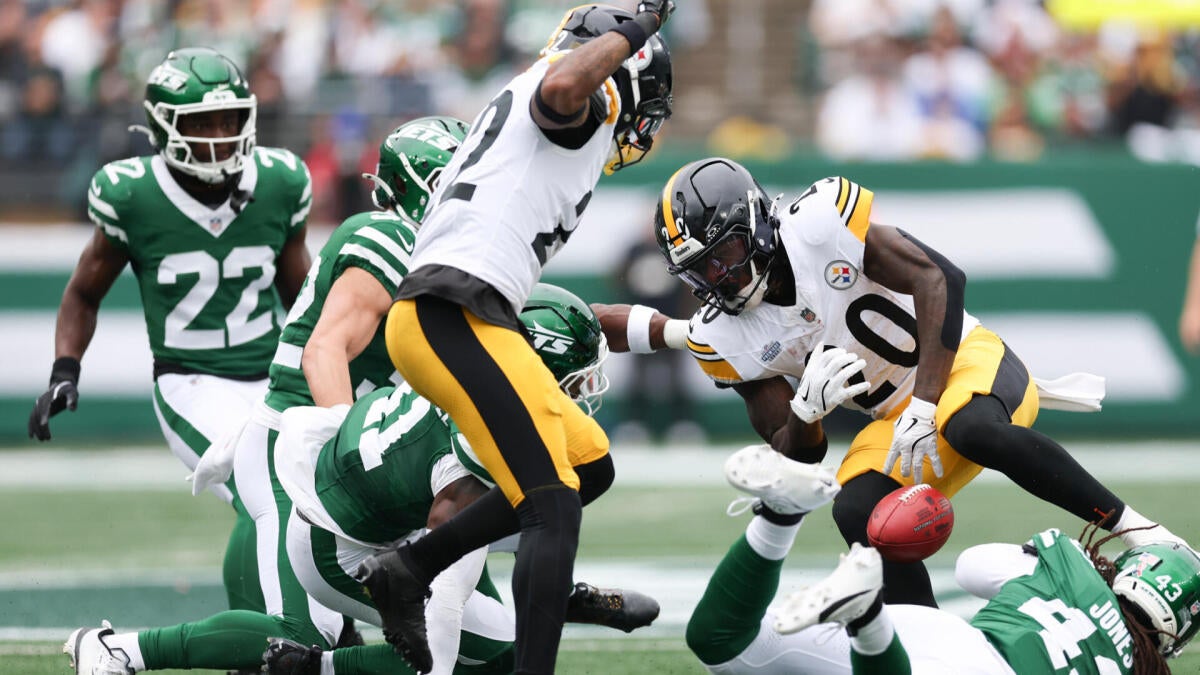
The Kaleb Johnson trade is the latest reminder that draft mistakes rarely announce themselves immediately. Sometimes they look like a third-round running back getting moved one year after he was selected. Sometimes they look like a first-round safety who starts for five seasons, a second-round receiver who flashes early but never becomes a long-term answer, or an offensive lineman who hangs around the league long enough that the pick never quite registers as a failure.That distinction matters when looking back at how the Steelers have used their premium draft capital. Pittsburgh hasn't spent the last eight years lighting first-, second-, and third-round picks on fire. There have been legitimate hits, including Alex Highsmith, Diontae Johnson, George Pickens and Pat Freiermuth and the early returns from several members of the 2023 and 2024 classes are also encouraging. But the larger picture since 2018 is less flattering: Pittsburgh has been slightly below average compared with the rest of the NFL, too many early-round picks have failed to become high-end, long-term players, and better options have come off the board shortly afterward more often than they have for the typical team.What the Steelers' recent draft record actually saysLet's start with the Steelers' draft classes from 2018 to 2022. Pittsburgh made 15 selections in the first three rounds during that span, and those players averaged a 21.1 Weighted Career Approximate Value (wAV), compared with 23.4 for all NFL first-, second- and third-round picks. (Approximate Value is Pro Football Reference's attempt to put one number on a player's overall career production, while wAV gives greater weight to his best seasons. Draft AV measures only the value a player accumulated with the team that drafted him.) By average wAV, Pittsburgh ranked 23rd among the 32 franchises; by Draft AV, the Steelers averaged 18.2 compared with 19.3 leaguewide and ranked 19th.2018-22 Rounds 1-3SteelersNFLAverage wAV21.123.4Average Draft AV18.219.3NFL rank, avg wAV23rd--NFL rank, avg Draft AV19th--This isn't a disaster in table form; Pittsburgh has done a reasonably good job of finding players who belong in the NFL. The problem is producing enough difference-makers with those high-round picks. Every Steelers selection in Rounds 1-3 from 2018-2022 played at least 25 NFL games, compared with 91.7% leaguewide, and Pittsburgh was essentially even with the league at the 50- and 75-game marks. But only 6.7% reached 100 career games, compared with 14.5% leaguewide, while 20% logged five seasons as a primary starter compared with 25.9% of the NFL. Round 1 looks different once you account for draft positionRound 1 initially looked like the biggest problem, but draft position changes the picture. Pittsburgh's four first-rounders from 2018-2022 averaged a 27.0 wAV compared with 32.9 leaguewide, but three of those four selections came between picks 20 and 28. The lone exception was linebacker Devin Bush in 2019, and even that requires context: Pittsburgh traded up from No. 20 to No. 10 to get him, giving Denver its first- and second-round picks that year plus a 2020 third-rounder. Bush finished with a 37 wAV, just below the 39.0 average for picks 1-16, but only a 21 Draft AV with Pittsburgh. That matters because the difference between the top and bottom halves of Round 1 is enormous: picks 1-16 averaged a 39.0 wAV, while picks 17-32 averaged 26.9. Once you account for where Pittsburgh actually selected, its first-round record looks better than the raw 27.0-versus-32.9 comparison -- with Kenny Pickett, more than Terrell Edmunds or Najee Harris, standing out as the clear first-round miss.Round 1 expectation, 2018-22Picks 1-16Picks 17-32Average wAV39.026.9Average games78.270.175+ games58.8%41.3%100+ games23.8%13.8%5+ starter seasons50.0%31.3%Adjust for that, and Pittsburgh's first-round record looks considerably less alarming. Edmunds, selected 28th in 2018, finished with a 27 wAV, almost exactly the 26.9 average for picks 17-32, and his 102 career games put him in the 89th percentile for that group. Najee Harris, picked 24th in 2021, has a 30 wAV and sits above the back-half expectation. Then there is Kenny Pickett: a 14 wAV, nearly 13 points below the back-half-of-Round 1 baseline, with his 36 career games ranking in the 14th percentile for picks 17-32 during that five-year stretch.Steelers first-rounderPickwAVAverage wAV by pick rangeDifferenceTerrell Edmunds282726.9+0.1Devin Bush103739.0-2.0Najee Harris243026.9+3.1Kenny Pickett201426.9-12.9That makes Pickett the clearest first-round whiff of this stretch, not Edmunds. Edmunds is instead a useful example of a different draft question: whether a player can be perfectly serviceable and still represent questionable value. He played 102 games, logged five seasons as a primary starter and finished right around expectation for where he was drafted. But the next several picks included Lamar Jackson at No. 32, Nick Chubb at 35, Shaquille Leonard at 36 and Braden Smith at 37. Edmunds had a 27 wAV; Jackson was at 110, Leonard 60, Chubb 49 and Smith 45. There wasn't a better safety immediately behind him, so calling Edmunds a bust misses the point. The question is whether Pittsburgh maximized the 28th pick in a draft neighborhood loaded with better players. The players Pittsburgh left on the boardThe exercise gets more uncomfortable as you work through the next few classes. The point isn't that Pittsburgh should have drafted every good player who happened to go five or 10 spots later -- roster needs matter, positional value matters, and no team is simply choosing from a list ordered by future wAV. But there's also something to be said for drafting good football players. When the same pattern keeps recurring, especially when better players at the same position or position group were still available, it becomes harder to dismiss it as hindsight.Some of the alternatives weren't realistic one-for-one choices. The Steelers weren't necessarily considering a quarterback when they drafted Chase Claypool, for example, so pointing to Jalen Hurts four picks later only tells part of the story -- especially given how rarely second-round quarterbacks develop into franchise players (Hurts being an obvious exception). But offensive linemen Spencer Brown and Robert Hainsey going shortly after Kendrick Green is a much more direct comparison. And sometimes the gap in player quality is large enough that positional need becomes less persuasive anyway. Fred Warner may not have filled the same immediate need as James Washington in 2018, although the comparison isn't as far-fetched as it looks today: Warner played extensively from the slot at BYU, and, in fact, some Steelers fans preferred him to Edmunds at No. 28. At some point, though, the question becomes less about checking a box on the depth chart and more about whether you identified one of the best players available.Steelers pickNotable players selected in the next 10 picksTerrell Edmunds, No. 28 (2018)Lamar Jackson (32), Nick Chubb (35), Shaquille Leonard (36), Braden Smith (37)James Washington, No. 60 (2018)DJ Chark (61), Brian O'Neill (62), Fred Warner (70)Justin Layne, No. 83 (2019)Bobby Okereke (89)Chase Claypool, No. 49 (2020)Trevon Diggs (51), Jalen Hurts (53)Kendrick Green, No. 87 (2021)Spencer Brown (93), Robert Hainsey (95)Kenny Pickett, No. 20 (2022)Trent McDuffie (21), Tyler Smith (24), Tyler Linderbaum (25), George Karlaftis (30)*For our purposes here, "materially better" means a wAV at least five points and 25% higher than the Steelers pick.There are important counterexamples, which is why this isn't simply an exercise in making every Steelers decision look bad in retrospect. Alex Highsmith was the best wAV outcome in his 11-player neighborhood beginning with pick No. 102, and George Pickens ranked first in his group as well. Diontae Johnson was a legitimate third-round hit even though Terry McLaurin, selected 10 picks later, ultimately produced a higher wAV. Pat Freiermuth has been a productive second-round player, while Chukwuma Okorafor has had a better NFL career than his reputation might suggest. Pittsburgh has found good players; the issue is whether it has done it often enough with higher selections to overcome the misses.The leaguewide comparison helps keep that in perspective. Passing on better players is part of every team's draft history; Pittsburgh has simply had more of those cases than the league average over this stretch. From 2018 through 2022, 86.7% of Steelers premium picks had at least one player in the next 10 selections finish with a materially higher wAV, compared with 78.7% leaguewide. More telling, 80% of Pittsburgh's picks had at least two materially better wAV outcomes among the next 10, compared with 66.5% across the NFL. That's not evidence of organizational incompetence, but it is evidence that Pittsburgh left more value immediately behind its picks than the typical team.The more recent classes don't offer a clean answer yet. Joey Porter Jr., Keeanu Benton and Darnell Washington have all logged substantial playing time from the 2023 class (Benton and Washington have signed extensions, and Porter Jr. is next). Zach Frazier has already accumulated a 13 wAV through two seasons, and Payton Wilson has played 34 games since being selected late in Round 3. But Broderick Jones, the 2023 first-round pick the Steelers traded up to take, never quite worked out; after a neck injury that required surgery late last season, he struggled this preseason and has been traded to the Cowboys. That makes it too early to call 2023-25 a course correction; for now, it's a mix of promising returns and more unresolved questions about the early rounds.If Jones took three years to reach that point, Kaleb Johnson got there in one. I had him RB8 in the 2025 class with a late-Day 2/early-Day 3 grade. Coming out of Iowa, I saw a decisive zone runner with build-up speed who consistently ran through arm tackles and generated yards after contact, but wasn't especially twitchy or dynamic and needed work in pass protection.The Steelers took him 83rd, and one year later, he's already gone. It's too early to declare that neighborhood another missed opportunity, but Jonas Sanker, Jared Wilson and Xavier Watts, all selected between Nos. 93 and 96, each produced a 7 wAV as rookies compared with Johnson's 1. That doesn't make any of them slam-dunk selections after one season, but it does make Johnson's quick exit even more troubling. Why the misses matter more without a franchise QBNone of this means Pittsburgh suddenly forgot how to draft. NFL teams miss. They draft a serviceable safety while future All-Pros come off the board behind him, spend a second-rounder on a receiver who never becomes what they envisioned, misjudge an offensive lineman or make a free-agent signing that doesn't work. The difference is how much those mistakes cost when there isn't a franchise quarterback masking all the missteps. Ben Roethlisberger didn't turn bad players into stars, but he changed the margin for error, and the Steelers could miss on Washington, Layne or Claypool and still enter a season believing they could win the AFC North because the most important position was settled.Once Roethlisberger was gone, those same mistakes became much harder to hide. Pittsburgh used the 20th pick in 2022, trying to find its successor in Pickett, and that miss was more damaging precisely because the most important position on the roster was still unsettled. That's the larger lesson: the Steelers haven't been awful with these picks, and adjusting for where they actually selected makes their first-round record look better than the raw numbers suggested. But 23rd in average wAV across Rounds 1-3 still isn't good enough when the quarterback position is unsettled, and watching better options regularly come off the board immediately afterward compounds the problem.So the question now, reinforced by moving Johnson just one year after drafting him, is simple: how many personnel mistakes can Pittsburgh afford while it waits for the next franchise quarterback to cover them up?
Kaleb Johnson and Broderick Jones trades show how costly Steelers' draft misses have become
Full Article
Original Source
Read the full article at Cbssports →KhanList aggregates and links to publicly available news content. We do not host full articles from third-party sources. Always verify important information with original sources.