
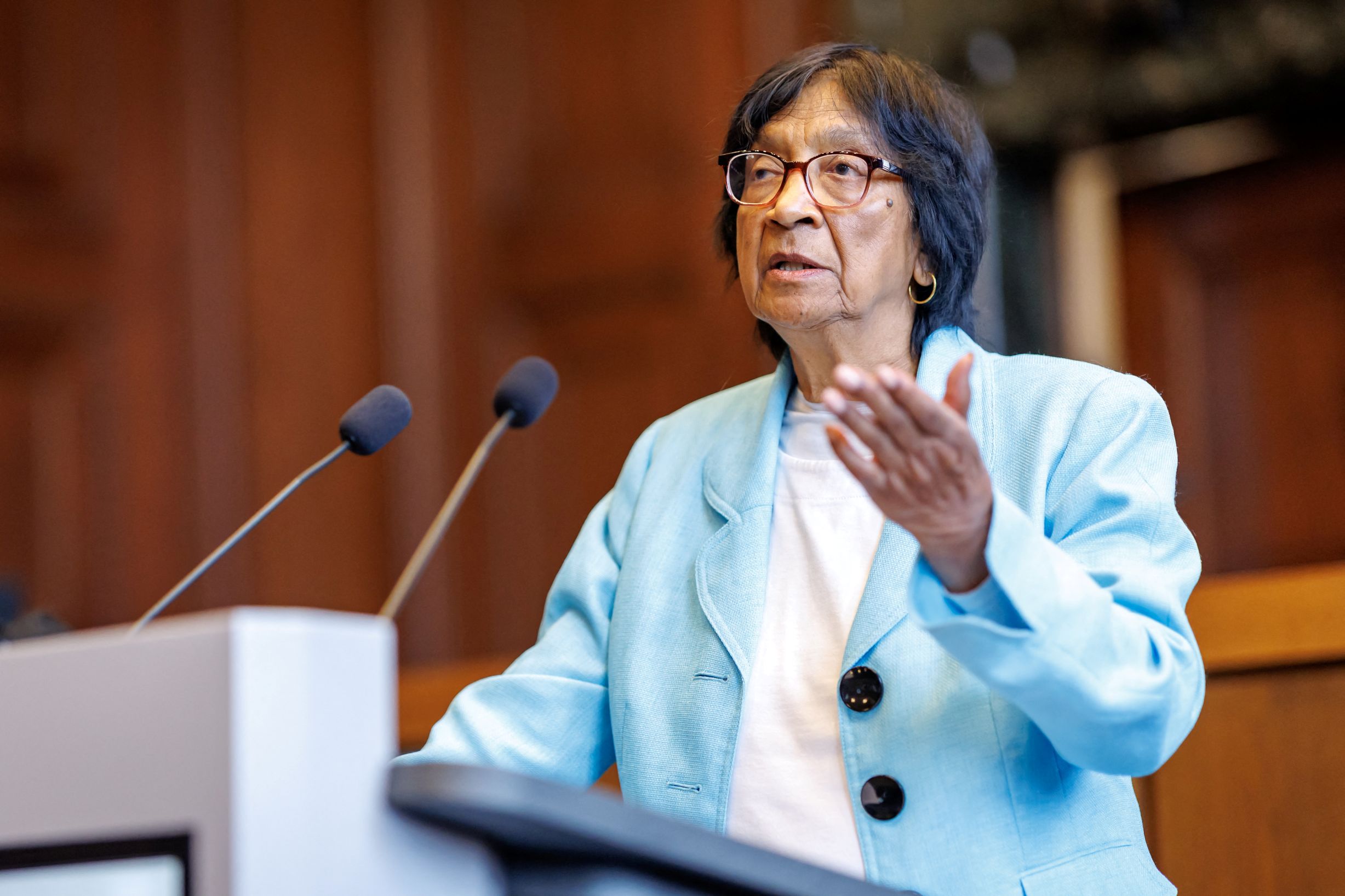
A former ICC judge, Pillay took her fight for justice from South Africa to the world’s courts. Her prize honors decades of holding leaders accountable, including leading a U.N. panel that found Israel was committing genocide.THE HAGUE, Netherlands (CN) — Navi Pillay spent decades putting the powerful on notice, and on Friday, the Nobel Peace Prize put her in the spotlight.The Norwegian Nobel Committee honored the South African jurist for advancing peace and international law, recognizing a career that took her from defending anti-apartheid activists to serving on the International Criminal Court.She also led the U.N. panel that found Israel committed genocide in Gaza.The situation there was among Pillay’s first comments Friday after hearing she had won the prestigious award. “What’s happening there is genocide,” she said while attending a forum in Nuremberg, Germany, where the trials of Nazi war criminals helped lay the foundations of international law.She was in the same room where the trials were held when the prize was announced in Norway.The committee credited Pillay with helping make war crimes, crimes against humanity and genocide punishable in practice. It praised her independence and courage, linking her early defense of Nelson Mandela and other apartheid opponents to her later work holding national leaders accountable.Its announcement also explained why that work deserved a peace prize: Courts offered a way to resolve conflicts without violence. The committee invoked the prize’s 125-year history of supporting international law and urged countries to defend the judges and institutions now coming under attack.“Whenever might overtakes right, it undermines stability, trust and peaceful co-existence,” the committee said.Hours after the award was announced, Washington extended sanctions from individual judges and prosecutors to the entire International Criminal Court. The restrictions could disrupt banking and software services needed to pay staff and pursue cases. The court condemned the measures and appealed to member countries for help keeping it operating.For Pillay, 85, the law was once the machinery of exclusion. Born into a family of Indian Tamil descent in Durban, she grew up under apartheid, confronting the discrimination she would challenge as a lawyer. In 1967, she opened her own firm and defended activists who resisted South Africa’s system of racial segregation.Her work later took her to the International Criminal Tribunal for Rwanda, where she served as a judge and president. There, she helped establish that rape and sexual violence could constitute genocide, recognizing that these were not simply crimes committed during war but could be deliberate means of destroying a group.Pillay served at the International Criminal Court from 2003 to August 2008 before becoming the U.N.’s top human rights official. She later chaired its inquiry into the occupied Palestinian territory, continuing a career spent examining abuses across different countries and conflicts.The commission last year also found that the Israeli president, prime minister and former defense minister “have incited the commission of genocide.” Israel, which has refused to cooperate with the commission since it was established in 2021, has strenuously denied the accusations.Israeli Prime Minister Benjamin Netanyahu wrote on X that the Nobel committee “has lost its moral compass” by awarding its highest honor to “a bigot who built her career around inventing and propagating blood libels against the one and only Jewish state.”Pillay has rebuffed critics who accuse her of antisemitism or ignoring Hamas’ attacks in Israel.Philippe Bolopion, executive director of Human Rights Watch, highlighted her influence in South Africa, Rwanda, the occupied Palestinian territory and the U.N., through work as an activist, investigator and judge.“At a time when international justice is under threat from rights-rejecting leaders, she has been a stalwart proponent of the international rule of law and impartial human rights work,” he said.Tomoko Akane, the court’s president, congratulated Pillay and recalled her service at both the permanent court and the Rwanda tribunal. She said the award carried particular significance amid challenges to the international legal order.“This is an important recognition of the vital role that international justice plays as a cornerstone of lasting peace,” Akane said.Pillay is still on the bench. She now serves as a judge ad hoc in the separate International Court of Justice, hearing Gambia’s case accusing Myanmar of violating the Genocide Convention.Courthouse News reporter Eunseo Hong is based in the Netherlands.Subscribe to our free newslettersOur weekly newsletter Closing Arguments offers the latest about ongoing trials, major litigation and rulings in courthouses around the U.S. and the world, while the monthly Under the Lights dishes the legal dirt from Hollywood, sports, Big Tech and the arts.Additional Reads
Jurist Navi Pillay wins Nobel Peace Prize for work from apartheid to global justice
Full Article
Original Source
Read the full article at Courthousenews →KhanList aggregates and links to publicly available news content. We do not host full articles from third-party sources. Always verify important information with original sources.