
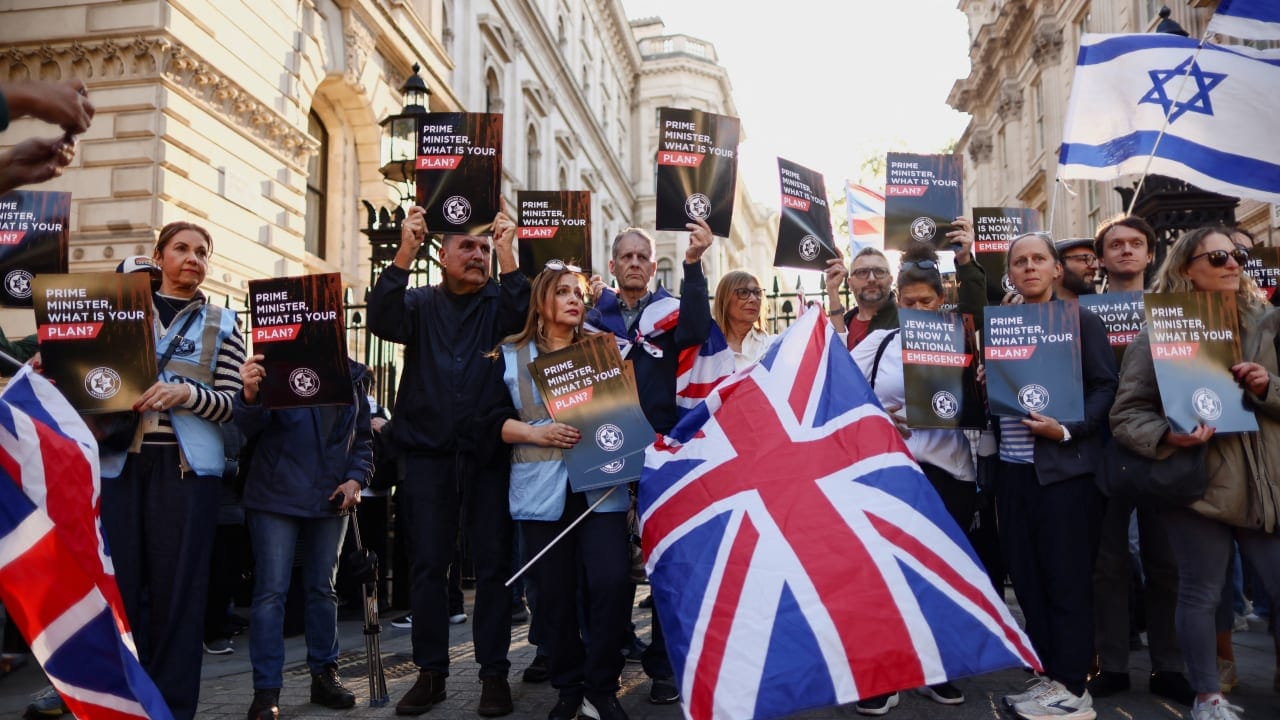
OCTOBER 6, 2026 17:21Half of British Jews now feel very emotionally attached to Israel, marking a sharp increase following the events of October 7, according to a major new empirical study by the Institute for Jewish Policy Research (JPR) released on Monday.The report details how the post-October 7 landscape dramatically shifted emotional ties to the Jewish State and intensified concerns over antisemitism, even as core markers of domestic Jewish religious life and practice remained remarkably stable.The study, called “October 8 Jews: The impact of October 7” on British Jewish identity, was conducted by Dr David Graham, a Senior Research Fellow at JPR.Utilizing JPR’s longitudinal research panel, the study tracked the exact same group of 2,500 British Jews across multiple survey waves spanning a six-year period from July 2020 to June 2025. This allowed researchers to measure actual individual changes in attitudes and behaviors before and after October 7, 2023, rather than relying on retrospective accounts or single-snapshot polls.The research aimed to examine whether widely discussed post-October 7 concepts applied to the UK, including the notion of the ‘October 8 Jew,’ describing individuals who experienced a renewed sense of Jewish consciousness and discovered that previously trusted progressive allies and spaces were no longer reliable, and the communal ‘Surge’, which refers to a broader rise in Jewish activity and engagement, particularly among previously unengaged Jews.People attend a rally organised by the Campaign Against Antisemitism, opposite Downing Street in central London on May 10. (credit: Justin Tallis/AFP via Getty Images)The report is organized into three core analytical sections that investigate how British Jews were impacted across different areas of life. The first section explores connections to Israel, the second shifts to experiences of antisemitism, and the third examines broader measures of Jewish identity, peoplehood, values, and religious observance.UK Jews increasingly attached to IsraelThe study first asked respondents about their connection to Israel through multiple indicators, revealing that overall emotional attachment rose from 72% in May 2023 to 76% in June 2024 and 78% by June 2025. Beyond that general rise, the report highlights a dramatic shift in intensity, with the proportion of those identifying as very attached surging from 38% prior to the attacks to 50% in June 2024 and holding steady at 51% in June 2025.Analyzing these figures, the report explains that this represents an enduring change rather than a temporary spike, showing that Israel became far more central to personal identity.Similarly, self-identification as a Zionist saw a statistically significant rise, climbing from 59% in November 2022 to 65% in June 2024, and holding at 66% in June 2025.In contrast, the report notes that those identifying as anti-Zionist remained virtually unchanged at 9% to 10% across the same periods, while the proportion identifying as non-Zionist declined from 17% down to 14%, showing that people on the fence chose a side rather than shifting toward opposition.The study also tracked the likelihood of making aliyah within five years, where the mean score on a scale from zero to ten increased from 1.38 in November 2022 to 1.95 in June 2024.Analyzing these figures, the report notes that this post-October 7 rise in aliyah sentiment, while reflecting genuine increases in emotional attachment and Zionist sentiment, remained lower than the score of 2.29 recorded in July 2020 during the COVID-19 lockdown, explaining that such fluctuations likely reflect both a growing connection to Israel and changing perceptions of how comfortable and settled respondents felt living in the UK at different times.Personal experiences with antisemitism rise in UKThe second section of the report evaluated personal experiences and perceptions of antisemitism, safety, and mental wellbeing. The survey found that personal experiences of antisemitism escalated drastically, with the proportion of respondents reporting that they had personally experienced at least one antisemitic incident jumping from between 17% and 20% in calendar years between 2020 and 2022 up to 29% in an 18-month tracking period spanning 2023 and the first half of 2024.Public perception matched this reality; the proportion of respondents who viewed antisemitism as a very major problem in the UK nearly tripled from 17% in May 2023 to 47% in June 2024, reaching 50% by June 2025. This coincided with a sharp drop in average feelings of safety on a zero-to-10 scale, falling from 7.4 in May 2023 down to 6.2 in June 2024 and 5.8 by June 2025.Consequently, the anxiety index mean score climbed from 2.99 in August 2021 to 3.76 in June 2024. Examining this sharp increase in anxiety, the analysis suggests that while rising antisemitism and declining safety certainly contributed, the elevated stress levels were likely driven primarily by concerns about antisemitism in the UK over and above concerns about Israel’s security, noting that anxiety increased uniformly across respondents regardless of their emotional attachment to Israel.Furthermore, charitable giving priorities shifted notably, with the proportion of respondents prioritizing Israel charities nearly tripling from 6% before October 7 to 16% by June 2025. The report suggests that post-October 7 realities drove the Jewish population toward more particular Jewish causes at the expense of more universal general UK charities.UK Jews report stronger ties to identityThe third section of the report investigated core dimensions of Jewish identity, peoplehood, and religious behavior. When respondents were asked to position themselves on a zero-to-10 scale regarding the strength of their Jewish identity, more than half chose nine or 10, with mean scores holding exceptionally steady at 8.29 in November 2022, 8.31 in June 2024, and 8.32 in June 2025.When asked about the importance of feeling part of the Jewish People, 90% considered it important in May 2023, rising slightly to 92% in June 2024 before settling at 89% in June 2025, with those answering very important shifting marginally from 63% to 66% and 64% across those same waves. Similarly, when asked about participation in synagogue prayer services over the preceding 12 months, responses showed negligible movement, with 28% reporting no participation in November 2022 compared to 26% in June 2024 and 27% in June 2025, while regular attendees participating most or every Shabbat remained steady at 26%, 28%, and 27% respectively.Self-described levels of religiosity also remained flat, with those placing themselves on the more strongly religious side resting at 49% in November 2022, 51% in June 2024, and 50% in June 2025. Taken together, these figures suggest that British Jews did not experience a broad-based transformation in religious observance or general identity strength following October 7.The report concludes by emphasizing that October 7 acted as a profound watershed primarily regarding emotional connections to Israel and Jewish peoplehood rather than a total structural reinvention of British Jewish life. While solidarity, Zionist identification, and concerns over security heightened significantly, broader indicators of Jewish identity exhibited remarkable continuity with little to no measurable change.In summary, the report noted that the “challenge facing Jewish leaders, educators and policymakers is how to translate these modest changes into deeper forms of participation, engagement and Jewish flourishing in the years ahead.”Follow us on Google
JPR study finds 50% of British Jews emotionally attached to Israel, up sharply since Oct. 7
Full Article
Original Source
Read the full article at Jpost →KhanList aggregates and links to publicly available news content. We do not host full articles from third-party sources. Always verify important information with original sources.