
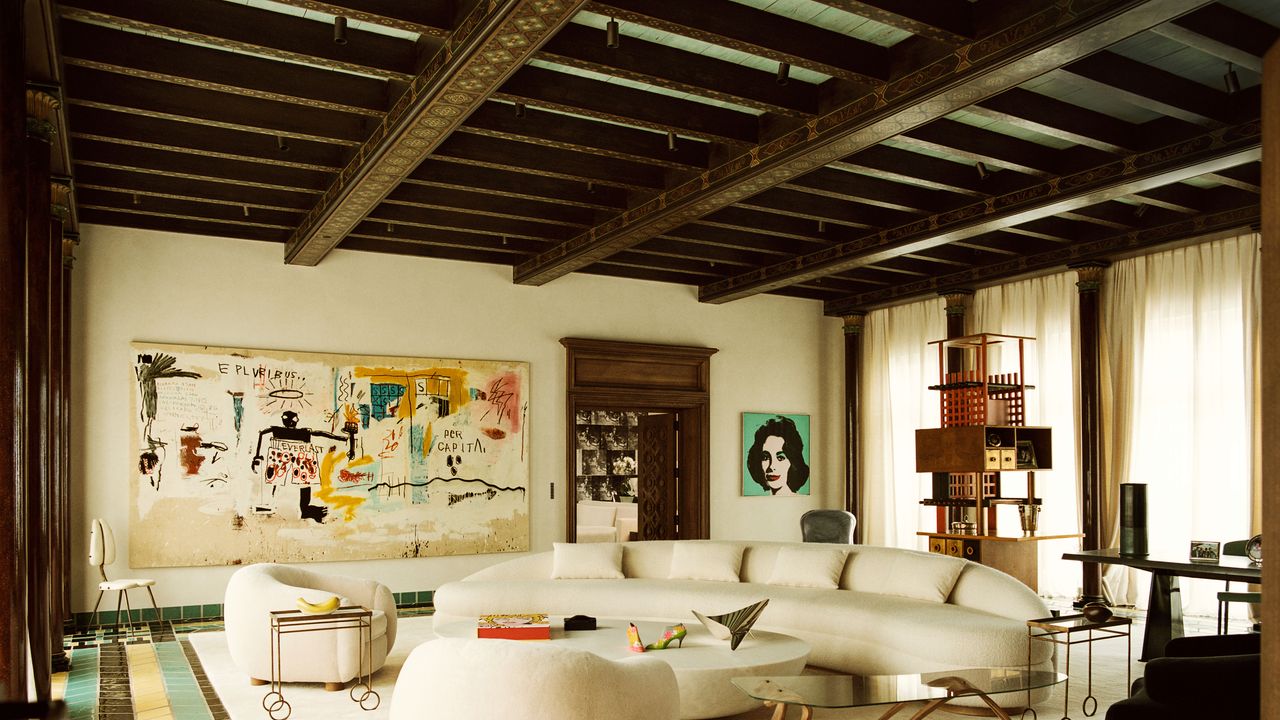
The Paris-based architect reconstructed an Addison Mizner-designed landmark residence around the couple’s legendary trove of art, design, and coutureJean-Michel Basquiat’s Per Capita, 1981, and Andy Warhol’s Liz #5 (Early Colored Liz), 1963, anchor one end of the loggia in Peter Brant and Stephanie Seymour Brant’s Florida home. A pair of Jean Royère Ours Polaire chairs join a Boomerang sofa and Galet I coffee table, both by Joseph Dirand Edition. Other pieces include a Tower cabinet by Ettore Sottsass, Yo-Yo side tables by Royère, and an Arabesco table by Carlo Mollino.ART: © Estate of Jean-Michel Basquiat. Licensed by Artestar, New York. © 2026 The Andy Warhol Foundation for the Visual Arts, Inc. / Licensed by Artists Rights Society (ARS), New YorkIt began with a chance encounter and a phone call. The French architect Joseph Dirand was walking into a restaurant in New York when he ran into an old friend, the art dealer Tico Mugrabi. Dirand mentioned that he was flying to Palm Beach the next day and his friend lit up. Mugrabi pulled out his phone and made a call. “Peter, my friend Joseph is coming to Palm Beach tomorrow,” Dirand recalls him saying. “You have to meet this guy.” The following day Dirand was sitting across from Peter Brant, the fabled industrialist and publisher, and his wife, Stephanie Seymour Brant, one of the defining supermodels of her generation, in their new home. The Brants had owned the house for only a few days, and it marked the opening of a new chapter for the couple.The Brants in front of Warhol’s White Disaster (White Car Crash 19 Times), 1963, in the great room. Jean Prouvé coffee table; sofa and chairs by Pierre Jeanneret. ART: © 2026 The Andy Warhol Foundation for the Visual Arts, Inc. / Licensed by Artists Rights Society (ARS), New YorkMarc Newson’s aluminum Lockheed Lounge, a Tower Cabinet by Ettore Sottsass, and a Trapeze table by Jean Prouvé all stand in the loggia. ART: © 2026 The Andy Warhol Foundation for the Visual Arts, Inc. / Licensed by Artists Rights Society (ARS), New YorkA Végétale mirror by Claude Lalanne reflects Untitled (Richard Prince and Cindy Sherman), 1980, and a 1930s settee by Jean-Michel Frank. ART: Richard Prince / GladstoneA pair of bespoke Philippe Anthonioz floor lamps Flank Jonathan Horowitz’s Self-portrait in “Mirror #1” (Kevin), 2012. Brown Jordan chaise longues under umbrellas by Business & Pleasure Co. stand poolside. There is something quintessentially American in how quickly it all unfolded, and for Dirand, it meant meeting a man he had long admired. As an inquisitive young designer he had pored over photographs of Brant’s earlier homes, and one image had stayed with him: It showed a Jean Prouvé desk beneath a Jean-Michel Basquiat painting, captured at a time when almost no one thought to set French postwar design against contemporary art. “For me, Peter was a kind of collector’s hero,” says Dirand.Brant’s eye for art and design was formed early. His father loved classical art and considered even Picasso “way too modern,” but on family ski trips to Switzerland the teenage Brant got to know the Zurich dealer Bruno Bischofberger, who subsequently introduced him to Leo Castelli, and the two titans of the art world became the young Brant’s mentors. Brant then bought his first Andy Warhol painting in 1966, and by the time Warhol’s business manager, Fred Hughes, introduced them in November 1968, he already owned about seven of them. Warhol and Brant would go on to become close friends for the remainder of the artist’s life.In a corner of the Great Room, Roy Lichtenstein’s The Refrigerator, 1962, faces a 1960 copper hanging cabinet by Paul Evans. a 1934 plaster vase by Alberto Giacometti sits on A Joseph Dirand Edition Iseo Gold coffee table. 1950s Hirondelles wall light by Jean Royère; pair of 1958 Diego Giacometti armchairs. ART: © 2026 Estate of Roy Lichtenstein/DACS. © 2026 Paul W. Evans / Artists Rights Society (ARS), New York.Warhol’s 1975 portrait of Murray Brant (Brant’s father) commands a wall of the paneled study. Direction armchair and Présidence desk by Jean Prouvé; Ettore Sottsass hanging lamp. ART: © 2026 The Andy Warhol Foundation for the Visual Arts, Inc. / Licensed by Artists Rights Society (ARS), New YorkA Koi pond in the lawn Artworks in the entrance hall include, from left, a Massangis stone lion-head fountain feature by Harumi Klossowska de Rola, 2022; Andy Warhol’s Self Portrait (Green), 1964; a Klossowska de Rola wolf sculpture; and Richard Prince’s Nurses’ Dormitory, 2002. The sanded Ceppo di Gré stone modular console is by Dirand. ART: © 2026 The Andy Warhol Foundation for the Visual Arts, Inc. / Licensed by Artists Rights Society (ARS), New York. Richard Prince / Gladstone. © Harumi Klossowska de Rola / Acquavella Galleries, New York.In the primary bedroom, George Condo’s 2004 portrait of Stephanie Seymour Brant hangs above a 1946 Charlotte Perriand sideboard on which stands an enameled earthenware lamp by Roger Capron. A Jean Prouvé Bridge armchair joins an Ours Polaire chair and sofa by Jean Royère around Prouvé’s Tripod coffee table. ART: © 2026 George Condo / Artists Rights Society (ARS), New YorkAn exterior view of the 1926 Addison Mizner residence Another view of the great room Few people then saw Warhol’s work the way Brant did. When he hung his first Marilyn at home, visitors were shocked: “People would come to my house and think, This is the worst thing I’ve ever seen. In the 1960s, he says, you could count the serious collectors of Pop art “on three hands.”His rule, he says, is to collect “something that was in style that’s out of style,” though never as speculation. Between their holdings and those of the Brant Foundation, which he established in 1996 to promote the education and appreciation of contemporary art and design, the collection now numbers more than 3,000 works, and he has never bought for a particular wall. What he misses in many newer collections is any sense of the person behind them. “You can see right away that this guy had a great adviser,” he says, “but there’s no madness in the collection. Every collection should have some madness.”Carlo Mollino’s Tipo B side chair rests beneath Jean-Michel Basquiat’s Per Capita, 1981. ART: © Estate of Jean-Michel Basquiat. Licensed by Artestar, New York.A painting by Glenn Ligon and a stool by Shiro Kuramata in Brant’s bath ART: © Glenn LigonSeymour Brant and Brant in the great room Brant has shared much of his collecting journey with Seymour Brant, whom he married in 1995. She has built a collection of her own: Her passion is clothing rather than paintings, and she has pursued it with the same scholarship and the same sharp eye as her husband. She was a close friend of the legendary couturier Azzedine Alaïa and has one of the most significant holdings of his work, alongside historic couture that Dirand describes as extraordinary. Where Brant is the storyteller, Seymour Brant is the quieter presence, though Dirand is clear that she was integral to every decision. Her collecting has even changed the way Brant sees his own. “It’s not a dress in a closet,” he says. “It’s a piece of art, and it mixes with art.”Brant has spent some 50 years in the Palm Beach area, first as a polo player. He and Seymour Brant had no need for a new home there—they loved the one they had as their children grew up. But when Collado Hueco, a home by Addison Mizner, the architect who defined 1920s Palm Beach, came on the market in 2020, the collector in him took over. “It was a piece of history,” Dirand says. “For him, there was no choice.” Designed in 1924 for the American businessman Paul Moore, it is one of Mizner’s boldest and most unusual houses.In a hall, a 1974 Diego Giacometti bench sits in front of Jean-Michel Basquiat’s Untitled (Sugar Ray Robinson), 1982. The curtain rods are by Julian Schnabel. ART: © Estate of Jean-Michel Basquiat. Licensed by Artestar, New York.Warhol’s The Kiss (Bela Lugosi), 1964, and a 1947 Alexandre Noll mahogany armchair in a corner of the primary bedroom. Philippe Anthonioz hanging light; Jean Prouvé tripod coffee table; Jean Royère Ours Polaire sofa. ART: © 2026 The Andy Warhol Foundation for the Visual Arts, Inc. / Licensed by Artists Rights Society (ARS), New YorkJohn Currin’s Constance Towers, 2009, presides over Seymour Brant’s dressing room. Furniture includes an Ambassador chair and Éléphanteau sofa, both by Jean Royère. ART: © John CurrinIn the great room, a plaster bas-relief, Support, and a carved-stone console by Alberto Giacometti are flanked by a pair of Éléphanteau chairs by Jean Royère. In the foreground is a Fondation Maeght chair by Diego Giacometti. Warhol’s Dollar Sign, 1981, in the hall ART: © 2026 The Andy Warhol Foundation for the Visual Arts, Inc. / Licensed by Artists Rights Society (ARS), New YorkThe house presented Dirand with a real puzzle. Asymmetrical, it spreads across multiple wings, varying from one to three levels. The main entertaining rooms had retained their original character, while the entrance and stair hall were dark and enclosed. Dirand set out to let the sunlight that moves across the house reach every part of the interior as much as possible. The collection shaped Dirand’s approach too. With so many treasured works coming into the house, the team wanted to ensure they would be protected against anything the unpredictable Florida weather could bring. What began as a renovation became, in Dirand’s words, “a reconstruction saving the historical.” Rather than demolishing and starting again, the team kept the historic walls standing, reinforced every one of them, and dug beneath to take the foundations deeper. New hurricane-proof windows were set into concrete frames, the roof was removed and rebuilt, and the original tiles and the patina of the plaster fireplace were carefully preserved. The project took about four years. Throughout, Dirand immersed himself in Mizner’s doors, ceilings, and patterns so that the new rooms would be a true homage rather than a copy.Early on, Brant handed Dirand two thick binders, one of artworks and one of design pieces. “This is what you can use,” he said. A few days later, on holiday with his family, Dirand spread every page across the floors. “I was walking on the paper,” he says. It reversed the usual order in which the architect designs the rooms and the art arrives afterward. Here the collection came first, though never rigidly, because “a collection is also something that is alive.”A Diego Giacometti bench and A Jean Royère Liane six-branch floor lamp in a hall The mirror and vanity in Brant’s bath A chair and floor lamp by Diego Giacometti stand next to the fireplace in the great room. Looking into the main entrance ART: © Estate of Jean-Michel Basquiat. Licensed by Artestar, New York.Jean-Michel Basquiat’s Per Capita, 1981, commands a wall of the loggia. Ours Polaire chair and Yo-Yo side table, both by Royère. ART: © Estate of Jean-Michel Basquiat. Licensed by Artestar, New York.A family photo and fragrance bottles line up on a windowsill in Seymour Brant’s bath. Warhol’s Big Campbell’s Soup Can with Can Opener (Vegetable), 1962, hangs in the stairwell, which also features a Jacques Adnet wall light. ART: © 2026 The Andy Warhol Foundation for the Visual Arts, Inc. / Licensed by Artists Rights Society (ARS), New YorkThe front drive At the heart of the home are two main spaces, the great room and the loggia, which are perhaps the spaces that both Dirand and Brant are most proud of. The great room is centered around a monumental fireplace that has the grandeur of a castle. Commanding one wall is a rare carved-stone console by Alberto Giacometti, nearly three meters high and crowned with a bas-relief of a female figure, made for Jean-Michel Frank’s important 1938 commission for the Born family in Argentina. It was one of a pair, and Dirand says no one knows where the other is today. Beside the fireplace hangs Warhol’s 1963 White Disaster (White Car Crash 19 Times), one of Brant’s most recent and important acquisitions; he had wanted a Car Crash painting since the ’60s. Prouvé furniture from Brazzaville, weathered by the Congo climate, sits amid Native American and African objects, and at the center of it all is a mirror polish copper table Dirand designed himself to reflect Giacometti’s bird vase and the fireplace behind it. Brant calls the table a masterpiece.Art in the main entrance includes, from left, pieces by Jean-Michel Basquiat, Richard Prince and Cindy Sherman, and Brice Marden. Furniture includes an Ours Polaire Chair and sofa and a kidney-shaped coffee table, all by Jean Royère, and a Charlotte Perriand stool. a 1936 Jean-Michel Frank settee stands in the background. ART: © Estate of Jean-Michel Basquiat. Licensed by Artestar, New York. © 2026 Estate of Brice Marden / Artists Rights Society (ARS), New York. Richard Prince / Gladstone.A glimpse into the primary bedroom, where a Jean-Michel Frank table lamp sits atop a bedside table. A wall niche holds a 2023 ibis sculpture by Harumi Klossowska de Rola ART: Harumi Klossowska de RolaA façade of the house The loggia is lighter and more playful, and its original black, yellow, and turquoise tiled floor and Egyptian-style column capitals offer a glimpse of Mizner at his most adventurous. One of the most prominent works hanging in the room is a monumental 1981 Basquiat painting, Per Capita, which Brant bought from Annina Nosei’s memorial show for the artist. At the center of the room stands an Ettore Sottsass Tower Cabinet, designed in the early 1960s, which Dirand admits he didn’t understand at first, until Brant showed him exactly how to place it. Now he can’t imagine the room without it.Upstairs, Dirand took down walls so that the primary bedroom runs the full width of the house, capturing light from sunrise over the ocean to sunset over the garden. In Seymour Brant’s bathroom, Estremoz marble walls are carved to evoke curtains, and beyond it lies her dressing room, an intimate boudoir. Brant’s bathroom, by contrast, is a marquetry of white and gray marble built around a pair of Glenn Ligon paintings. Dirand calls the room “minimalist ornamental.”A 2023 flamingo sculpture by Harumi Klossowska de Rola (one of a pair) stands on the terrace. In Seymour Brant’s bath, François-Xavier Lalanne’s Singe II, 1999, sits between a stool by Diego Giacometti and a bespoke bench by Philippe Anthonioz. In the loggia, a 1986 work from Warhol’s Last Supper series hangs above a table by Jean Prouvé. The chair is also by Prouvé.ART: © 2026 The Andy Warhol Foundation for the Visual Arts, Inc. / Licensed by Artists Rights Society (ARS), New YorkEvery piece in the house comes with a story, and Dirand heard many of them over years of breakfasts, lunches, and dinners with the couple. “Every single piece could be a book,” he says. During those conversations, the collaboration between Brant and Dirand grew into a close friendship. Brant’s other great passion is horse racing, and his formidable stable has included Sottsass, the 2020 winner of the Prix de l’Arc de Triomphe, Europe’s most prestigious race. One day, Brant called Dirand with news: Sottsass had a son, a young thoroughbred already winning races of his own. He had named him Dirand.This story appears in the December issue. Never miss a story when you subscribe to AD.Not a subscriber? Join AD for print and digital access now.Sign up for our daily newsletter to get the best of design in your inbox.Read MoreHow a London Town House Solved A Contest Between Husband and Wife—With a Drop of Pink in the White CeilingsAD100 designer Leonora Hamill worked on the design of their South Kensington home and the art of compromiseVictorian Architecture Meets Mediterranean Charm in This Warm and Whimsical London Home“The family wanted an elegant and peaceful home that, above all, would be warm and cozy,” says designer Marta de la RicaHow Yves Saint Laurent, Grandparents, and Deflated Disco Balls Inspired This Designer’s Art-Filled HomeDesigner Andrew Torrey layered his new Manhattan apartment with an eclectic combination of art and heirloomsA 750-Square-Foot Home Gets a Fresh and Fun Look, Thanks to Colorful Floors and a Pink BathroomA compact attic apartment is transformed into a lively Monza, Italy, home where bold colors and unique furnishings come together naturallyBarbara Corcoran Wasn’t Going to Let Her New “Beach House on Fifth Avenue” Get AwayThe real estate mogul brought an easygoing mix of antiques, pattern, and personal treasures—even a custom Scrabble table—to the decidedly Uptown penthouseMeghan Trainor. Zedd. Joe Jonas and Sophie Turner. This $18 Million Manse Is Collecting Celeb Owners. Who’s Next?Maybe it’s the pub, maybe it’s the recording studio, but there’s certainly something about the home—which just returned to the market—that LA elites find enchantingA No-Style Home Is Transformed Into an Ode to LA’s Iconic Architecture and DesignDesigner Dean Levin incorporated his custom furniture designs with pieces by iconic French, Danish, and Italian designersThis Shell-Shaped Villa Has Mediterranean Views and a Windswept FeelThe seaside home was built using local materials to make it feel like it was gently eroded by the wind and the sunThe Portaluppi Bathroom is the New “It” LooSo long, white marble shower. Designers are going big on bathrooms with serious Milanese swagger, including moody stones in green or oxblood, walnut paneling, and Art Deco fixtures channeling iconic architect Piero PortaluppiBilly Joel at Home: 10 Photos of the Piano Man Through the DecadesFrom the musician’s Manhattan apartment to his iconic Long Island glass house, Joel has spent plenty of time in a New York state of mind
Joseph Dirand Joins Forces with Peter Brant and Stephanie Seymour Brant to Reimagine a Historic 1920s Palm Beach Mansion
Full Article
Original Source
Read the full article at Architecturaldigest →KhanList aggregates and links to publicly available news content. We do not host full articles from third-party sources. Always verify important information with original sources.