
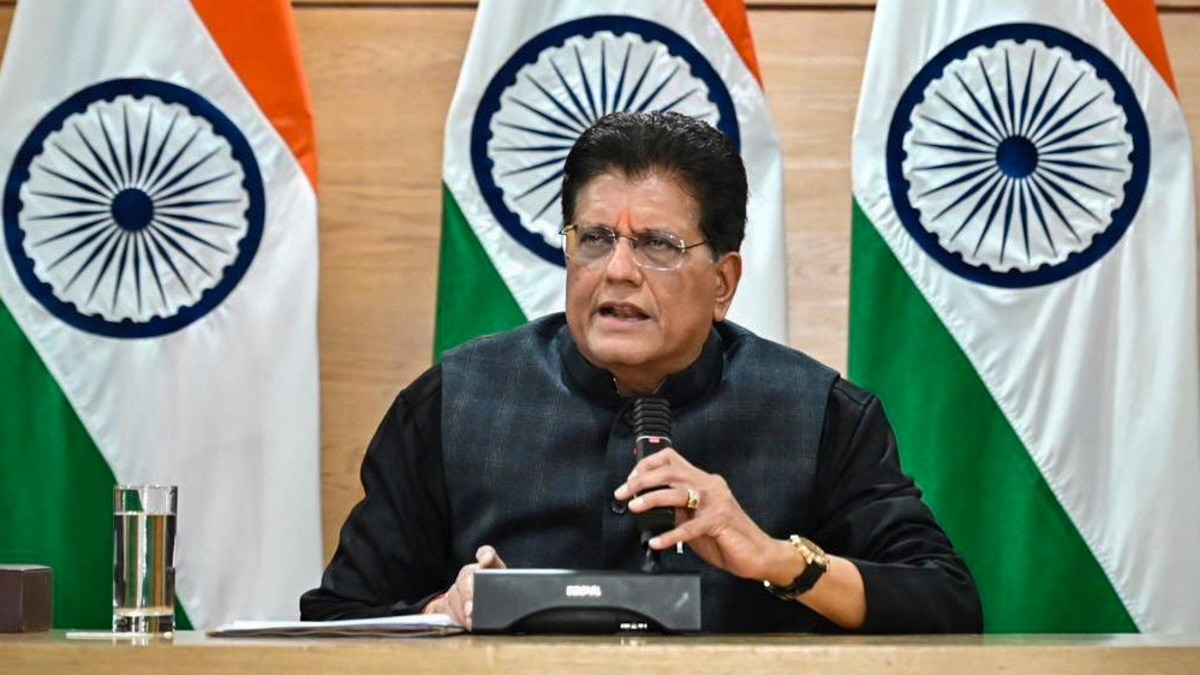
Piyush Goyal has defended India's 7.8% first-quarter growth figure and attacked critics questioning the data. The dispute has sharpened scrutiny of the revised GDP series, deflators and sector-wise measurement changes.Piyush Goyal defends 7.8% GDP growth, says critics ‘distort truth’ to demotivate IndiaUnion Minister Piyush Goyal appeared to take a swipe at economists who have questioned the latest GDP numbers, saying the country’s record 7.8% real economic growth in the first quarter of fiscal 2026-27 reflects the hard work of 140 crore Indians and cannot be dismissed by comparing figures from different GDP series.“Truth cannot be hidden... Ministers do not manufacture this data,” Goyal said, accusing critics of distorting economic figures to demotivate people.His remarks came amid a wider debate over the government’s revised GDP series and a claim that first-quarter growth would have been around 2.6% if last year’s GDP had not been revised down.Goyal also took aim at those questioning the latest numbers, including former finance secretary Subhash Chandra Garg and economist and former Reserve Bank of India Governor Raghuram Rajan, though he did not name either of them in his remarks, saying, “A few jobless people call themselves economists and appear on TV channels to harm the country. Do not fall for this.” He added that Opposition leaders who want to see India as “a dead economy” would fail again and that India would continue to grow rapidly under Prime Minister Narendra Modi.The comments came a day after Goyal had also attacked the criticism of the GDP data, arguing that questioning the figures amounted to insulting the hard work of 1.4 billion Indians. His remarks came amid a debate over the credibility of India's 7.8% GDP growth in the first quarter of fiscal 2026-27. Garg has questioned the basis for the latest growth figure, while Rajan has also raised questions over India's economic growth and the methodology behind the numbers.Goyal accused such critics of creating a negative narrative around the economy and urged people not to be influenced by their arguments.“You tell the world that the achievement of 140 crore Indians is something we are all proud of,” he said.He also attacked Opposition leaders who, he alleged, wanted to portray India as a “dead economy”.“They will fail again. Like they have failed many times before. And under the leadership of Prime Minister Modi, India will progress even more rapidly,” Goyal said.GOVERNMENT REJECTS 2.6% GROWTH CLAIMThe government on Wednesday rejected the argument that first-quarter economic growth was closer to 2.6%, calling the comparison an “apples and oranges” exercise.Saurabh Garg, Secretary in the Ministry of Statistics and Programme Implementation (MoSPI), said the claim was based on comparing figures from different GDP series and using current-price estimates instead of the constant-price measures used to calculate real growth.The argument was made by former finance secretary Subhash Chandra Garg, who said GDP growth would have been about 2.6% in current prices if last year’s GDP had not been revised down from roughly Rs 86 lakh crore to Rs 80 lakh crore.Saurabh Garg said the Rs 86.05 lakh crore Q1 FY2025-26 figure cited by critics belonged to the old GDP series with 2011-12 as the base year.That series was superseded when the government introduced the new 2022-23 base-year series in February 2026.Under the new series, Q1 FY2025-26 current-price GDP was initially estimated at Rs 80.32 lakh crore. It was later revised to Rs 80.44 lakh crore and then to Rs 80 lakh crore after updated data, including the new Index of Industrial Production and Producer Price Index, were incorporated.“It is unfortunate that comparison is being made of apples and oranges,” Garg said, pointing to strong volume growth in sectors such as steel, cement and automobiles.WHY THE GDP FIGURES WERE REVISEDMoSPI said the successive revisions were part of the normal GDP revision cycle and reflected the incorporation of additional information, updated data sources and methodological changes.“The claim that the numbers have been compressed now relates to a number which has been released in February 2026, but which has not been quoted,” Garg said.The ministry said the old Rs 86.05 lakh crore estimate was initially published in August 2025 under the 2011-12 base-year series. After the new 2022-23 series was introduced in February 2026, the corresponding Q1 estimate became Rs 80.32 lakh crore.It was subsequently updated to Rs 80.44 lakh crore when provisional FY2025-26 GDP estimates were released in June, before being revised to Rs 80 lakh crore after the new IIP and PPI series were incorporated.The government said these changes did not amount to an attempt to reduce the previous year’s GDP simply to make the latest growth rate appear stronger.Growth comparisons, it said, have to be made using figures from the same comparable series and at constant prices, which remove the effect of price changes.WHY 7.8% GROWTH IS BEING DEFENDEDIndia’s economy grew 7.8% in real terms in Q1 FY2026-27, according to the revised GDP series.Goyal described the growth figure as something “that no other country has been able to replicate” and attributed it to the “capability, hard work, and joint effort of 140 crore people in the country”.“Due to this, India has emerged as a global trusted partner. PM Modi has led the country with farsightedness,” he said.He also accused Opposition leaders of trying to portray the Indian economy negatively.“A few Opposition leaders who want to see India as ‘a dead economy’ will fail once again, just like they have failed again and again. India will continue to grow rapidly under the leadership of PM Modi,” Goyal said.MANUFACTURING DEFLECTOR SPARKS QUESTIONSMoSPI also addressed questions over a negative implicit GVA deflator for manufacturing, saying it should not be interpreted as evidence that factory-gate prices had fallen.Manufacturing GVA in the June quarter was calculated using a double-deflation method, under which output and intermediate consumption are separately adjusted for price changes before real GVA is derived.When input prices rise faster than output prices, nominal GVA can grow more slowly than real GVA. This can result in a negative implicit deflator even when both output and input prices are rising.Manufacturing real GVA grew 9.2% during the quarter, compared with nominal growth of 7.7%, resulting in an implicit GVA deflator of minus 1.5%, according to the ministry.MoSPI cited textiles and cotton ginning, basic metals, and rubber and plastic products among activities where input-price growth exceeded output-price growth.The ministry also pointed to international experience, saying negative or volatile manufacturing deflators can emerge in economies using double deflation during periods of energy and raw-material price shocks.AGRICULTURE AND GDP PRICE MEASURESAgriculture follows a different process. Quarterly agricultural GVA is first estimated at constant prices using production data, with current-price estimates then derived using the relevant producer-price index.The agriculture, forestry and fishing output PPI rose by around 5% during the quarter, resulting in a positive implied inflation rate of 3.9%, MoSPI said.The ministry also explained why the GDP deflator, which was around 2.5%, does not necessarily move in line with consumer or wholesale inflation.The GDP deflator is derived from the ratio of nominal to real GDP and captures price effects across the wider economy, including investment, government spending, exports and services.By comparison, the Consumer Price Index tracks a defined basket of household consumption, while the Wholesale Price Index largely focuses on goods and excludes services.MoSPI said more than 300 individual price deflators are used at item or group level in GDP compilation. Differences in coverage, weights, price concepts and sectoral movements can therefore create sizeable gaps between the GDP deflator, CPI and WPI.MINING DATA ALSO UNDER SCRUTINYThe ministry also addressed the sharp gap between nominal and real growth in mining.Real mining and quarrying GVA contracted 2.4% in Q1 FY27, broadly in line with weakness recorded in the Index of Industrial Production.Mining IIP declined 3.8% in April and 1.4% in May, before rising 1.6% in June.At the same time, producer prices rose sharply. Mining and quarrying PPI inflation stood at 22% in April, 21.2% in May and 15.5% in June.Prices of crude petroleum and natural gas rose as much as 72.2% in May, while metal-ore prices increased by more than 23% in each of the three months.As a result, nominal mining and quarrying GVA grew 22.3% during the quarter despite the contraction in real GVA.STATISTICAL DISCREPANCY EXPLAINEDMoSPI also cautioned against interpreting the sizeable statistical discrepancy between GDP estimates derived through production and expenditure approaches as proof that GDP has been overstated or understated.The discrepancy is a balancing item reflecting the difference between the two approaches and can change as more comprehensive source data become available.Future revisions could therefore move GDP in either direction depending on changes to the underlying production- and expenditure-side estimates.The ministry said such discrepancies become very small or zero in final current-price estimates, citing FY2022-23 and FY2023-24 as examples.The government’s detailed clarification comes as India transitions to the new 2022-23 base-year GDP series, which incorporates newer data sources, revised methodologies and updated price indices.The changes, including the use of double deflation in manufacturing, have triggered questions over how India’s economic growth, prices and sectoral performance are being measured. The government maintains that the latest 7.8% growth estimate is based on the new comparable series and reflects underlying economic activity rather than changes made to artificially lift the headline number.- EndsPublished By: Sonali VermaPublished On: Sep 2, 2026 19:43 IST
Jobless economists: Piyush Goyal hits out at critics questioning India's 7.8% growth
Full Article
Original Source
Read the full article at Indiatoday →KhanList aggregates and links to publicly available news content. We do not host full articles from third-party sources. Always verify important information with original sources.