
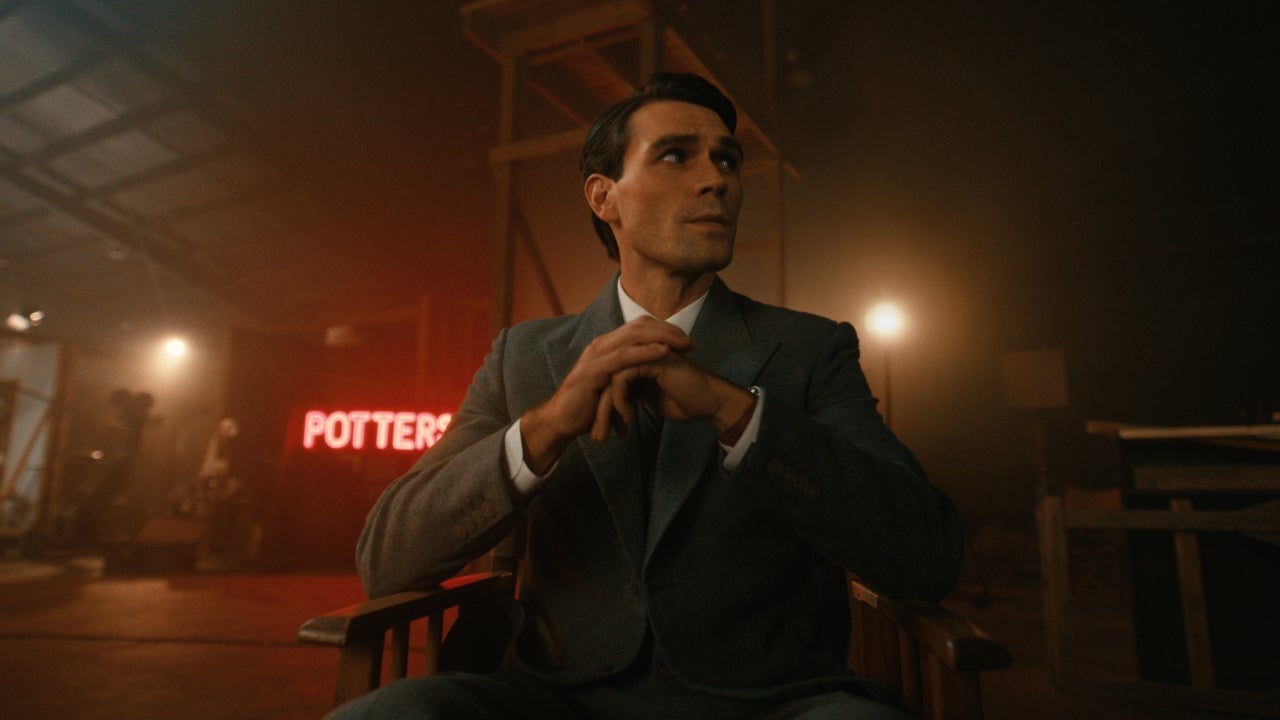
There’s a moment in the James Stewart biopic “Jimmy” that stands out, and probably not in the way the filmmakers’ intended. It’s the scene where the iconic star of “Mr. Smith Goes to Washington” and “It’s a Wonderful Life” breaks down during World War II, torn between his image as an American ideal and his inability to live up to that standard in real life. You’ll know it when you see it. It’s when he declares: “This isn’t a movie, Julia, this is my life!”Sigh. It’s always tough when a movie, especially a movie as fawning and fake as “Jimmy,” demands that you accept its reality by declaring it’s not a film. It’s even worse when the filmmakers double down by having this Julia person ask Stewart “We’re real, aren’t we?” a few moments later. It’s worse because no, she’s not real. Julia is a fictional, composite character representing Stewart’s many girlfriends, which makes her exactly the wrong person to break the fourth wall by declaring there’s no fourth wall. “Jimmy” is a film for two kinds of people: Folks who love James Stewart the way they love the bald eagles and apple pie, and folks who got dragged to see a James Stewart biopic against their will and need everything explained to them. If you’ve seen every James Stewart movie you’ll catch a lot of references, and if you’ve read the biographies you’ll pick up on a lot of familiar details. If you haven’t, you’ll get all those things shoved in your face. The film has the unmistakable air of propaganda, because it can’t just dramatize Stewart’s life, it has to sell us on his greatness. And to be fair, James Stewart was pretty great. He starred in “Harvey” and “Vertigo” and “The Shop Around the Corner” and “The Man Who Shot Liberty Valance.” He gave up his cushy celebrity status and high-paying acting career for years, opting instead to fly bomber runs in WWII. He’s permanently installed in the American cultural firmament, and rightly so, but he was also a person — and films like “Jimmy” aren’t about people. They’re about solidifying a historic legacy. KJ Apa, who plays Stewart, impeccably adopts the actor’s mannerisms and iconic speech patterns, but that’s how Stewart appeared in his movies. KJ Apa plays James Stewart the way James Stewart would play James Stewart, but what we needed was Apa’s unique perspective on Stewart’s life. Everything Apa does and says in “Jimmy” evokes one of Stewart’s familiar performances. The film’s lead actor is a chameleon, nobody can say he didn’t do his homework; but to quote the late Patrick Stewart (or, more accurately, to quote Jean-Luc Picard): “It is possible to commit no mistakes and still lose.” Aaron Burns’ biopic takes place between the night James Stewart won the Academy Award for “Philadelphia Story” through his service in the war, followed by the production of “It’s a Wonderful Life.” The backstage Hollywood shenanigans are the best part, because Burns adds amusing details like Frank Capra (Max Casella) pitching a movie about a magical Christmas suicide intervention while a giant “Liberty Studios” sign is installed behind him. Later in the movie, after “It’s a Wonderful Life” was such a box office dud that it tanked Liberty Studios, Capra and Stewart share their final scene while the sign is torn down. Casella is excellent as Capra, by the way, and in a late, two-minute cameo, Christopher McDonald is superb as actor Lionel Barrymore. They seem to be in a different film than Jason Alexander, who plays MGM studio head Louis B. Mayer like he’s always about to break into a musical number. Stewart’s life takes a turn when he’s drafted and insists on serving, even though Mayer could probably weasel him out of it. “Jimmy” spends most of the rest of the film focusing on Stewart’s Air Force career, transforming the experience into a glossy Golden Age of Hollywood drama with blunt, tearjerking death scenes and unconvincing CGI air battles. There’s a scene where Lady Julia (Kara Killmer), a British aristocrat who woos Stewart between skirmishes, asks him to dress as Father Christmas and cheer up some orphans. A cherubic child actor, who has hopefully already been given the worst material of their career, asks him for new parents for Christmas, and it’s so corny that you half expect the kid to break into a choleric cough and die on the actor’s lap, right then and there. It’s distracting when Stewart returns home after the war and Mayer offers to make a movie about his real-life exploits, only for Stewart to reject it for being in poor taste. That’s what “Jimmy” just did, by transforming the actor’s most difficult years into arch, outsized melodrama. If you ever wondered why nobody made a major motion picture biopic about James Stewart’s life before, sadly, “Jimmy” has the answers: It can’t separate the man from his pictures, and until the final act, it never successfully dramatizes how they intertwined. When “Jimmy” finally gets around to the making of “It’s a Wonderful Life,” it perks up and improves. Justin Strawhand’s screenplay credits the film with healing the actor’s psychological wounds after the war, and it briefly makes a convincing case, but it’s too brief and it can’t save the movie like a last-minute cavalry charge. “Jimmy” is sometimes a halfway decent movie about the Golden Age of Hollywood during and after World War II, but most of the time it’s a subpar, overblown, congratulatory B-movie about World War II. It makes the mistake of deifying a man instead of understanding him. You can mimic James Stewart all you want, but, apparently, you can’t take his heart, his soul or his talent with you. “Jimmy” is in theaters now, from Fathom Entertainment.
‘Jimmy’ Review: A Blunder-ful Biopic About James Stewart’s Wonderful Life
Full Article
Original Source
Read the full article at Thewrap →KhanList aggregates and links to publicly available news content. We do not host full articles from third-party sources. Always verify important information with original sources.