
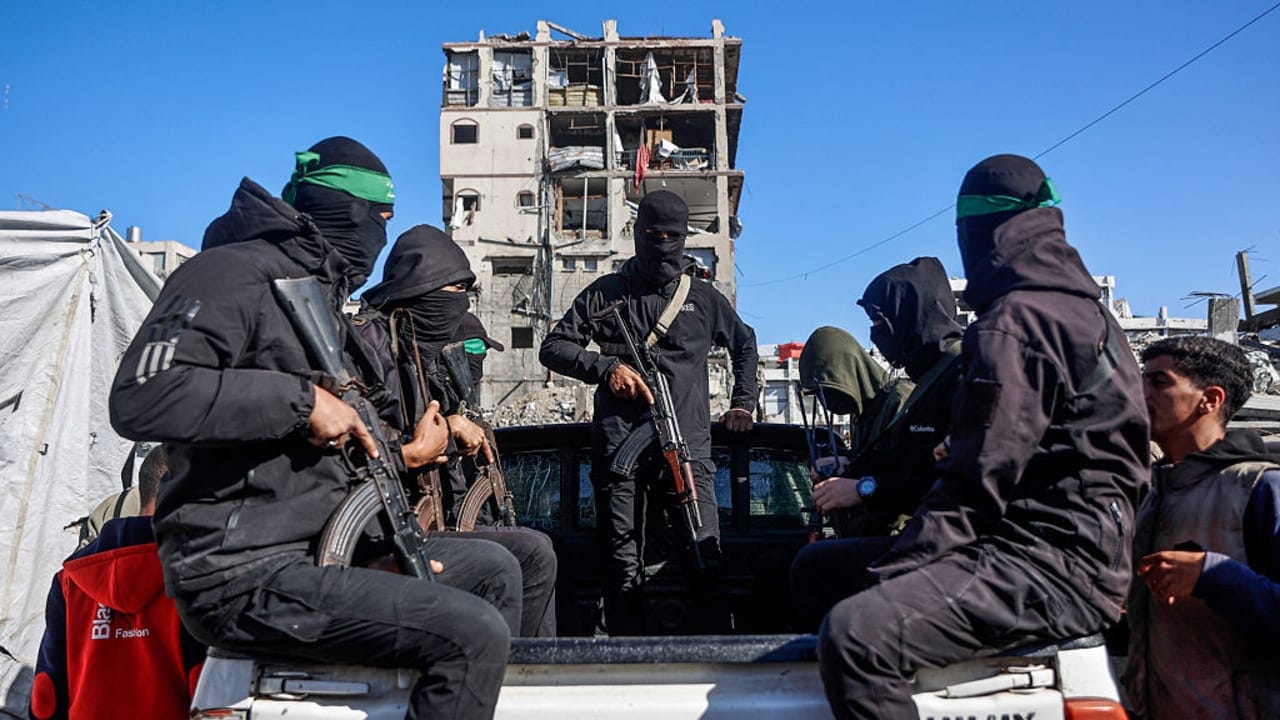
OCTOBER 8, 2026 14:24Hamas’s leadership planned to use strategic deception to lull Israel into a false sense of security before the October 7 attacks, activating double agents as late as the eve of the invasion to feed the Shin Bet (Israel Security Agency) false information, according to a new study by Lt.-Col. (res.) Jonathan Dahoah Halevi published by the Jerusalem Center for Security and Foreign Affairs on Wednesday.A core part of Hamas’s strategy was conceived in early 2022 and sought to create the impression that Israel’s “carrot and stick” policy, which combined threats to assassinate senior Hamas leaders with economic relief for Gaza, was working, according to the research.Through the evening of October 6, Israeli intelligence was fed the impression that there was a state of routine in Gaza, allowing Hamas to conceal its plans while arming and concentrating its forces, according to a senior figure in Hamas’s military wing.According to the terrorist’s testimony, Hamas identified an Israeli espionage network in 2017 and was able to recruit some members of the network to become double agents operating under Hamas’s direction.The IDF investigation into the failures leading up to the massacre noted that, on October 6, indications of a Hamas attack were received alongside reassuring signs, although the investigation did not explain what those reassuring signs were. The Shin Bet investigation reported that “human intelligence sources,” or intelligence agents, confirmed that Hamas was operating routinely.HAMAS TERRORISTS secure the area as Egyptian workers accompanied by members of the Red Cross search for the last two remaining bodies of hostages -an Israeli soldier and a Thai national- from under the rubble of the Jabalia refugee camp, in the northern of Gaza Strip on December 1, 2025. (credit: Omar AL-QATTAA / AFP via Getty Images)Hamas officials have since acknowledged the use of deception as part of the preparations for the attack. In a late 2023 interview with Ammar Taqi, senior Hamas official Khaled Mashal admitted that, ahead of October 7, Hamas carried out strategic and tactical deception, including conveying "reassurance" messages.“Regarding the aspect of strategic deception and the method of deception, as I mentioned, there was a general feeling that [Gaza] [under Hamas leadership] was focusing on its affairs, and wanted to bring in a certain amount of fuel, electricity and aid, meaning [Gaza] was licking its wounds and pains because of the blockade imposed on it, and after the 21 war [Hamas] did not respond to the escalation [in actions] carried out by the occupation in al-Quds and Al-Aqsa,” Mashal said.“For example, as I mentioned, during the previous Ramadan, in this year 2023, on days 13 or 14 in the middle of Ramadan, they [the Israelis] broke into Al-Aqsa, and the public [wondered] where was Gaza? The enemy began to analyze and thought that Gaza was occupied with itself. The holidays came from September 15 to October 6 [2023], and then, behold, the movement's leadership wisely sent deception messages to the enemy once again. We know some of them.”Hamas inspired by Egypt's deception during Yom Kippur WarMashal also admitted that he took inspiration from Egypt’s strategy during the Yom Kippur War, when Egypt attacked Israel on a religious holiday, and shared that Cairo had informed soldiers to go on a religious pilgrimage to Mecca to lull Jerusalem into believing that no war was coming.“A message, in order to fulfill its purpose, must be an indirect message, meaning messages that will not be understood [by the enemy] to be deception messages, which the enemy will swallow. The enemy also uses deception against others, and the resistance succeeded in deceiving the enemy, and it picked up false messages,” Mashal said at the time. “After that, there was concealment, meaning avoiding exposing the preparations. Of course, the tunnels...”The JCFA study noted that Hamas-affiliated political commentator Issam Shawar said that Hamas had been taken by surprise by a similar strategy a few months earlier when Israel began Operation Shield and Arrow against Palestinian Islamic Jihad in May 2023. According to Shawar, one day before the launch of the operation, Israel carried out a deception operation by informing Hamas that it would allow the transfer of the financial grant from Qatar to pay the salaries of public-sector employees.The use of deception by Hamas was also noted by Palestinian journalists immediately after the October 7 attack. On October 8, 2023, JCFA noted that Palestinian journalists had commented on Hamas’s use of deception tactics.Fadi Ramadan noted that Hamas had carried out two separate deception operations. The first created a false impression in Israel that the planned attack would come through tunnels into Israel, while in practice Hamas launched a ground invasion. The second involved conveying to Israel that the “carrot and stick” policy had been effective.JCFA also suggested that former Palestinian Authority minister for prisoner affairs Sufian Abu Zaida had been deceived by Hamas’s plans.Explaining that the terror group had a channel of contact with Israel through Zaida, JCFA said that the former PA official was enlisted to negotiate a deal with Israel to release prisoners for the bodies of Israelis already held in Hamas captivity before October 7.Zaida had reportedly met with Ghazi Hamad in Gaza, who confirmed that now-assassinated Hamas leader Yahya Sinwar had authorized the deal. After returning to Israel, Zaida contacted a retired Shin Bet officer, who arranged a meeting between him and active Shin Bet personnel in Ashkelon. In July 2022, Zaida met with Sinwar in Gaza, in the presence of Rawhi Mushtaha, where Sinwar presented his priorities regarding a possible agreement with Israel concerning the release of prisoners.Sinwar-Zaida meeting led to increased Israeli interest in deal with HamasAccording to Duhoch-Halevi’s assessment, the meeting between Sinwar and Zaida strengthened Israel’s interest in a deal, and former Shin Bet chief Ronen Bar personally met with Zaida to hear the conditions Hamas set for a possible deal.Zaida claimed Bar asked him to convey a message to Sinwar that Israel would be willing to advance far-reaching economic measures in Gaza.The negotiations between the sides advanced to the stage of deliberations over the names of the prisoners to be released as part of the deal, and drafts were exchanged between the sides.Two days after the major annual military exercise conducted by Hamas, on September 14, 2023, Zaida met with Sinwar again in the presence of Mushtaha, where Sinwar dictated a message to Zaida for the Israeli side, according to which "by the end of September we will put cards on the table that will cause an earthquake regarding the negotiations, and they should prepare to empty the prisons."Zaida was asked to convey this message verbatim to the Shin Bet representatives who were in contact with him, and another meeting with Sinwar was scheduled for October 8. Abu Zaida traveled to Israel, conveyed the message to Shin Bet personnel, and returned to Gaza on October 5 ahead of another planned meeting with Sinwar.“It appears that Abu Zaida was a component of the deception plan operated by the Hamas leadership in an attempt to convince Israel that it was serious in its intentions to reach an agreement for the exchange of Palestinian prisoners for Israelis (living and dead) held in Gaza, as a move that would lead to the regulation of relations between Israel and the Hamas government on the basis of economic relief on Israel's part and infrastructure development in the Gaza Strip,” Duhoch-Halevi said, adding it was “reasonable” to think Sinwar’s scheduled meeting with Zaida on October 8 “served as a smokescreen for the secret continuation of military preparations.”Follow us on Google
JFCA study reveals how Hamas hid its October 7 invasion plans from Israeli intelligence
Full Article
Original Source
Read the full article at Jpost →KhanList aggregates and links to publicly available news content. We do not host full articles from third-party sources. Always verify important information with original sources.