
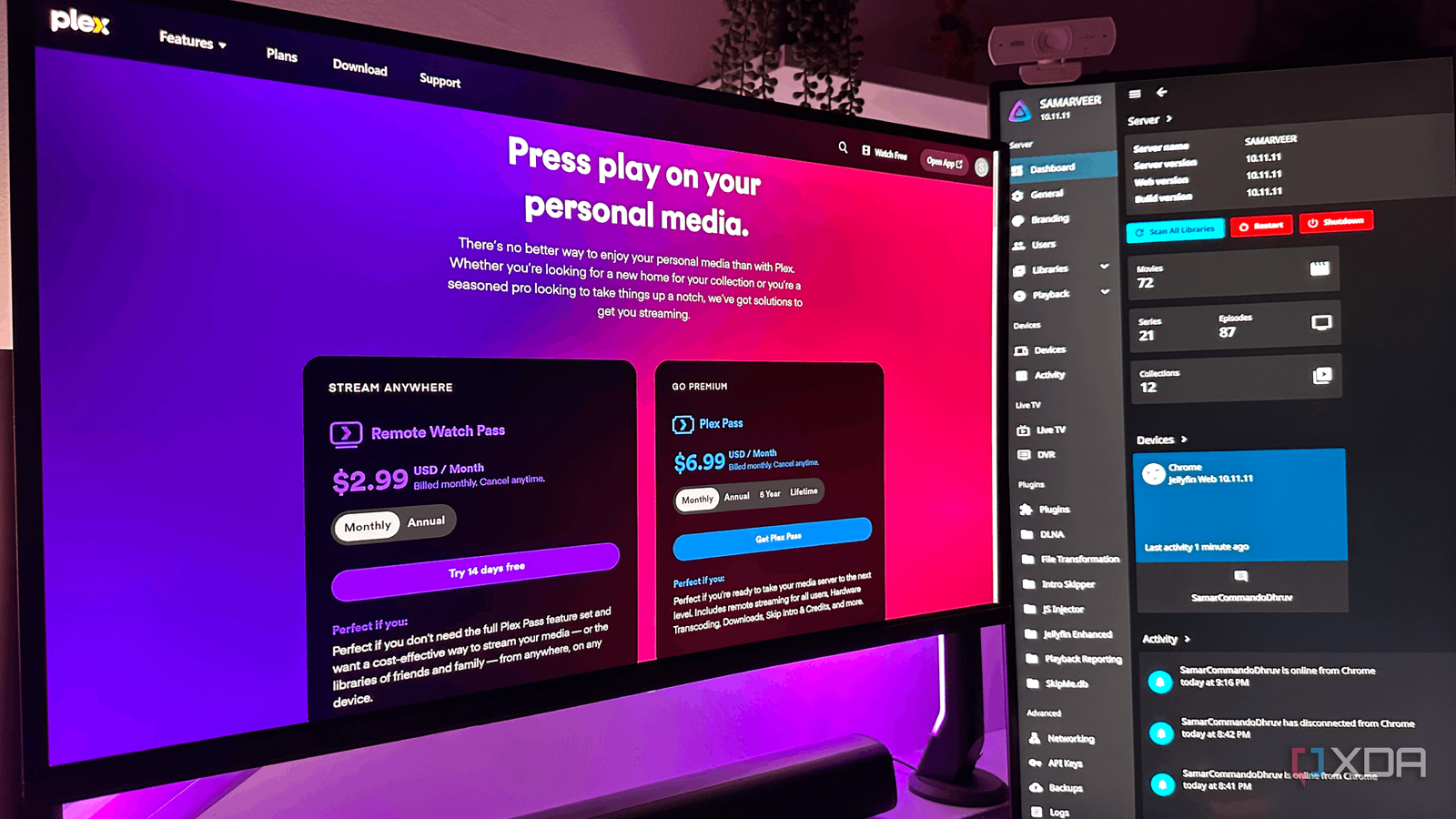
Published Sep 29, 2026, 3:01 PM EDT Gaming has been Samarveer’s greatest passion, and the Literature graduate in him takes immense joy in dissecting games for their themes, messages, and impact. Samarveer holds a deep appreciation of gaming, and considers the platform to be the most immersive and impactful across all media. He can be found engaging with gaming communities online, always ready to debate the finer points of ray tracing or itching to write an 8-page collegiate thesis on any game that impacts him emotionally. When it comes to self-hosting your own media, Plex is undoubtedly the household name, and rightly so. It may be a paid commercial service, but it's also the easiest to operate, and the one with the least friction involved. On the other hand, its open-source alternative, Jellyfin, remains the "power-user choice." Jellyfin has undeniably improved over the years, and tremendously so, and I'd daresay it's ready for prime time. And yet, the elephant in the room remains — you still have to set it all up yourself, which, when it comes to FOSS (Free and Open Source Software) is par for the course. Sadly, it's also why millions still swear by Plex, and continue spending money to stream their own media files across their own networks. Jellyfin has every feature you need But you still need to set them all up yourself Just because Plex asks for $6.99 a month for the Plex Pass doesn't mean that it automatically has the better feature set than Jellyfin. In fact, with the right collection of plugins, a Jellyfin media server can become much more robust than a vanilla Plex server. Effectively speaking, there is no feature in the paid Plex Pass that Jellyfin doesn't offer for free. There is, of course, a catch, though. From finding and installing the right plugin to setting up port forwarding or familiarizing yourself with Tailscale to share your media server with your friends, Jellyfin demands that you learn and set it up all by yourself. If you need hardware transcoding on your server, you have to enable it yourself, much like HDR-to-SDR tone mapping and other crucial features that make or break any media server. Plex Pass costs $6.99 per month, $69.99 per year, or $749.99 for lifetime access. The plugins, of course, are where much of the initial friction comes from. You can't simply throw $7 at the screen and get metadata, playback history, auto-subtitles, intro skipping, trailers, or custom themes. Instead, you have to find the right plugin for yourself and add it to your server manually. Admitted, all of the "work" involved in setting up a Jellyfin server comes rather easily for the initiated, but for those new to self-hosting, Jellyfin can be surprisingly intimidating during their first week. Jellyfin's biggest strength is also its weakness Friction remains the biggest deal-breaker in 2026 Anyone who is put off by Jellyfin's initially barebones structure would naturally complain about the complexity involved. Ironically, that complexity only exists because Jellyfin refuses to make your choices for you. Where Plex hides the "boring" administrative stuff behind a polished interface, Jellyfin willingly exposes it for you to choose your metadata providers, subtitle sources, transcoding behavior, remote-access method, library structure, and practically everything else. Once you do know what you're doing, it's exactly this freedom that feels fantastic. Hardware transcoding becomes a feature you can use from your own GPU. You can even choose not to expose your server to the internet and instead use Tailscale. Even if you want to completely redesign the interface, there's probably a plug for exactly what you're looking for. Plex makes you a customer first and an administrator second, while Jellyfin hands you the keys to the kingdom from the get-go. It's exactly these features that appear as too many knobs for newcomers. Understanding Direct Play versus transcoding, figuring out why HDR content suddenly looks washed out, or realizing that your server needs hardware acceleration enabled before it stops hammering the CPU can turn what should be a media server into a surprisingly educational weekend project. That, ladies and gentlemen, is the Jellyfin trade-off. Plex makes you a customer first, and an administrator second, if that. Conversely, Jellyfin makes you the administrator from the moment you download it and open up the dashboard. Once it's all configured, there's nothing quite like the control you get with Jellyfin. Getting there, however, requires some earning. Plex becomes incredibly hard to justify once Jellyfin is up and running The hard part is learning the ins and outs of your own server With a Jellyfin server, once the libraries are configured, metadata is sorted, transcoding is working, and remote access is taken care of, the server largely disappears into the background. Mine has reached the point where I rarely think about it at all. Oh, and it doesn't sip $6.99 every month from my bank account. Plex still has an advantage when other people are involved, though. I can hand a Plex account to someone who has never heard the words "Direct Play" or "hardware transcoding," and they can generally figure it out themselves. Jellyfin can offer a similarly polished experience, but getting someone there may require a small amount of tech support. And that, more than any missing feature, is why Plex remains so difficult to displace. Jellyfin can become an exceptional media platform once you've built it properly, but Plex's greatest trick is making the person using your server completely unaware that there is a server behind it. Jellyfin iOS compatible Yes Android compatible Yes Desktop compatible Yes Jellyfin is one of the best Plex alternatives you can get, and that's thanks to its open-source nature and powerful set of features. There are apps for basically every platform and it's completely free to run your very own server. The friction is becoming harder to justify I don't think Jellyfin needs to become Plex to win people over. That would actually undermine much of what makes it appealing in the first place. What it needs is to make the first few hours less intimidating, especially for someone who has never touched a self-hosted application before. Every time I use Jellyfin right now, the gap between a "power-user project" and a genuinely mainstream media server gets smaller. I do completely understand why someone would pay for Plex, but Jellyfin increasingly feels less like an alternative for enthusiasts, and more like a polished and sensible choice that simply asks a little more elbow grease upfront.
Jellyfin's setup complexity is why Plex still charges $7 a month and gets away with it
Full Article
Original Source
Read the full article at Xda-developers →KhanList aggregates and links to publicly available news content. We do not host full articles from third-party sources. Always verify important information with original sources.