
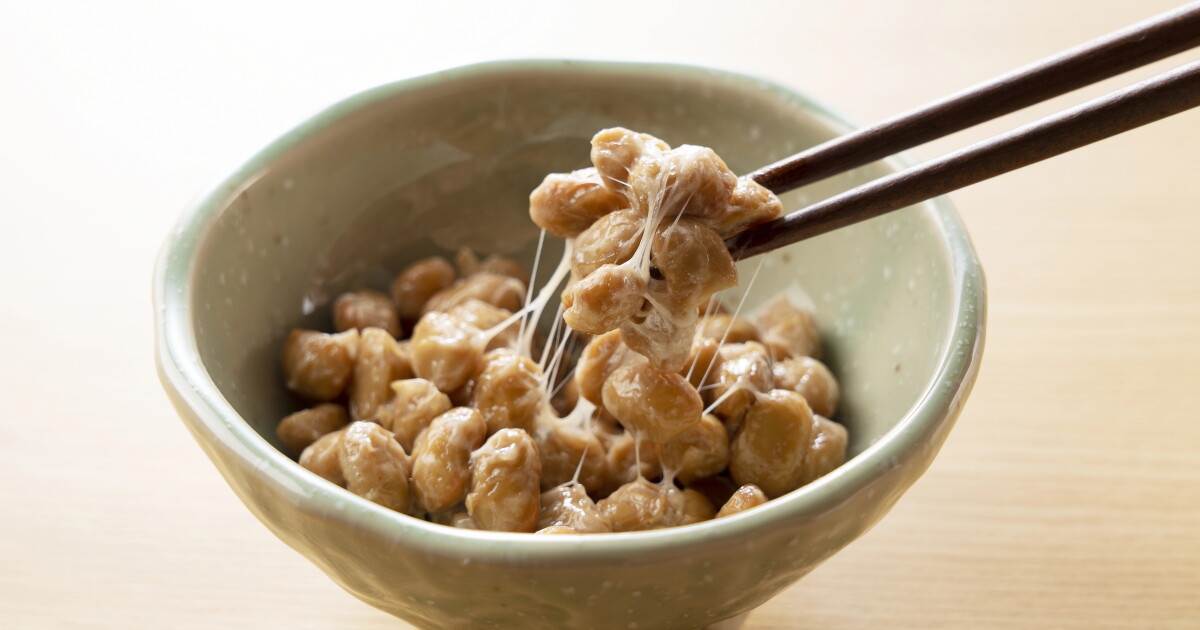
There are some things where you'll always remember your first time – and eating natto is one of them. However, this ancient Japanese fermented bean dish is reaching celebrity status as a health food, and there are decades of science behind it. From heart health, disease prevention and bone strengthening properties, natto is going global for good reason. (And it's definitely not for its taste.)According to Japan’s Ministry of Finance, natto exports reached 5,248 tons in 2025, nearly tripling from 2017. China and the US are the major buyers. I've only had natto once – by accident – and not even in Japan but at a sushi train outlet in Sydney, Australia. I chose a plate of inari sushi topped with what I thought were cooked chickpeas, as it passed by on the conveyer belt. And let's just say I wish I hadn't. Even as someone who loves fermented foods – "stinky tofu" is my favorite dish in Taiwan – these slimy, smelly beans were a shock to the senses.So what is natto? It’s made via a specific fermentation process using cooked soybeans with Bacillus subtilis var. natto, producing beans with a very distinctive pungent smell and sticky, stringy texture. "Sticky, stringy" is putting it nicely; it's more mucous-like, really.But don't let that put you off. While you can eat it as is, natto also works as a topping, or something to mix in with other ingredients. It's versatile and easy to "hide" if the texture and smell is a bit too much. Natto offers a big dose of plant protein, fiber and minerals, and is an unusually concentrated source of vitamin K2, particularly menaquinone-7 (MK-7). And just a 50-g serve is low in calories but packs 8.3 g of protein and 4.8 g of fiber. It also delivers a decent hit of magnesium (50 mg) and potassium (330 mg).Vitamin K is not often in the spotlight, but it plays a beneficial role in aiding blood clotting and K2, specifically, aids bone metabolism. A 2020 study specifically looked at its role in reducing the risk of fractures in post-menopausal women in Japan, and that's just one paper that's investigating how natto can boost bone health.It's also been studied for its cardiovascular and hypertension benefits, with encouraging results. In the famous Takayama study, published in the American Journal of Clinical Nutrition in 2017, which featured nearly 30,000 participants, scientists found that those who ate the most natto had a significantly reduced risk of dying from cardiovascular disease than those with the lowest intake. This was after the data had been adjusted for other factors that could influence the results.In a 2020 BMJ study of 92,915 adults, researchers found that those who regularly consumed natto had an average of 10–11% lower all-cause mortality (though this also included other fermented soy products). Natto itself was linked to lower cardiovascular deaths, once again, though.While we're yet to understand the specific mechanistic pathways, it appears that natto's key enzyme nattokinase has a positive effect on blood pressure, with even short studies showing its impact."This study further supports that nattokinase can be used as an effective adjunctive therapy for hypertension, but relatively low-dose supplementation of nattokinase may have no significant lipid-lowering effect," scientists wrote in the 2023 paper. "More work will need to be done to determine whether the positive efficacy of nattokinase on cardiovascular risk factors is dose-dependent."Then there's its impact on gut health – which fermented foods all seem to have a positive impact on. However, our studies on these remain a work in progress.In a smaller study of 44 women, participants ate either 40 g of natto or boiled soybeans daily for two weeks each. Natto increased fecal Bacillus levels, but it didn’t alter bowel behavior. So the research proved that there was some microbiome benefit, but downstream impacts were unclear.These were observational studies, of course. And some of the earliest ones looking into natto as an emerging health food.Earlier this year, scientists made a breakthrough in understanding natto's unique fermentation process on a molecular level, which may not mean a lot to most of us but offers up important information as to how this food then interacts with human biology."This is the first study to reveal that microbial fermentation significantly transforms the supersulfide profile in plants," the researchers wrote. "Moreover, the diverse supersulfides abundantly present in natto may contribute to its health-promoting properties."Supersulfide molecules are metabolites produced by plants and play a key role in cellular metabolism. As such, there's growing interest in their potential to boost human health and disease prevention.And we're now getting more longitudinal studies about natto and longevity. In 2025, the results of a 15-year study of 1,548 elderly men in Japan found that those with regular, consistent natto intake had a significantly lower risk – 40% – of "all-cause mortality" compared with those who never ate the fermented beans. (There were limitations, of course, such as self-reporting and it again being observational.)In addition to this, more comprehensive work looking into how natto appears to improve bone health has made this avenue of research particularly interesting. A late 2025 meta-analysis found that six studies looking at natto and osteoporosis returned similar positive results for those who habitually ate natto. "Natto, a traditional Japanese fermented soybean food, is the richest natural source of menaquinone-7 (MK-7), a form of vitamin K2 involved in osteocalcin activation and bone mineralization," wrote the team. "This study aimed to systematically evaluate the effects of habitual natto consumption on serum MK-7 concentrations, osteocalcin carboxylation status, and bone mineral density (BMD) in Japanese populations."The scientists concluded that "habitual natto consumption is associated with improved vitamin K status and bone metabolism markers," yet the evidence has remained largely based on observational work.So while this just touches the surface of natto, expect to hear much more about it – particularly its potential role in supporting our health as we age.
Japan's 1,000-year-old superfood has growing ties to longevity
Full Article
Original Source
Read the full article at Newatlas →KhanList aggregates and links to publicly available news content. We do not host full articles from third-party sources. Always verify important information with original sources.