
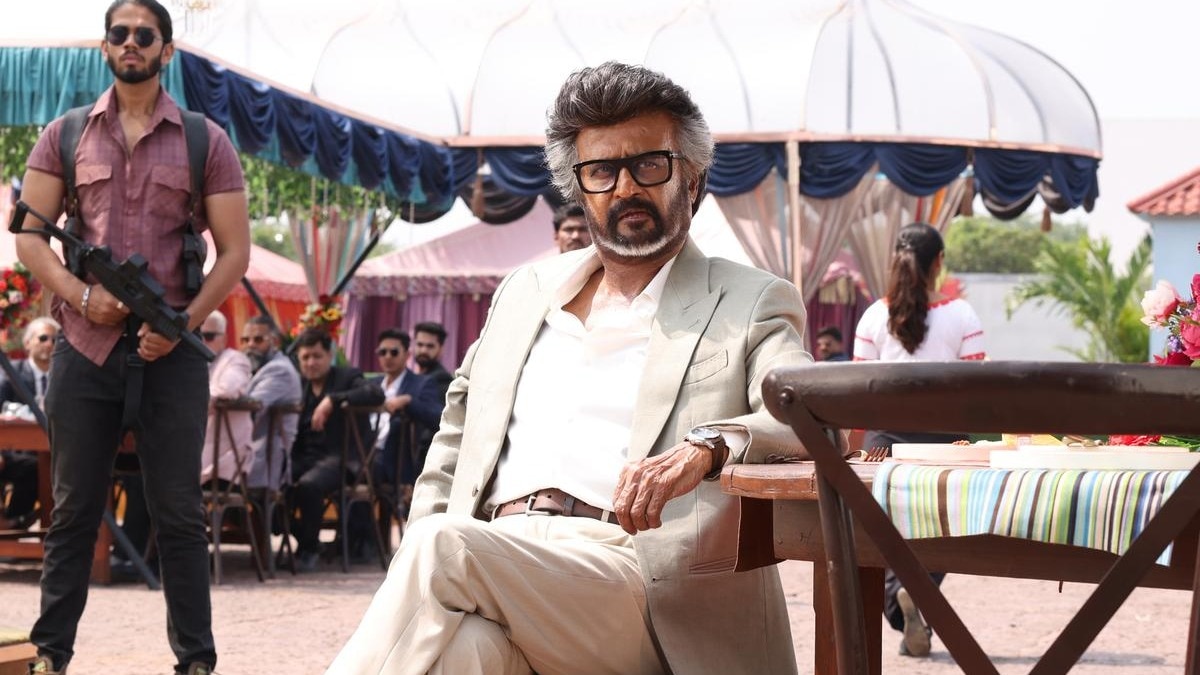
It was 9.25 am in Noida, and I was rushing through the gates of a popular mall, hoping to make it in time for the title card of Jailer 2. With a Rajinikanth film, the title card is half the experience.I am 33, but a Rajinikanth release has a way of making age irrelevant. At the entrance, I noticed a family ahead of me: a middle-aged man, his wife and their daughter, who had a young child with her. They were carrying a bottle of milk and a packet of biscuits, and the security guards stopped them. Outside food and drink were not allowed.My first instinct was to worry about the delay. Surely there would be an argument, perhaps a scene. The clock was ticking, and the title card was due any moment. But nobody protested. They simply decided to collect their belongings on the way out.“Title card potraporan. Ulla poiruvom,” the woman said. What if they played the title card? Let’s go in. Rajinikanth turns 76 in December, and a family will give up its milk and biscuits at the gate rather than miss his name on a screen. Half a century of stardom has turned him into something closer to a myth than an actor, and a myth doesn’t have to do very much. Nelson Dilipkumar has worked this out. The result is an action film in which the superstar throws almost no punches and still brings the house down. It may also be a blueprint for how directors can keep making action films around an ageing Rajinikanth for years to come.I have felt this before. When I was younger, Deepavali at home brought that fizz of celebration. These days, only a Rajinikanth FDFS (First Day First Show) does. He was a star when colour television first entered our homes. He was a star when DTS transformed theatres and when 3D arrived. He remains one in the age of IMAX and artificial intelligence. Everything about how we watch films has changed. The butterflies on the eve of a release have not. Okay, back to Jailer 2.MOORTHY SIR AND THE MISSILESAfter killing Varman at the end of Jailer, Tiger Muthuvel Pandian, now going by Muthu, is lying low, working at a supermarket and quietly hunting the idol-smuggling network Varman had spoken about. The trail leads to Moorthy, a councillor with a fruit shop and an inflated sense of himself. Muthu becomes his driver.On a bridge, Muthu tells a group of idol-smuggling middlemen that Moorthy wants them out of town by nightfall. Moorthy is a paper tiger, a small-time bully, and none of the men has ever heard of him. The absurdity is a brilliant comic set-up: a man issuing threats on behalf of someone nobody knows, addressing him as “Moorthy sir” with a perfectly straight face. The middlemen laugh him off and move in, sickles in hand.Enter the snipers. The trademark Jailer snipers. In a flash, the men are down, and it turns out Moorthy is not to be taken lightly after all. Muthu calmly tells them that Moorthy sir wants to meet them immediately. But first, they must move their cars out of the way so that his car can get past the bridge. The men have the keys, but their cars are parked on the other side of the bridge. How are they supposed to get them out of the way?He removes his spectacles and holds them towards the camera. If you have watched Jailer, you know what comes next, except the snipers now seem to have upgraded to missiles. The cars explode.Muthu hasn’t thrown a punch or raised his voice. And the theatre erupts as Anirudh’s Hukum kicks in, Tiger turns, walks in slow motion and gets back into his car.The entire first half runs on this idea. Rajinikanth is content to be a driver, washing cars and buying tea for Moorthy sir and his sidekicks, including Kohli, a cleverly written doubter who distrusts Muthu from day one. Nelson never has anyone spell out how great the hero is. He lets the audience wait for the local don to discover who his driver really is. The pay-off comes in a tea shop, to Anirudh’s One Sun, One Moon, and no, I am not going to spoil it. It is beautifully staged, and again it is minimal. There is no hundred-henchmen beating. You will know it when you see it.In the pre-interval stretch, all Rajinikanth has to do is stand and deliver his lines with swagger while a villain stands in fear. His boots fill the frame, and Anirudh serves up yet another variation of Hukum.The second half has a terrific callback to Baasha, a lavish lunch for hungry Thalaivar worshippers. It plays like an edited reel from one of the finest mass masala films for a new generation, a glimpse of what it must have felt like to watch Maanik Baasha walk through Mumbai all those years ago.That is all. That is enough to get a hall full of people, young and old, hooting and screaming their lungs out.HOW A MAN BECOMES A MYTHWhy does so little work so well? Because Rajinikanth spent fifty years earning it.He wasn’t always in this position. He entered Tamil cinema in the 1970s as an outsider who didn’t fit the hero mould, debuting in a supporting role in K Balachander’s Apoorva Raagangal in 1975. He had to make himself impossible to ignore.Kamal Haasan, with whom he shared the screen in several early films, was already an established lead whose craft lived in the nuance of a character. Rajinikanth, in his early supporting and negative roles, had no such room to be subtle. He had a few minutes to be remembered, so he made them impossible to look away from: the swagger, the speed, the unpredictability.In Bharathiraja’s Pathinaaru Vayathinile, he played Parattai, the unforgettable villain who would pull off a line or a mannerism and then turn to his friend and ask, “Idhu eppidi irukku?” How was that? It was a cheeky, almost self-conscious check that the performance had registered. Parattai wanted to be noticed. The actor playing him was working out how.The answer was in the details: a cigarette trick, a flick of the wrist, a tilt of the head, the flip of the sunglasses before they go on, a particular way of delivering a line. He turned mannerisms into signatures, and signatures into a language audiences could read before he spoke. Even in the much-talked-about cameo in Jailer 2, a single sunglasses flip speaks a vocabulary he spent decades making his own.Which is why a silhouette is now enough. At 75, he doesn’t even need to walk to get whistles. There is a shot of him standing at the end of a runway, and the theatre erupts. Anirudh builds the anticipation, Nelson holds the frame, and Rajinikanth simply stands there. From Parattai begging to be noticed to a man who only has to be an outline. Nobody in that hall needs the performance explained. They have been reading him for decades.WHEN THE BODY STARTED ASKING QUESTIONSRajinikanth and his fans love action, and he has kept taking on action-heavy roles with conviction. Some worked remarkably well. Others sat awkwardly with his age. In Pa Ranjith’s Kaala, I loved almost everything about him except the much-celebrated rain-soaked fight on a Mumbai flyover. When he punches a succession of henchmen, you can’t help feeling a little awkward. The punches lack the force they once carried, and he cannot move as swiftly as he did. The railway station fight in Darbar, set to Anirudh’s groovy Kannula Thimiru, has the same believability problem. This is not a criticism of his stardom. It is what time does to action cinema. You cannot expect Sachin Tendulkar to smash Shoaib Akhtar over point at 60. But you would still buy a ticket to watch him take guard. The body can’t always match the mythology, and the smart filmmaker’s job is to stop asking it to.NELSON’S TRICKNelson saw that in Jailer and sharpens it in Jailer 2. Tiger doesn’t have to overpower every man in his way. He can command a room without throwing a punch, make a threat credible without raising his voice, and remove his spectacles to let the snipers do the rest. What the body can no longer do, the film does for him. The score, the framing, the silhouettes and the wait all become part of the performance.And the myth is secure enough to share. Namo Narayana, an actor many viewers wouldn’t associate with a turn like this, gets room to make Moorthy sir pompous, ridiculous and gloriously unaware of his limits, while Rajinikanth happily plays the straight man. It is the same confidence that lets Ramya Krishnan’s Neelambari in Padayappa push back and steal scenes. A star who doesn’t need to win every scene can afford a formidable co-star. There is a difference between sharing the screen and surrendering it. He has done the former all his career, and now he does it with enough ease to hand scenes over, knowing nobody will forget who the real power is.A BLUEPRINTThis is what makes Jailer 2 more than a good Rajinikanth film. Nelson has shown how to build an action film around a 75-year-old superstar without making the 75-year-old do the work. The ingredients are simple: let the persona carry the weight, build set-ups and pay-offs instead of fights, give villains and sidekicks real scenes, and save the whistles for the stillness.But it is not foolproof. The template only works for a director who understands what Nelson does: that “doing less” is not a licence for lazy staging. The silhouette works because the set-up earned it. A film that borrows the silhouette without the set-up will get a cheer and then a shrug.Which brings me back to that family at the gate. They were willing to leave their milk and biscuits behind rather than miss the title card. Nobody walks into a Rajinikanth film asking to be shown what he can do. They walk in already knowing. What they are paying for is the moment the film confirms it.At 75, Rajinikanth doesn’t need to throw a punch. He removes his spectacles. Anirudh takes over. And the roof nearly comes off.- Ends
Jailer 2: How to unleash Rajini without making him throw a punch
Full Article
Original Source
Read the full article at Indiatoday →KhanList aggregates and links to publicly available news content. We do not host full articles from third-party sources. Always verify important information with original sources.