
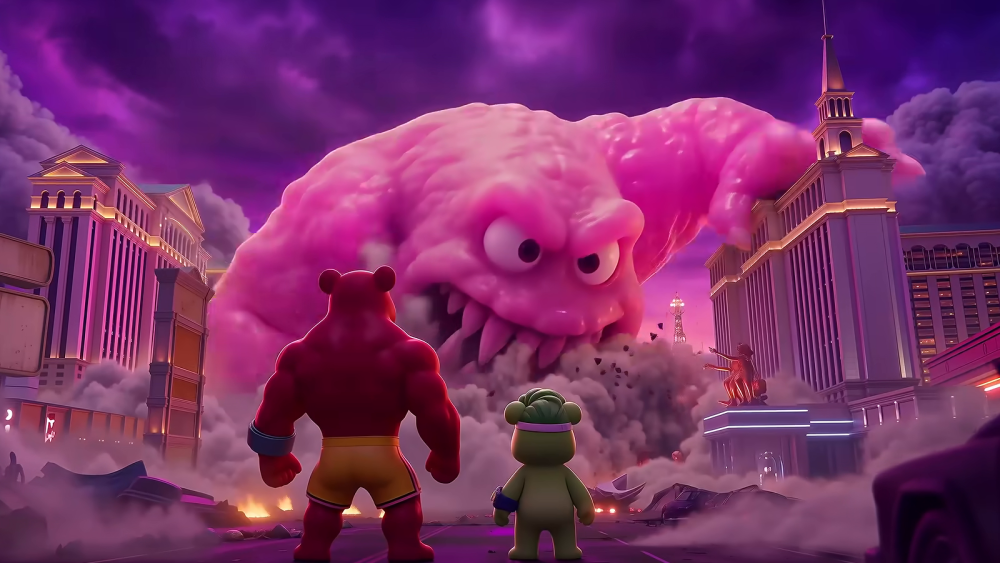
A theater and film studies’ graduate, it was eventually Kaan Haylaz’s lifelong love for gummies that led him to commercial success, and the birth of the ‘IvyBears‘ vitamins brand and IP. “IvyBears was never simply a consumer brand that suddenly decided to venture into entertainment,” he told Variety in an online interview in the wake of MIPJunior. “In many ways, the story actually began the other way around, and it was my son, Pars, who ultimately brought these two worlds together.” What started as a father’s personal mission to help his son, who was struggling with food, gradually evolved into an international consumer brand, now turned entertainment IP in what Haylaz coined as his “reverse flywheel strategy.” Popular on Variety Kaan Haylaz, creator of ‘IvyBears.’ Credits Moontrail Animation Studios, IvyBears “I’ve always been fascinated by the way animation creates characters that become part of our lives,” recalled Haylaz. “In my early childhood, I was a big fan of ‘Transformers’ and ‘He-Man, the Masters of the Universe’. Later, in the late ’80s and early ’90s, it was mainly the ‘Ninja Turtles’… until Pixar launched ‘Toy Story’ and animation changed permanently from hand-drawn 2D cels to fully digital 3D imagery.” Yet in all these success stories, Haylaz underlined that traditional entertainment companies typically create characters, build an audience and subsequently commercialize that audience through consumer products and merchandise. “We deliberately reversed that model. Not because entertainment was an afterthought, but because life gave me a deeply personal reason to start with the products.” From the start, turning his gummies into super-powered heroes, and mirroring these characters on both labels and animated narratives was in fact at the foundation of Haylaz’s strategy. “Imagine a child watching the IvyBears on television, developing an emotional connection with those characters, and then recognizing the same heroes on a product in a supermarket or pharmacy. The entertainment and the consumer product are no longer two separate businesses. They become parts of the same universe.” For the CEO and founder of Malta-based Moontrail Animation Studios, taking this reverse approach means IvyBears can already benefit from an established international retail infrastructure through which our characters can reach consumers, as Moontrail and IvyBears characters continue to develop into a multi-IP animation studio. From brand to content, quality as a compass Which still meant for Haylaz crafting quality content, based on impactful characters kids could relate to. “I believe children are much more sophisticated viewers than adults sometimes give them credit for,” he added. “A colorful character alone doesn’t create an emotional connection. When you create a character, you look for very unique traits that people can still relate to, while making sure the characters complement each other. When I thought of the IvyBears, the one thing I definitely wanted to avoid was another set of “cute or fluffy” characters that were too predictable. I see IvyBears as the ‘A-Team’ meets ‘Angry Birds’. A group of very distinctive characters with unique traits: they stand for good, but love to punish the bad guys, hence their not-really-cute but super-confident attitude.” To bring his characters to life, Haylaz relied on AI tools, guided by human talents, in an approach he discussed openly. “I believe the discussion (around AI) is both legitimate and necessary. AI is not the filmmaker. AI is a tool in the filmmaker’s hands. At Moontrail, creative direction, storytelling, emotional decisions and artistic judgment remain purely human responsibilities. We are not trying to eliminate artists from the filmmaking process. We are trying to eliminate many of the financial but also technical barriers that have historically prevented independent creators from bringing ambitious ideas to life.” As he framed it, this approach allowed Moontrail to greatly increase production speed and reduce costs, producing 12-minute animated epsiodes in approximately two weeks. “We have built a relatively lean studio of around 20-plus full-time people that combines traditional film-making expertise with modern AI-supported production workflows. Most of our crew have a storytelling or film background, like myself. What historically could require millions in upfront financing before an audience even had the opportunity to discover it can now be developed, produced, published and tested much more independently.” AI as an empowering, imperfect tool For Haylaz, the biggest revolution isn’t that AI makes animation faster. It’s that AI makes independent filmmaking economically achievable on an entirely different scale. “And that changes who gets to tell stories.” Creating with generative AI is, per Haylaz, far more complex than typing a few prompts. “In fact, nothing could be further from the truth. Maintaining consistent characters, environments, lighting, visual identity and emotional performances across an entire episode is a substantial technical and artistic challenge. Because a character might look fantastic in one shot but lose subtle aspects of their identity or expression in another, maintaining cinematic continuity demands considerable supervision, iteration and attention to detail.” And while AI can accelerate individual production tasks, it doesn’t automatically understand storytelling, timing or emotional pacing, Haylaz went on. Which also added to the broader challenge of navigating a technological environment that evolves almost weekly, alongside important questions about intellectual property and creative rights. “For us, the greatest challenge isn’t generating beautiful images. It’s turning those images into a coherent, emotionally engaging film, a story that works and that ultimately starts with the right script.” Scripts and characters Haylaz is very keen on protecting, as he envisions building long-term intellectual properties rather than producing disposable content. “Our characters, their personalities, their stories and their visual identities represent the fundamental assets of Moontrail Animation Studios. We therefore distinguish between the technologies used to produce content, and the ownership and control of the underlying intellectual property. Commercial licensing, confidentiality, the protection of original production materials and the terms governing third-party AI tools are all important considerations in our approach. Ultimately, our ambition is to build characters with lasting value, and protecting their originality is essential to that ambition.” Expanding the IP, caring for the audience Launched earlier this year, the IvyBears YouTube channel already boasts more than 7.7M subscribers, with more than 75 million views across all platforms. A digital-first hit, that Moontrail is currently expanding into other character-based series (“The Dr Muppy Show,” “Banana Rainbow”). Haylaz revealed to Variety that an IvyBears animated feature was also in development, with production expected to start before the end of the year. “In essence, we are leveraging ‘IvyBears’ established global popularity to accelerate the growth of our entertainment franchise. Our mid-term ambition is to establish ‘IvyBears’ as a recognizable international children’s entertainment property, spanning animated series, feature films, licensing, merchandise, gaming and more consumer products, while continuing to develop entirely new original IPs through Moontrail.” IPs that, much as “IvyBears,” Haylaz is building with kids at the heart of his creative concerns. “As a father of three children, I watch anywhere between three and five animated shows or films every single day. I see the bonds they create, the emotions they trigger and the messages (and the importance of those messages) they deliver. Animation is a major emotional vehicle throughout a child’s life.” Haylaz originally created IvyBears because he wanted to help his son. “Today, I’m creating animated stories that my children, and hopefully millions of children around the world, can grow up with. For me, it’s all about storytelling that moves children.”
‘IvyBears’ Hits Cannes After YouTube Breakout, Spawns Animated Feature Project (EXCLUSIVE)
Full Article
Original Source
Read the full article at Variety →KhanList aggregates and links to publicly available news content. We do not host full articles from third-party sources. Always verify important information with original sources.