
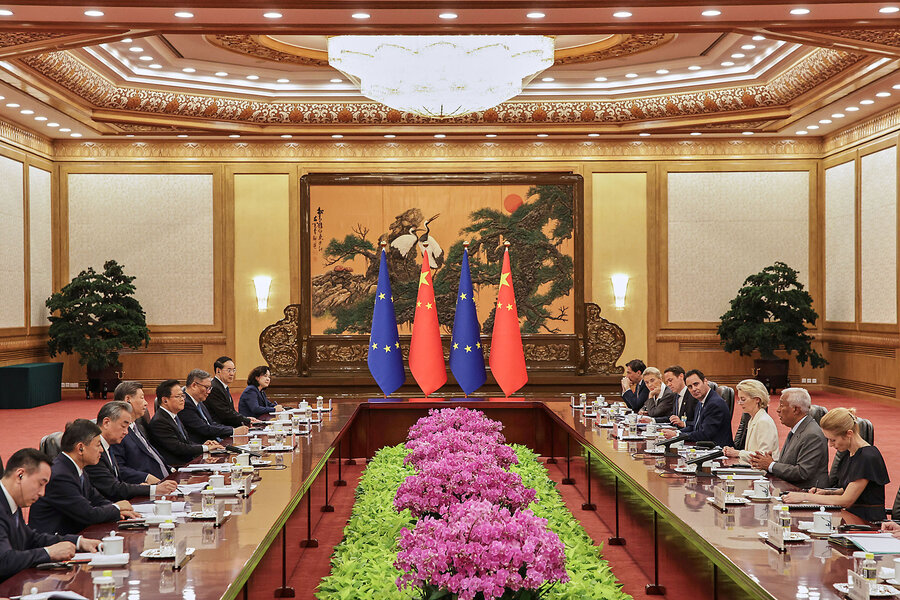
London | Sept. 30, 2026, 6:12 p.m. ET | 4 min read One all-out trade war has been averted, at least for now, thanks to last week’s summit between U.S. President Donald Trump and Chinese leader Xi Jinping.But there are new signs that another might erupt – this one pitting China against the 27 nations of the European Union, collectively the world’s second-largest economic force behind the United States.Ahead of high-stakes EU-China talks in Beijing next week, European concerns are partly based on perennial Western grievances about China’s trade practices: the state subsidies and currency undervaluation that have helped its exporters undercut competitors abroad. But mostly, it’s about a fundamental retooling of China’s economy under President Xi, a shift EU countries have come to see as an economic and political threat.“China Shock 2.0,” it’s being called by European politicians and pundits.That’s a reference to the initial “shock” of a quarter-century ago, when China emerged as the low-cost manufacturer of most of the world’s staple consumer goods – a boon for consumers that also depressed wages, cost jobs, and closed businesses in the West. China Shock 2.0 is of a different order.Mr. Xi has centered his strategy on making China a world leader in the higher-end, higher-value, high-tech manufacturing he sees as dominating the 21st-century economy.China is already the world leader in making batteries, solar panels, and wind turbines. Matthias Schrader/AP/FileVisitors inspect a Chinese-made BYD Atto 3 electric crossover vehicle, at the IAA Mobility motor show in Munich, Germany, Sept. 8, 2023. And a keen concern for the EU’s largest manufacturing economy – Germany – is that the People’s Republic has also become the global leader in electric vehicles.China’s own economy is slowing, unemployment is rising, and domestic demand is lagging. The huge amount of modern manufacturing products it’s turning out far outstrips what can be sold at home.A large and growing portion of those products is for export to Europe. The talks set for next Thursday in Beijing between EU Trade Commissioner Maroš Šefčovič and Chinese Commerce Minister Wang Wentao come amid a growing sense of urgency on the European side.That’s been fueled by a number of factors. The increase in Chinese exports to the EU could have an impact on European manufacturers, including Germany’s critically important car industry. Any resulting job losses could also boost support for Europe’s right-wing populist political parties.There’s also a growing view in Europe that earlier efforts to curb Chinese imports have had little effect.In 2024, for instance, the EU placed a tariff on Chinese electric cars. It did lead to a slowdown in their sales. However, China’s exports of hybrid cars, which were not covered by the tariff measure, have shot up from just under 4,000 vehicles a month to 50,000.The EU is still eager to avoid an all-out trade war with China. It has seen how China’s export limits on its supply of rare earth materials, critical to high-end manufacturing, helped prod Mr. Trump to retreat from his all-out tariff battle with Beijing. A truce on tariffs was extended at the recent summit with Mr. Xi until early next year.Europe, too, has been hit by the rare earths restrictions, and it knows Mr. Xi is virtually certain to hit back against any major EU move to rein in Chinese exports. Benoit Tessier/APMaroš Šefčovič. the European commissioner for trade and economic security, answers questions from the media at a gathering of Group of Seven trade ministers, in Paris, May 6, 2026. But Mr. Šefčovič’s mission comes amid calls from a number of key European countries, including Germany and France, for more forceful EU action.A report this year from France’s High Commission of Strategy and Planning warned of a “Chinese [export] steamroller” that posed a “systemic threat to Europe’s industrial base.”It concluded that one quarter of France’s own exports were being threatened by lower-cost competition of “at least equal quality” from China. And Germany was even more vulnerable. “One third of [its] exports – and even two thirds of domestic production – are directly threatened.”In the run-up to the Beijing talks, EU officials have reportedly been trying to persuade China to accept a voluntary limit on its European hybrid-vehicle exports as a first step toward a wider resolution of trade differences.But a range of other options is also being considered, including a “Buy European” stipulation that would limit government-backed or large-scale purchases of automobiles to those produced inside the EU, as well as a constraint on Chinese purchases of European companies. Overall, the aim is to find a way to significantly reduce China’s widening trade surplus with the EU. It’s running at well over $1 billion a day, and grew by nearly 10% in the first six months of this year.Mr. Šefčovič said he had been stressing to Chinese officials the need to bring the trade gap down, saying “thousands and thousands of jobs in the EU” would otherwise be at stake.He does not appear to expect a major breakthrough in next week’s talks.But in recent remarks at a policy forum in Berlin, he said he felt that some progress was essential.“What we definitely need to bring back are clear pointers,” he told the meeting – specifically, “a couple of pilot schemes where I can prove for a certain group of products that this consultation, this cooperation, works.” Deepen your worldviewwith Monitor Highlights.Politics with respectGet political stories with respectful analysis.There‘s a world of new ideas in everyBooks newsletter.There‘s more to life, enrich yours withCulture & Learning weekly.Follow humanity‘s discoveries withScience & Nature stories in your inbox.Gain a spiritual perspectivefrom the stories in your inbox.Want to understand the deeper impact of critical events? Learn the Monitor‘s insight.Already a subscriber? Log in to hide ads. The alternative, he implied, was a strengthening of calls within the EU for more forceful, bloc-wide action.And if the U.S.-China standoff is any guide, that would likely provoke pushback from Beijing. ALREADY A SUBSCRIBER? LoginReal news can be honest, hopeful, credible, constructive.The Christian Science Monitor was founded in 1908 to lift the standard of journalism and uplift humanity. We aim to “speak the truth in love.” Our goal is not to tell you what to think, but to give you the essential knowledge and understanding to come to your own intelligent conclusions. Join us in this mission by subscribing.
It’s now the EU’s turn to avert a trade conflict with China
Full Article
Original Source
Read the full article at Csmonitor →KhanList aggregates and links to publicly available news content. We do not host full articles from third-party sources. Always verify important information with original sources.