
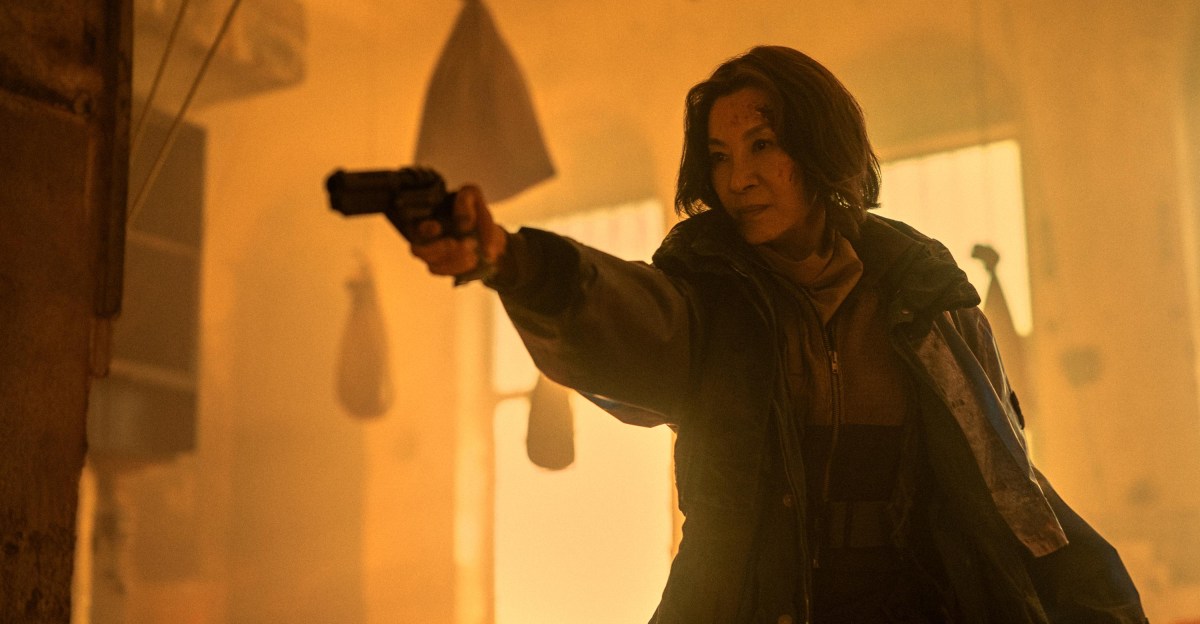
As a longtime fan of the films, Blade Runner 2099 showrunner Silka Luisa says she was more excited than scared when it came to adapting the series for TV. The new show is set 50 years after the 2017 film Blade Runner 2049 and imagines a bleak future where artificial humans known as replicants have taken over society after a brutal war. Luisa, who previously served as showrunner on Apple TV’s Shining Girls adaptation, says she largely had to put any concerns about the monumental task of following up Blade Runner out of her mind while working on the show.“I just don’t think you can approach Blade Runner with fear,” she tells The Verge. “It’s a bold concept. It always has been. P.K. Dick took really big swings and it’s not for the timid. So any fears I had I just ignored and kept focused on the monumental task at hand.”And yet, there was one particular moment during production that made Luisa pause and think about just how big of a deal this project was. Blade Runner 2099 stars Michelle Yeoh and Hunter Schafer as pair of noir detectives — Yeoh is a replicant approaching the end of her life, while Schafer is trying to hide the fact that she’s human — and, in the grand tradition of previous leads Harrison Ford and Ryan Gosling, each has a distinct and iconic jacket. “Once they put the coats on, it really did just transform them,” Luisa says. “The screen test was one of the few moments where I stopped myself and was just blown away by the fact that I was making Blade Runner.”Blade Runner 2099 is streaming on Amazon Prime Video today, and you can read my chat with Luisa exploring everything from the show’s origins to the research process to those all-important jackets.The interview has been edited and condensed for clarity.Image: Amazon MGM StudiosWhat do you think it is about Blade Runner that has made it so enduring?It’s one of the rare properties that asks really deep philosophical questions, but within a detective noir narrative. I think it’s the juxtaposition of both a structure that’s accessible and familiar, but then these really heady, vital questions: What does it mean to be human? How do you find connection? Just these evergreen concepts that every generation needs to grapple with in their own way and in their own time. There really isn’t anything else like Blade Runner.Given all of that, was it intimidating or scary to take this on?I know it seems insane almost to say no, but I just don’t think you can approach Blade Runner with fear. It’s a bold concept. It always has been. P.K. Dick took really big swings and it’s not for the timid. So any fears I had I just ignored and kept focused on the monumental task at hand. And you just stay so concentrated on moving the show forward at each step that you’re not really thinking of it in that objective sense.Does the time gap in the narrative help with that and give you the space to create your own thing?Absolutely. Every iteration has evolved forward. [Original Blade Runner director Ridley Scott] took a big leap from the book. There definitely are touchstones from the novel in his film, but he put his own stamp on that story. And [Blade Runner 2049 director Denis Villeneuve], it’s the same thing. 2049 is mesmerizing, it’s spectacular, but in its own way. It feels like it sits in the world of the Blade Runner canon, but is not a replica of what Ridley did. And that’s what makes it so special. That actually gave us a lot of freedom to try and carve our own path, because if the world is too familiar, it’s not unsettling and it’s not going to give you any feeling of awe. You’ve already seen it before. And so you have to make it your own in some sense.So where did you start with this story? What was the initial concept?The starting point was the idea of technology overtaking us. The war between “robots” and humans is something that has been visited in science fiction many times. And to me what felt fresh wasn’t necessarily what the war looked like, but what the aftermath looked like. I couldn’t close my eyes and picture off the top of my head what would happen to us, what would society shift into, what is post-human. That was really exciting. So it definitely started with the concept of this junction point between the world as we know it and a possible world to come.Image: Amazon MGM StudiosWas the idea of having this inverse relationship from the original film, where replicants are now hunting humans, always part of the concept?Yes, it started with the idea of flipping the world, and once you do that at the macro level, you start to think about what is the more intimate story you’re telling. And if you flip the world now suddenly you have a replicant society, it’s not about a replicant trying to look human, it’s the opposite way around. And so an undercover story just seemed like a natural answer to what would be the narrative shape. It also gave me a relationship as opposed to a single person’s journey.Was it a lot of work imagining what this new replicant society would be like?So much of the initial writing process was just the visuals. It was really hard to write in spaces that I couldn’t picture. We started to put images up in the writers room from the real world, a blend of films, unusual references from the real world, historical references. You have to ask: What does the texture of the space feel like? Who works there? How long has it existed? What neighborhood is it in? You start to ask all of these questions, and you need to know the answers to write the scenes. It definitely slows the process of writing. Because normally I love to do a lot of historical research. If I’m setting something in a place, I would read a lot about it, and find all of the details in the real world. Here I needed that same amount of detail, but we had to create it.The Blade Runner films have such a slow and deliberate pacing. How do you think about that when you’re doing a story that’s eight hours long compared to a much shorter movie?The pacing of the show was one of the biggest conversation points early on, because everybody would be wary of having a truly Blade Runner pace. When you’re in a theater, it is such a meditative experience to be in that world. And there was a fear that if you translate it to television, people won’t have the patience for that. So on the page, I really was pushing the momentum of the storytelling, to the point of even not having exteriors, where you’re just jumping into scenes.In the editing process, once we started to actually look at cuts, if you cut it too tightly you don’t have these moments of breath where the music can live. Once we had [composer Leopold Ross’] score, and we started putting it to pictures, you want to give him a moment in the sun. You want to have those dreamier sections of the show that are, to me, really fundamental to what makes something Blade Runner. It’s always a question of how far you can stretch the rubber band. Everyone will debate whether the pacing is too slow or too fast, and it’s a really hard calibration.Blade Runner has such a strong lineage of cool jackets. How important was it to get that look right for both Michelle Yeoh and Hunter Schafer?Our costume designer Helen [Huang] is phenomenal. Her jackets are incredible, and I love that both of them have really distinct silhouettes. Helen is so thoughtful in how she starts to conceive of these really iconic pieces. For Michelle, she wanted to have something that was referencing a more traditional trench, and then for Hunter it was more of a bomber jacket. She pulled all of these incredible historical references and then blended them with different textures that would make sense with the harsh environment. It’s just masterful work.Once they put the coats on, it really did just transform them. The screen test was one of the few moments where I stopped myself and was just blown away by the fact that I was making Blade Runner.Follow topics and authors from this story to see more like this in your personalized homepage feed and to receive email updates.Andrew Webster
‘It’s not for the timid’: Blade Runner 2099’s showrunner on adapting the series for TV
Full Article
Original Source
Read the full article at Theverge →KhanList aggregates and links to publicly available news content. We do not host full articles from third-party sources. Always verify important information with original sources.