
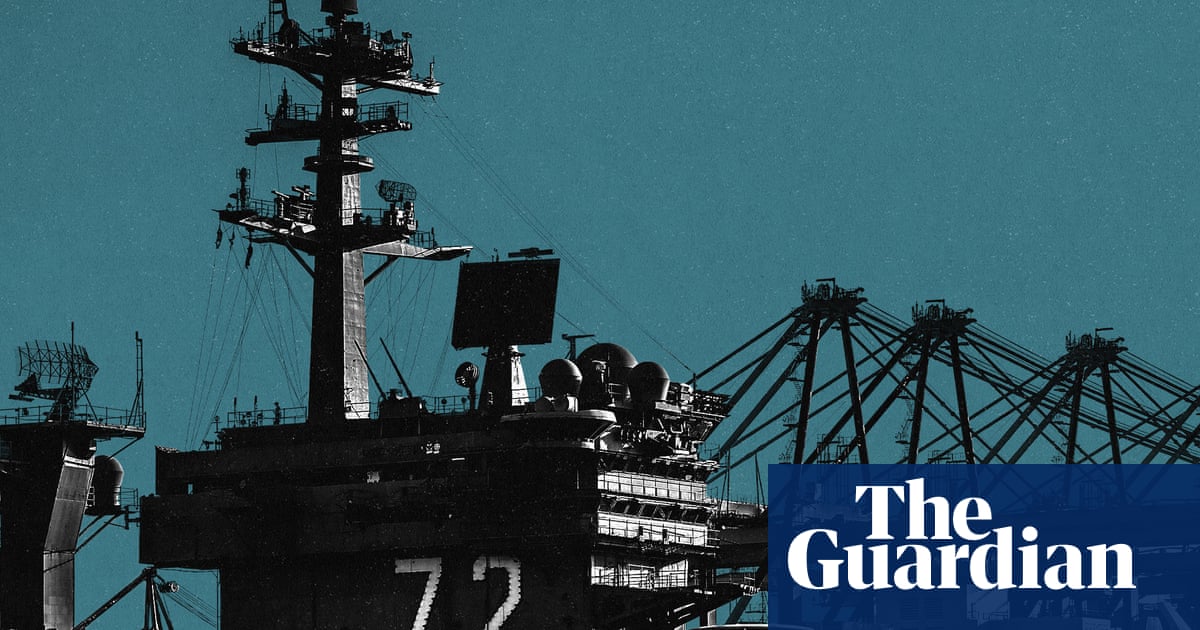
A mother in San Diego is counting down the days until her son comes home.“I had a big sign made, welcoming him back,” she said. “I can’t wait to see him.”Her son is one of roughly 5,000 sailors and marines onboard the USS Abraham Lincoln, the US aircraft carrier that has been deployed for nearly a year, and since late February was supporting US military operations against Iran.What began as a deployment bound for the Pacific, anticipated to return in the spring, became something entirely different after the United States launched its war with Iran. The Lincoln was diverted to the Middle East, and the deployment became what one military official described as “one of the most operationally intense and consequential of the modern era”.The months that followed were marked by combat operations, deployment extensions, a record-breaking stretch at sea, and reports of shortages of food and basic supplies and deteriorating mental health among some crew members, including reports that several crew members had attempted to jump overboard.Senior Trump administration officials pushed back against accounts of poor conditions, but some families and veterans warned that the length and intensity of the deployment were taking a toll on both those serving onboard and their loved ones.As reports of conditions leaked out, the Lincoln soon became a flashpoint in the increasingly contentious debate over the war and, for some, a symbol of the strains and pressures the conflict has placed on the US military and the people serving in it.Now, after months at sea, the Lincoln is in the final stretch of its journey back to San Diego, where it is expected in the coming days.But as the carrier heads home, the toll of the deployment has come into sharper focus. In late September, the navy disclosed that during the deployment, eight service members from the Lincoln and its accompanying strike group had attempted to take their own lives.A crew member walks next to aircraft on the flight deck of the USS Abraham Lincoln as it departs the port of Laem Chabang, near Pattaya, Thailand, on 6 September 2026. Photograph: Chanakarn Laosarakham/AFP/Getty ImagesWhen the Lincoln left San Diego last November, its deployment was expected to be relatively routine. The carrier was scheduled to spend several months in the Pacific region before returning home to California in the spring.Instead, as the US and Israel launched their war against Iran, the carrier was redirected to the Middle East.The Lincoln and its strike group, carrying approximately 6,000 to 7,000 sailors across roughly a half-dozen ships, were soon pulled into combat operations, which would see them shoot down “more than 200 Islamic Revolutionary Guard Corps drones threatening international shipping and US forces”, according to Adm Brad Cooper, who heads US Central Command. The group’s guided-missile destroyers, he said, engaged in “arguably the most intense combat at sea the navy has seen” since the second world war while the carrier’s air wing carried out hundreds of “decisive strikes on IRGC targets”.The crew worked long hours as the carrier remained at sea for months without a port visit. The war disrupted regional resupply routes and traditional hubs, making it harder to replenish the ship and rotate personnel, especially after Iran damaged a US navy base in Bahrain.By August, the Lincoln had spent more than 250 consecutive days at sea.Armen Kurdian, a retired US navy captain who served on the Lincoln in 2005, described the carrier as a “giant floating city” where sailors live in close quarters, and “you’ve got aircraft smacking down on decks repeatedly, hundreds of times per day, and that rattles the ship”.The strain of this deployment was compounded by uncertainty over when the sailors would come home. Some familiessaid they went weeks without hearing from their loved ones, and for stretches of time, they said, those onboard did not receive letters and care packages from home.Then reports began to emerge about conditions on the ship.In April, photographs purporting to show poor-quality meals on the Lincoln circulated widely online. The US navy denied reports of food shortages, calling such claims “false”.But by August, some families began describing a more troubling picture of what their loved ones onboard had told them about the conditions: shortages of food and basic supplies, plumbing problems, and exhaustion and deteriorating mental health among the crew. Two leading military newspapers also reported that there had been two attempts by sailors to jump overboard, causing concern among families and military health experts.That month, it was reported that more than 200 family members attended a virtual town hall with navy leaders to discuss their concerns. One spouse reportedly said her husband, a sailor onboard, had texted her that day, saying: “He hopes he doesn’t wake up tomorrow.”One mother whose 19-year-old son is onboard the carrier said this week that there were periods when she went a month without hearing from him. When they did communicate, she said, he sometimes sent photographs of the food, which she said looked “horrible”.At one point, he told her about a power outage on the ship, but assured her that he was doing OK. He would tell her how other sailors had begun “to not be themselves” and were “losing themselves”.“It’s been hard knowing the conditions and the type of food they’re being fed, and just not having any contact for long periods of time, and them being gone so long,” the woman, who requested anonymity, said. “It’s just been difficult.”The reports of supply shortages and declining morale and mental health prompted outrage from Democrats, and swift pushback from senior officials in the Trump administration.The US defense secretary, Pete Hegseth, at Norfolk, Virginia, on 5 October 2025. He said reports of poor conditions on the USS Abraham Lincoln were ‘completely misrepresented’. Photograph: Bloomberg/Getty ImagesPete Hegseth, the US defense secretary who has pledged to restore the “warrior ethos” to the US military, said the conditions on the Lincoln had been “completely misrepresented”. Navy officials acknowledged that the war had disrupted traditional supply networks, but maintained that the carrier had adequate food, medical care and supplies.When reporters asked Donald Trump whether the families were concerned about the reported conditions on the vessel, he claimed, “No, they’re not,” and when asked if he thought the deployment had gone on too long, he responded: “Not nearly long enough.”For some naval families, that comment was difficult to hear.One mother whose son was onboard the Lincoln said she became angry when she heard Trump’s comments.“I thought, you know, this guy has never served a day in his life,” she said. “Neither has his family, none of his children have – how would he feel if it was his kid on that ship?”She said she understood that the sailors were at war, but what troubled her was how long the deployment had lasted, with no opportunity to leave the ship and little sense of when the crew would return.“For a long time I didn’t hear from him because he didn’t have internet or whatever,” she said. “So it was hard not knowing what’s going on, and then listening to news reports about all this stuff that’s going on, I was very worried.”When she was finally spoke with her son after the reports of the suicide attempts and poor living conditions emerged, she asked whether he was eating, and if he was OK. She said he told her he was eating three meals a day, and sounded well. But from thousands of miles away, it was impossible to know for sure.Donald Trump, when asked about the length of the deployment of the USS Abraham Lincoln, said it was ‘not nearly long enough’. Photograph: Andrew Caballero-Reynolds/AFP/Getty ImagesThe picture emerging from the Lincoln was complicated, and worried families scrambled to try to piece together what was happening through brief phone calls and text messages, as well as news reports relaying what other relatives had heard.Some families weren’t surprised by the reports, saying that their relative onboard had described similar conditions. Others, however, said their relative had described nothing of the sort, which led them to believe that some of the accounts circulating online had been overblown or just the experience of a handful of sailors.One mother, herself a navy veteran, said she believed some reports about food and plumbing had been “blown out of proportion”. Food on these vessels in general, she said, could be “pretty disgusting”.Her bigger concern was the length of the deployment, the lack of port visits, and the inability of sailors to receive mail and care packages from home for extended periods.“I can’t imagine not feeling the ground under my feet for that amount of time,” she said. She also worried about sailors on their first deployment and whether such an experience might influence their decision to re-enlist.For some families, the feeling of helplessness became overwhelming.In August, Jefferson Kelley, whose son is onboard the Lincoln, wrote to his senator, Bernie Moreno, a Republican from Ohio, offering to take his son’s place on the ship for the remainder of the deployment.In the letter, shared with the Guardian, Kelley proposed what he called a “parent swap”.“If there is any lawful way for me to serve in his place so that he may return home, I am asking for that opportunity,” he wrote.His son had never complained to him or his family about conditions on the ship, Kelley said, adding that he often responded that he was doing fine, but as a father, he said he couldn’t help by worry about his son, especially as the reports continued to emerge.“I was trying to show that I am someone that is willing to do more than just sit at home and say somebody should do something or complain on social media,” Kelley said, describing his son’s deployment amid the war in Iran as a “very, very difficult experience” for the family.The USS Abraham Lincoln has been on a record-long deployment amid the US war on Iran. Photograph: Morteza Nikoubazl/NurPhoto/Getty ImagesOn 15 August, as headlines about conditions on the Lincoln intensified, and as Democratic lawmakers demanded more information from the Pentagon, Adm Cooper, who heads Central Command, visited the carrier.Not long afterward, he released a statement, claiming that of the US navy’s 11 active aircraft carriers, the Lincoln “currently has among the lowest number of cases related to mental health”. But, he added, “this doesn’t mean that all is perfect”.A long deployment at sea, Cooper said, “is uniquely challenging and tough, and every single one of us, including me, reacts to stressors in different ways”.In an opinion piece in the Wall Street Journal that week, Cooper wrote that “the crew is tired, but they continue to fire on all cylinders”.“History will record this deployment as one of the most operationally intense and consequential of the modern era,” he said. In the essay, Cooper said that “recent media reporting has portrayed varying perspectives on operational tempo, crew morale and the realities facing our deployed forces”, adding: “What I found aboard the Lincoln is that many elements of those stories are old news.”That same month, for one sailor, the strain of being away from home was compounded by events happening there. In a post on social media, Joshua Aviles, a sailor onboard the Lincoln, wrote that he had just learned that his father was detained by federal immigration authorities.Aviles said his father had a driver’s license, social security card and work permit, and that the family “had done everything through immigration to get his green card approved, and we are just waiting”.“I don’t know how I can mentally continue working 12+ hour days knowing that my dad is somewhere, possibly being treated like a criminal,” he wrote in a Facebook post.US immigration officials said at the time that Aviles’ father had entered the country illegally, and that “having a family member in the military is not a free pass to violate our nation’s laws”.Several days later, Aviles said his father was released.The USS Abraham Lincoln approaches the port of Laem Chabang near Pattaya, Thailand, on 2 September 2026. Photograph: Bloomberg/Getty ImagesIn late August, it was finally announced that another US aircraft carrier, the USS George Washington, had arrived to relieve the Lincoln, and that the Lincoln would be heading back to San Diego.On the journey home, the Lincoln docked in Thailand for several days, giving sailors a chance to walk on land and rest before beginning the final passage home.In Thailand, the Guardian spoke with several sailors, who requested anonymity, who described eating “uncooked beef” and sliced-up, uncooked potatoes during the deployment. One sailor said that in his opinion, the decline in living standards was down to the battle conditions imposed during the combat operation, dubbed Operation Epic Fury, rather than the unprecedented length of deployment.Another of the sailors said that the hardest part of the deployment was “pushing through, keeping the mentality”, while another serviceman hinted at the toll the long deployment had taken: “Some people adapt to it, but not everyone.”Shakeria Fairfax, whose daughter, Jada, is onboard the Lincoln, couldn’t pass up the chance to be reunited with her daughter after such an intense deployment. She flew to Thailand, and still, to this day, Fairfax struggles to describe the moment they saw each other.“The best way I could describe it is just kind of like when I first looked at her it was the overwhelming sense of love after having had so much time apart,” Fairfax said in an interview this week. “There was such a sense of pride, love and pride.”USS Abraham Lincoln sailors arrive during their port call at the Hard Rock Hotel in Pattaya, Thailand, on 2 September 2026. Photograph: Anthony Wallace/AFP/Getty ImagesFor two days in Thailand, they played their favorite card game, went shopping and did what Fairfax called “girly things” – manicures, pedicures, facials and massages.“It felt like we had some normalcy back in our lives after having been apart,” she said.Like several other families the Guardian has spoken with, Fairfax did not want to disclose details of her daughter’s experience on the vessel, but described her as “extremely resilient”.The deployment was Jada’s first, her mother said. She had completed basic training in October before she was deployed in November. When Fairfax woke to the news in February that the US and Israel had launched their war against Iran, she “couldn’t believe it”.“We don’t come from a military family, and now my child is at war and I don’t know what that looks like,” she said.Not long afterward, Fairfax lost contact with her daughter for several weeks, receiving only a handful of emails saying that she was OK. Then, on Easter weekend, Jada finally FaceTimed her mother. “It was beautiful,” Fairfax said.Over the months that followed, Fairfax remembers only one occasion when her daughter told her she was feeling discouraged. Fairfax said she felt powerless, and asked her what she could do to help. Jada, who turned 25 onboard the ship in June, asked her mother to tell her stories about when she was growing up, she said.So she did. “I told her stories. I sent her photographs,” Fairfax said. “Some of them she received, some of them she didn’t.”Balloons forming a US flag adorn a bar to welcome the arrival of personnel of the USS Abraham Lincoln in Pattaya, Thailand, on 2 September 2026. Photograph: Anthony Wallace/AFP/Getty ImagesJada told her mother about some sailors onboard the ship who did not have the same kind of support system – people who did not receive care packages or have family members sending them reminders of home. And as the deployment continued, Fairfax said she could only imagine how difficult that must have become for those sailors. She and her daughter have since talked about finding a way to help those who do not have that support, she said.For Fairfax, there was never much of a question about whether she would go to Thailand to see her daughter when she docked, as to her: “It was really about showing up for my daughter.”Now she hopes to be able to head to San Diego to welcome her home.The most serious disclosure about the deployment came after the Lincoln left Thailand.In a letter responding to questions from the Democratic senator Kirsten Gillibrand of New York, Hung Cao, the acting US navy secretary, acknowledged that eight navy personnel in the Lincoln strike group had attempted to take their own lives during the deployment, but said that no sailor had died from the attempts.Cao said one sailor assigned to the air wing went overboard from the ship in early August but was “quickly recovered by an air wing search and rescue helicopter”. The sailor was treated by the vessel’s medical department and transferred off ship for follow-up care, Cao said, and the sailor’s family was notified.Another sailor, he said, attempted to go overboard in March, but was stopped by his shipmates. That sailor was “also provided immediate medical care and subsequently returned to home port”, he added.According to US Department of Defense data, there were 356 attempted suicides recorded in the navy in 2024. There were 287 in 2023, and 282 in 2022. This month, NPR reported that a 21-year-old sailor onboard the USS Fort Lauderdale, which had been deployed in the Caribbean as part of the Trump administration’s operation around Venezuela, died by suicide in June, a month before the vessel returned to Virginia.JD Vance greets the acting secretary of the navy, Hung Cao, on the USS Kearsarge in New York harbor on 4 July 2026. Photograph: Vincent Alban/Getty ImagesCao said that the navy launched a suicide prevention and response taskforce earlier this year, and also said in the letter that the Lincoln had deployed with five chaplains, an embedded integrated prevention counselor, a psychologist, a clinical social worker, three behavioral health technicians and a facility dog.Cao said that the Lincoln “maintains adequate food supplies” but that due to the ship’s “participation in major combat operations with limited opportunities for resupply in a combat ‘environment, the number of main entree options served during regular meal hours was reduced from two to one for a short time”.“Four meals were served daily, and all meals provided were nutritionally balanced, with adequate calories per day made available to every sailor,” he said.The navy also acknowledged that earlier in the deployment the ship had experienced “localized piping failures” and temporary issues with its desalination units but that “shipboard engineering teams successfully completed repairs, and the potable water supply remains safe and tested daily”.The new information prompted further calls from members of Congress for investigations and greater transparency.In a statement, Gillibrand, who is a member of the Senate armed services committee, criticized the Trump administration’s handling of the reports from the vessel.“What Trump and Secretary Hegseth dismissed as ‘fake news’ turned out to be serious and deteriorating conditions for our service members,” she said, adding: “Our troops and their families make immense sacrifices every single day, yet the president dismissed them with open disrespect.”In response, a White House spokesperson said that Trump has “rightfully restored a focus on readiness, lethality and supporting our war fighters at the Pentagon”.“The president cares about our troops more than anyone, and he is ensuring our brave service members have all the resources they need to be successful as the United States military continues to economically strangle the Iranian regime,” they added.Richard Blumenthal, the Democratic senator from Connecticut, also requested that navy leaders provide an “accounting of the eight suicide attempts”, including when they occurred and when senior navy leaders were informed of the incidents. He has also asked navy leaders to “detail the steps you will take to protect sailors’ mental health and wellbeing during future extended deployments”.Richard Blumenthal, the Democratic senator from Connecticut, asked US navy leaders to provide an accounting of the eight sucicide attempts among the Lincoln strike group. Photograph: Ken Cedeno/AFP/Getty ImagesIn an interview with the Guardian, Donald Guter, a retired navy judge advocate general, described the eight reported attempts as a “tremendously concerning number” but said that “given the operational tempo and the total lack of opportunity for port calls, in a way, it shouldn’t have surprised people”.He described the Lincoln’s deployment as “extraordinary”, saying that spending “that long at sea without any breaks, at that operational tempo, is stressing on anyone”.Carl Schuster, a retired US navy captain, said that during his long deployments, which lasted between six and seven months, it was not unusual to have one or two suicide attempts.But, he said, “keep in mind, the Lincoln spent over 250 days at sea in a nine-month deployment, which is a much longer deployment and much more time entirely at sea than I ever did, so I’m not surprised at the additional stress and the additional attempts”.“We’re asking the crews to sacrifice much more than was normal in my day,” Schuster said. “All of us have a breaking point.”Lory Manning, who served more than 25 years in the navy, said that given the size of the strike group and the unprecedented length of the deployment, she didn’t think it was that “far out of bounds to have that many attempts” across thousands of people who “have been bottled up on ships for 10 months”, particularly amid prolonged uncertainty, deployment extensions and intense combat conditions.“I’m very glad that nobody succeeded,” Manning said.John Cordle, who retired from the navy in 2013 after 30 years of service and served in a carrier strike group, said he could remember only one suicide attempt onboard a ship of the two that he was in command of, so to him, “eight seems like a lot”.Cordle said that his longest deployment had been seven and a half months and his longest period without a port call had been 110 days.“I never had to deal with conditions this extreme,” he said of the Lincoln’s deployment.He urged the navy in the future to be more transparent earlier about the conditions onboard, especially with the families, and said that he hoped the leaders learned from the Lincoln’s deployment.Several veterans also cautioned that the strain of these deployments could potentially affect enlistment in the future.“Given the history of what does and doesn’t make people re-enlist, it’s certainly quite possible that none of them want to go through that again,” said Manning, “and maybe not the sailors, maybe it’s their families that don’t want to have to go through it again.”Generals John D Caine, Randy George and Eric Smith, and Adm Daryl Caudle, during a State of the Union address at the US Capitol on 24 February 2026. Photograph: Bloomberg/Getty ImagesDuring a town hall in late August, Adm Daryl Caudle, the chief of naval operations, warned that long deployments could become more common. That warning came as, earlier this year, the USS Gerald Ford returned from a record-breaking 326 days at sea, marking the longest deployment by a US warship since the Vietnam war.“In the short term, until I can grow the navy we need, I hate to admit it, but longer deployments are going to be probably part of that,” Caudle said.Matthew Brown, a US navy reserve commander and former captain of the USS Scout, said he visited the Lincoln in mid-September.Brown runs Chimney Trail Health, a behavioral healthcare company that specializes “in creative adaptations of cognitive behavior theory”. He said the Lincoln’s captain had invited him to provide his company’s cognitive readiness training program to the sailors as the carrier headed home.He said he delivered an in-person seminar, “sort of like a tabletop workshop-type thing”, to those onboard, and that it was “well received”.At that time, the crew were on their journey home, and Brown said he observed that their “morale was that they were obviously quite tired because it was a very like rigorous deployment” but that “they were resolute”.The sailors, he added, “were strong, and many of them maintained a very good sense of humor”.For future deployments, Brown said that having more personnel onboard trained in the basics of cognitive behavior theory and equipped with evidence-based materials could help when it comes to addressing some of the mental health challenges that may arise.Later in September, the congresswoman Sara Jacobs, a Democrat representing California’s 51st district, which includes San Diego, said she joined a bipartisan delegation for in-person oversight of the Lincoln as it journeyed back to San Diego.Congresswoman Sara Jacobs. Photograph: Tom Williams/CQ-Roll Call, Inc/Getty Images“I raised my concerns directly with the ship’s command and received a briefing on logistics, supply issues and lessons learned for future deployments,” she said. “I also met with sailors and marines onboard who painted a very different picture of this war; they shared stories of the deployment and their struggles to wash clothes, get medicine and healthcare, and eat enough food.”Jacobs said that she didn’t blame the ship’s leadership, saying they had done the best they could under difficult circumstances. Instead, she said she blamed the president, whom she accused of “knowingly launch[ing] a war without the required planning and strategy needed”.She said she would push for an investigation into the conditions and a House armed services committee hearing to hear directly from service members once they returned.Meanwhile, another US carrier, the USS Theodore Roosevelt, was just recently dispatched to the Middle East.In a video statement in early September, navy leaders said that they were learning from the Lincoln’s deployment, and had loaded the Roosevelt up with additional food, hygiene products and other supplies before it got under way.“We’re also focused on quality of life,” they said, adding that they will provide additional entertainment and fitness equipment onboard, and said that they were improving communication with families throughout the deployment.“To the Lincoln team, thank you for what you accomplished, and for what you taught us, and to the Roosevelt team, we’re doing everything we can to make sure you are ready for the mission,” they said. “You and your families.”
‘It’s been hard'’: families await the return of the USS Abraham Lincoln
Full Article
Original Source
Read the full article at Theguardian →KhanList aggregates and links to publicly available news content. We do not host full articles from third-party sources. Always verify important information with original sources.