
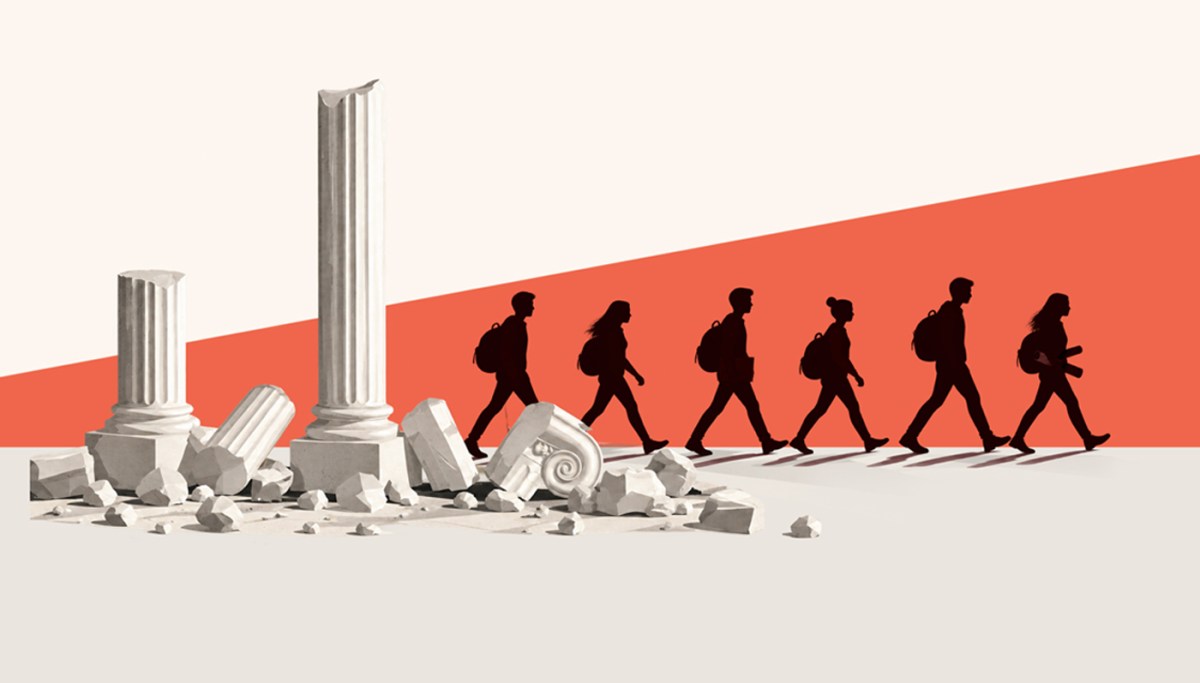
Ken Goodrich was just 10 years old when he first held a flashlight to help his tradesman father work at night.The now bestselling author of the E-Myth series and mentor to many people working in construction, heating, ventilation, and air conditioning, and other trades, says that the increasing number of parents with high school and older children is encouraging them to seek a possible future in such industries as an alternative to going to college. And that generation is listening.“The old straightforward dream of going to college and joining the middle class is going away,” Goodrich told the Washington Examiner. “You can get going faster, and these areas are a place to start your career because they are stable and are continuing to grow.” What many people don’t always appreciate, he says, is that the world of “trades” includes all kinds of roles. It isn’t just about the stereotype of a worker with tools around his or her waist.“There are so many facets to the trades with a lot of administration positions, sales, and customer service roles,” he said. “These businesses have robust staff numbers.”The ability to earn good money as a young apprentice, or in other roles within robust, growing industries, is very attractive to both young people and their parents, many of whom also don’t want to be saddled with the extraordinary costs of the more traditional college route. Goodrich described the student debt crisis in the country as a “tragedy.”(Washington Examiner Illustration/Getty Images) It’s a trend politicians of both parties are picking up on. Gov. Josh Shapiro (D-PA), on his first day in office in January 2023, signed an executive order removing the four-year college degree requirement for roughly 92% of state government jobs (about 65,000 positions).“If you have the skills required to do the job and a passion for public service, an arbitrary degree requirement shouldn’t stand in your way,” said Shapiro in a July statement amid his 2026 reelection bid, which, per polls, he’s expected to win easily.Creating job openings for non-college Pennsylvanians could play well nationally if, as expected, Shapiro enters the 2028 Democratic presidential primary field.President Donald Trump’s administration has taken a similar approach. It has emphasized skills-based hiring in the federal government and workforce training in skilled trades. During Trump’s first nonconsecutive term, in June 2020, he signed executive orders to emphasize job skills over college degrees for federal employment. It directed agencies to strip unnecessary degree requirements unless legally required, an approach that was expanded after Trump returned to the White House.It’s in the data Some numbers bear out this push for workers who have bypassed college.National Student Clearinghouse data show that enrollment in undergraduate certificate plans increased 10.2% in spring 2026 over the same period in the previous year, compared with just a 1% rise in students new to bachelor’s degree programs. The number of students was, however, essentially the same across both.Preliminary fall 2025 data also showed particularly strong growth in mechanic and repair technology and engineering technology programs at two-year colleges, according to Scott Beaulier, economist and dean at the College of Business at the University of Wyoming.Gen Zers, seeing their futures somewhat constrained via more traditional routes, are waking up to an economic reality where skilled trades and apprenticeships might be a better way for them to punch their way to the middle class, said Paul Iaccerino, who runs a five-year electrician apprentice program in New York funded by the Building Industry Electrical Contractors Association, a regional group of union electrical contractors.It isn’t just graduating high school students who are seeking such a path, either. Some young employees already have bachelor’s degrees but find themselves working in positions that very often are at a lower level than their qualifications might suggest, mirroring Federal Reserve Bank of New York findings that about 42% of recent college graduates are underemployed in jobs that don’t actually require degrees, according to Eric Jochim, a co-owner and vice president of marketing at Beyond 21st Century Beauty Academy. Many of the students entering his California-based cosmetology program already have bachelor’s degrees when they enroll, amid concerns that entry-level jobs in their chosen field are actually still available in an increasingly AI-dominated world.The same is true at Iaccerino’s program, where many of the enrolled Gen Zers, who make up about 70% of the 145 apprentices, have found themselves coming from other paths, such as traditional college, before ending up in the apprenticeship. The average age of apprentices entering the program is also consistently getting lower, Iaccerino noted.Different strokes for different folks Most sources were quick to point out, however, that it is not as simple as saying this trend is just a case of traditional college versus apprenticeships, concluding that there is therefore value in multiple approaches.It is also important to stress that entering an apprenticeship program requires plenty of study.Apprenticeships, too, are not tied only to traditional trades but are increasingly used in areas such as healthcare, education, information technology, advanced manufacturing, and other professional and technical occupations.“Apprenticeship is a model for developing talent, not simply a synonym for the construction trades,” said Chris Harrington, the state director of North Carolina’s State Apprenticeship Agency. A variety of apprenticeships, therefore, and not simply a case of opposition to a more traditional college route.“For some occupations, a bachelor’s degree is clearly the right pathway,” added Harrington. “For others, a Registered Apprenticeship, certificate, associate degree, or combination of work and education may be the better fit. I don’t think we serve young people well by presenting those choices as a hierarchy.Very often, too, it isn’t always an either/or prospect.“A young person might begin working as an apprentice, complete an industry credential or certificate, progress to an associate degree, and later pursue a bachelor’s degree if it adds value to that person’s career,” he added. “Those pathways should connect rather than compete.”Congress is sitting up and taking notice All that said, the shift is real, and Congress is noticing it to some degree, perhaps more than traditional colleges are.The Workforce Pell Grants, with their extension in Trump’s signature second-term domestic achievement, the One Big Beautiful Bill Act, to certain qualifying short-term workforce programs, are one example of greater focus on such a shift. Tax-friendly 529 savings plans have also expanded under the bill, with many more vocational programs also being included, said Patricia Roberts, chief operating officer at Gift of College.In addition, the Skills-Based Federal Contracting Act, which would effectively bar federal agencies from mandating contractor staff to have a college degree, has passed the Senate and awaits presidential sign-off. Education Secretary Linda McMahon has also recently argued that more traditional four-year college degrees may have been oversold and that there is high demand for skilled workers in the trades, according to Peter Duris, CEO and co-founder of Kickresume, which helps people build applicant-tracking-system-friendly resumes.The Pell Grant move is valuable in that it clearly recognizes that valuable postsecondary learning doesn’t always have to fit within a traditional degree structure, said Harrington at ApprenticeshipNC. But it is also not a program designed primarily for Registered Apprenticeship, he added. That program, recognized and backed by the Department of Labor, faces Workforce Pell restrictions on eligibility rules, timing requirements, and other narrow parameters.“More broadly, continued federal interest in apprenticeship and work-based learning suggests recognition that the country needs multiple high-quality pathways into skilled employment,” Harrington said. “But more work remains to align education, workforce, and financial aid policies with the way apprenticeship actually operates, where individuals are simultaneously employees and learners, and training often occurs over a longer period and through a combination of classroom and work-based instruction.”On the Registered Apprenticeship front, the current administration has set a goal of surpassing 1 million active Registered Apprenticeships and committed hundreds of millions of dollars to expanding the program, said Fraser Patterson, CEO and founder of Skillit, which uses an artificial intelligence platform to connect tradespeople with construction-related jobs.“This is becoming politically important as the country asks who will build the housing, energy, manufacturing, and AI infrastructure being proposed,” Patterson said.Adapt or die Colleges, too, need to embrace the shift. There may be signs they aren’t quite ready to do that, many of them anyway, as they sometimes seek to resist such a trend rather than embrace it.Degrees, for example, need to be more closely aligned with career paths in the current economy.Relatively high entrance fees and other barriers remain even as some colleges are able to shift their offerings to include more vocational programs. It also takes time to set up thriving online programs, which are useful when many students and apprentices have to continue to work. In addition, traditional colleges may be jumping on the bandwagon but not actually distinguishing much between the different approaches needed for academic versus vocational learning.“In our current economy, students can’t stop working to seek education,” said Thomas Weston, chief strategy officer at the Colorado-based U.S. Career Institute. “They need the flexibility to work and study at the same time.”Generation Z may be the generation that pushes back on the concept of college for all and the idea that working with your hands is less aspirational than working behind a desk.James Flannery, 26, certainly believes so. He is a first-year electrician apprentice at the trade program operated by Iaccerino in New York. James used to study cybersecurity at a New York college, but eventually felt it wasn’t for him and took up the apprenticeship instead. His father continues to own a hardware store in the Bronx, and James’s decision to enter the apprenticeship came while he was working there.“When we were at school, it was really all about just college, college, college; we weren’t told about any other routes,” he said. “I’m definitely feeling a lot happier about my future now [that] I am doing this.”James might be an example of a new generation increasingly demanding that their education fit a more obvious eventual career path, especially in a very difficult and different career environment facing multiple challenges that differ from previous periods.“I don’t think the future is ‘college versus the trades,'” said Skillit’s Patterson. “The bigger change is that young people expect education to connect clearly to jobs, earnings, and real skills.”It’s a more uncertain path than the past ones of simply going to college, getting a degree, and then starting a career. Perhaps there therefore shouldn’t be the traditional separation of white- and blue-collar jobs, argues Sarah Boisvert, who operates a New Mexico-based training program designed to help apprentices and interns find digital technology pathways in close alignment with employers, something she calls “New Collar” jobs.Such jobs, she notes, still require a lot of study, and it is therefore right that there is less stigma attached to such a pathway with some parents than even just a few short years ago.PAXTON FIGHTS TO KEEP GAINS TRUMP MADE WITH TEXAS LATINOSFresh approaches that involve all aspects of education and learning are needed, and there is room for all of them.“We need to demonstrate the value of our degrees, connect students more directly to employers, and create flexible opportunities for lifelong learning,” said Beaulier at UW. “A successful tradesperson might eventually benefit from business education in accounting, entrepreneurship, or management. These pathways can complement one another.”Nick Thomas (nickthomas.journoportfolio.com/) is a writer based in the United Kingdom.
It’s a brave new working world with Gen Z leading the charge
Full Article
Original Source
Read the full article at Washingtonexaminer →KhanList aggregates and links to publicly available news content. We do not host full articles from third-party sources. Always verify important information with original sources.