
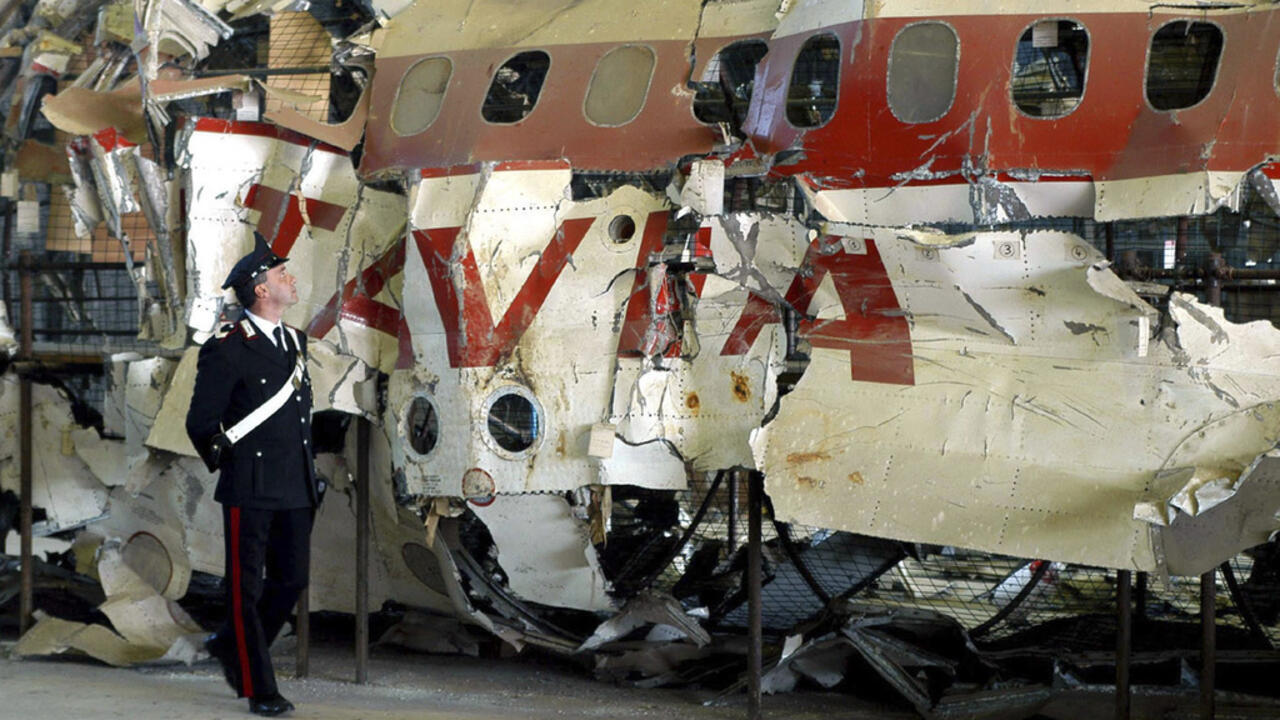
A rocky outpost of Italy in the Tyrrhenian Sea, the island of Ustica owes its name to the smouldering volcanic lava that gave its striking rock formations their dark hue. For many Italians, however, the picturesque island is synonymous with a notorious plane crash that claimed 81 lives, and the intricate cover-up that buried its causes in a thick fog of lies, decoys and mysterious deaths. The fate of Itavia Flight 870, which plunged into waters off Ustica on June 27, 1980, remains a subject of fierce debate after countless expert reports and judicial enquiries spanning several decades. The most widely accepted theory suggests the plane was caught up in an aerial dogfight and mistakenly shot down by a fighter jet, which a former Italian president has claimed was French. News this week that French authorities would hand over defence documents to Italian investigators has been greeted as a potential gamechanger in Italy, where prosecutors and plaintiffs have long accused France and other Western allies of withholding evidence. The 11th-hour twist led prosecutors on Wednesday to abort plans to shelve the latest investigation into the crash, throwing a lifeline to families of the victims who have relentlessly lobbied Italian governments and the judiciary to pursue the case. Cover-up The DC-9 plane operated by the now-defunct Itavia carrier was in the final stretch of its journey from Bologna to Palermo on a clear summer evening when it suddenly broke up and crashed into the sea, killing all 77 passengers and 4 crew members, all of them Italian. The incident is known in Italy as the strage di Ustica, a term commonly used to refer to the deadly terrorist attacks that rattled the country in those years, many of which also remain shrouded in mystery. Watch moreVictims of Italy’s deadly ‘Years of Lead’ demand justice “At first, it was labelled an ‘accident’ or a ‘tragedy’. But as efforts to cover up the incident became apparent over time, people started calling it a ‘strage’ (massacre),” said historian Cora Ranci, who has written a book about the Ustica affair and the many smokescreens she says have hampered investigations. Like other unsolved civilian massacres, she added, the Ustica affair “has contributed to the erosion of trust between citizens and institutions in Italy, fuelling the sense that those in power are bound by a code of silence and that their actions are shrouded in secrecy”. The reconstructed wreckage and other recovered items lie in a hangar near Rome in December 2003. © Emiliano Grillotti, AP Following the crash, officials hastily concluded that it had been caused by mechanical failure, precipitating the demise of the already struggling carrier Itavia. Judicial inquiries resumed only years later under pressure from victims’ families, spurred by an investigative journalist convinced that the plane had been shot down. Progress was slow, hampered by the fact that that tracking data and radar scans had been wiped clean at all but one of the various Italian bases within range of the incident, leaving investigators with little hard evidence to work on. Four air force generals were tried on charges of treason and withholding evidence, though none were convicted. The untimely deaths of at least 15 military personnel and others connected to the case – through transport accidents, shootings, stabbings and suicides by hanging – furthered muddied the waters, compounding the sense of a conspiracy to hide the truth. In 2013, Italy’s highest court ruled that the plane had been brought down in an aerial battle, either by a missile or through a near-collision, without identifying a culprit. It ordered the state to compensate families of the victims, adding that cover-ups in the investigations were considered “definitively ascertained”. The ruling was in line with the conclusions of an earlier, decade-long inquiry, which determined that the intended target of the operation was a smaller aircraft travelling in the DC-9’s slipstream to evade radar detection. “We’ve known for years that the passenger plane was downed in a combat operation,” said former senator Daria Bonfietti, the head of the association of families of the victims that lobbied the authorities to recover the wreckage and reopen investigations decades ago. But, she added, “we still don’t know who did it.” The Libya link Despite the court rulings, some remain deeply sceptical of the missile scenario, leaning instead towards the theory of a bomb exploding on board the plane. They point to the numerous terrorist attacks that shook the country in those years, including the Bologna station bombing that killed 85 people and injured score more just weeks after the Ustica crash. Potential culprits cited by proponents of the bomb theory – which has never been upheld in court – include far-right activists, Palestinian militant groups and Muammar Gaddafi’s Libya. The late Libyan strongman is also at the heart of the missile hypothesis, which gained further traction in 2007 when former Italian president Francesco Cossiga claimed that the passenger jet had been shot down by French military planes who were after Gaddafi. Cossiga, who was prime minister in June 1980, cited Italian intelligence but offered no evidence. He claimed Italian sources had tipped off Gaddafi, ensuring that he was not on board the smaller plane allegedly tailing the Itavia flight. Now at Bologna's Ustica Memorial Museum, the wreckage is part of an art installation designed by French artist Christian Boltanski, featuring a lamp for each of the 81 victims. © Davide Alberani, Wikimedia Creative Commons Proponents of the Libyan link say it is substantiated by the recovery, three weeks after the Ustica disaster, of the wreckage of a Libyan MiG fighter on a mountain in Calabria, which may have been chased and downed on the same night as the DC-9. “We know from declassified documents that Italy at the time was covertly allowing Libyan aircraft to fly though its airspace to Yugoslavia for purposes of training and maintenance,” said Ranci. On top of creating dangers for civilian warplanes, she added, this tacit agreement infuriated the Americans and even more so the French, who were fighting a proxy war with Gaddafi’s Libya in Chad. The Ustica crash came months after France’s embassy in Tripoli was ransacked and after a botched Libyan attempt to shoot down a French surveillance aircraft over the Mediterranean, which sent tensions spiralling. Bonfietti, whose elder brother was on board the Itavia flight, said successive judicial inquiries had established that multiple military aircraft were operating over the Tyrrhenian on the day of the crash, including US, French and other NATO aircraft. “Now we need those countries to tell us what they were up to and why they kept quiet about it,” she said. Watch moreGladio: NATO’s secret cold war operation in Italy “If Gaddafi was indeed their target, it’s obvious that whoever carried out the operation could not openly claim it – not in a Cold War context,” said Bonfietti. “Instead, they decided to cover up what happened and pretend the plane experienced a mechanical failure.” Locating the Foch Allegations of French involvement resurfaced in 2023 when former Italian prime minister Giuliano Amato urged France to come clean on the mysterious plane crash, asking President Emmanuel Macron to look into the matter. “If he shows that the allegation is unfounded, so much the better. If it is true, he should apologise,” Amato, who served as deputy PM at the time of the incident, told a news conference, suggesting it would be easier for someone Macron’s age to overcome old taboos. Bonfietti said she had personally asked Italy’s current Prime Minister Giorgia Meloni to raise the issue with Macron when they met for a summit in June. According to Italian media reports, it was those talks that helped pave the way for the release of French documents. Italy's Prime Minister Giorgia Meloni raised the Ustica issue with French President Emmanuel Macron during a bilateral summit in Antibes in June. © AFP The former senator said she hoped the new files would help expose what she described as France’s “past lies”, including about the whereabouts of a French aircraft carrier that Cossiga claimed was involved in the Ustica incident. Italian prosecutors say testimony from witnesses contradicts French claims that the Foch carrier was docked at Navy headquarters in Toulon on June 27 and that the Solenzara base in Corsica had closed and ceased all radar recordings hours before the Ustica crash. “If the Foch was instead in the Tyrrhenian, as witness accounts suggest, it would have been in a position to detect and record what happened,” said Ranci, adding that the same applied to a US Navy carrier stationed in the Tyrrhenian and an AWACS mobile radar station believed to have been flying overhead. Contacted by FRANCE 24, France’s defence ministry said it had “always responded to requests from the Italian judicial authorities” in connection with the case. It said it “recently confirmed (to Italian authorities) that a batch of documents could be used in legal proceedings”, adding that these documents “had been brought to the attention of the Italian authorities several years ago”. The ministry did not say whether classified documents previously withheld would this time be handed over. Analysts have voiced scepticism that the French documents would lead to any breakthrough, stressing that the decision to make them available to Italian prosecutors in no way constitutes an admission of guilt. According to Professor Gregory Alegi, a professor at LUISS University in Rome and a prominent critic of the missile hypothesis, France’s willingness to share more information “suggests they know they have nothing to fear”. Some families of victims have expressed hopes that French cooperation might open new lines of investigation, urging prosecutors to also pursue the terrorism lead. All agree the French move will at least ensure the inquiry is not shelved. “It’s quite possible the French sent us nothing new – their shopping list or something – but the important thing is they sent us documents and so investigations go on,” said Bonfietti. “We owe it to our loved ones to keep fighting for the truth.”
Italy’s Ustica enigma: Can French files solve mystery crash blamed on stray missile?
Full Article
Original Source
Read the full article at France24 →KhanList aggregates and links to publicly available news content. We do not host full articles from third-party sources. Always verify important information with original sources.