
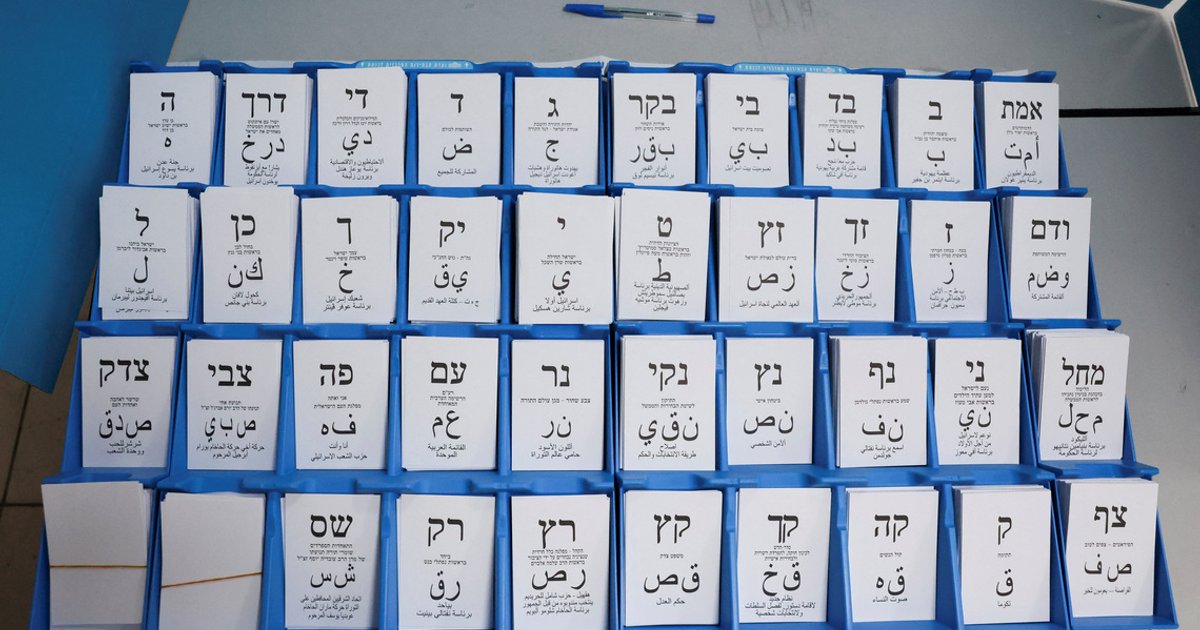
CAIRO/BEIRUT/GAZA, Oct 28 - Israelis voted in record numbers in Tuesday's wartime election billed as a major turning point in the nation's history. Others across the Middle East were merely filled with more pessimism after a nationalist veteran prime minister and a former hawkish military chief competed for Israel's leadership.Benjamin Netanyahu, Israel's longest-serving prime minister, won the support of an unexpectedly clear majority of Israeli Jews in the contest, apparently ensuring he will survive at least in a caretaker role.In Egypt, the first Arab country to make peace with Israel in 1979, 62-year-old lawyer Outhman Selim said his hopes that a Netanyahu defeat would steer the country away from the far right had been dashed.With nearly 86% of votes tallied on Wednesday, Israeli media forecast Netanyahu's bloc of right-wing, hardline and ultra-Orthodox parties winning 53 seats in parliament, surpassing 48 for the opposition bloc of rival Gadi Eisenkot.The election was the first since the Palestinian militant group Hamas shook Israel on October 7, 2023, killing 1,200 people and taking 251 hostage.The ensuing war in Gaza, which flattened most of the territory and killed more than 74,000 Palestinians, according to health authorities there, has left Israel increasingly isolated on the world stage, with a decisive shift in global public opinion against it, including in its closest ally the United States.WIDESPREAD INDIFFERENCEIn Gaza, displaced Palestinian Majed Jundia made no distinction between Netanyahu and Eisenkot, a former military chief."They want to eradicate the Palestinian people so they do what they want," said Jundia.Netanyahu was heavily criticised over security failures leading up to the Hamas assault on Israel's deadliest day.Portraying himself as the only leader who could protect the country, the consummate political survivor argued that his assassinations of the leaders of Hamas, Lebanon's Hezbollah and their ally Iran made Israel, and the world, safer.Kamel Haddad, an 81-year-old Lebanese man who has witnessed Israel's conflicts with neighbouring states over decades, expected no changes."As for who wins? I couldn’t care less. Let them tear each other apart, what difference does it make to me?” he said. "They might get preoccupied with one another since there are issues between them now. Perhaps they would leave us be for a bit.”While Netanyahu lost his bloc's majority in the 120-seat Knesset, as expected, his opponents were left with no hope of unseating him without an unlikely deal to accept broad backing from Arab parties, which many Jewish leaders reject.Even then, he would remain as caretaker during any coalition negotiations, or until a new election next year.Addressing his Likud party's faithful at its election headquarters in Jerusalem, Netanyahu called for the formation of "a strong, right-wing national government".PROSPECT OF RENEWED WAR WITH IRANHe also highlighted Israel's military successes and raised the prospect of renewed joint military action against Iran alongside his ally, US President Donald Trump."If one wins, he wants to strike you; if the other wins, he wants to kill you. That’s it, nothing else," said Jordanian Tarek al-Kaissy, reflecting on the competition between Netanyahu and his main rival Eisenkot.Eisenkot emphasized his security credentials on the campaign trail, citing his "Dahiyeh doctrine" of responding to attacks with disproportionate force, which he deployed as a commander during Israel's 2006 war with Hezbollah in Lebanon.His approach lowered any expectations of change, even before the election began.In Tehran, banners with images of slain Supreme Leader Ayatollah Ali Khamenei reminded Iranians of the early days of US and Israeli strikes at the end of February, which kicked off the war. Just to the right was a poster of late Hezbollah leader Hassan Nasrallah, who was killed on Netanyahu's orders."I genuinely see the possibility of attack," said 50-year-old Iranian citizen Abdollah Karimi. REUTERS
Israel's high-turnout vote brushed aside in rest of the Middle East
Full Article
Original Source
Read the full article at Straitstimes →KhanList aggregates and links to publicly available news content. We do not host full articles from third-party sources. Always verify important information with original sources.