
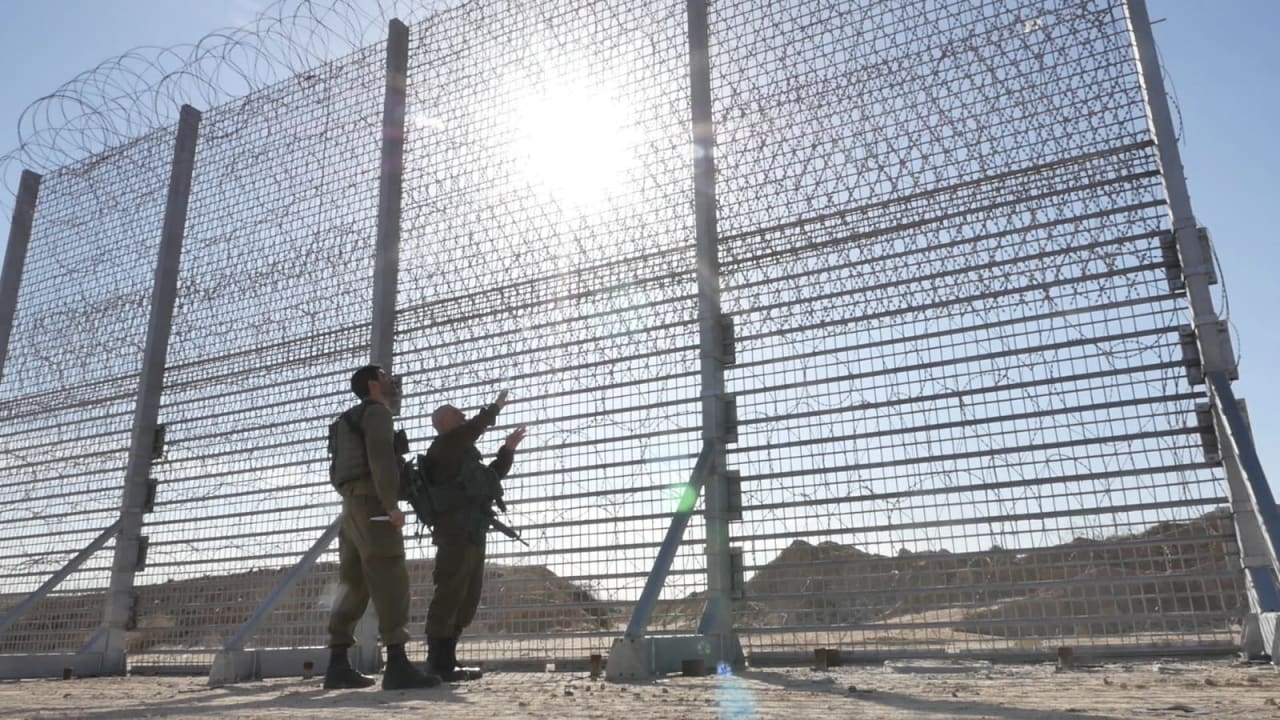
SEPTEMBER 10, 2026 18:00Since October 7, 2023, Israel has been fighting a war unlike any in its history, across multiple fronts, often with methods the rest of the world is only beginning to absorb.The record is formidable. Hezbollah has been decapitated and badly degraded as a fighting force. The infrastructure it spent years and enormous sums building for its own October 7-style assault on northern Israel has been shattered.Hamas remains alive, but it is hardly kicking. The Houthis have discovered that distance does not necessarily provide immunity. Iran has suffered blows that punctured the aura it spent decades constructing.Across these fronts, Israel has displayed tactical brilliance. Air power has been used with extraordinary precision and range. Israeli ground forces have adapted to dense urban warfare against an enemy embedded inside and beneath a civilian population.The IDF has shown ingenuity, resilience, speed of learning, and an ability to move between conventional war, counterterrorism, and long-range strike. The world has noticed. And therein lies the danger.The aftermath of Hamas's Nova music festival massacre in Re'im, southern Israel, on October 7, 2023. Picture taken November 2, 2023 (credit: Arie Leib Abrams/Flash90)There are two problems lurking beneath Israel’s success. The first is external. The West and much of the region are increasingly seeing Israel as a regional powerhouse. But Israel is not the regional powerhouse, and confusing those two things would be dangerous.Israel remains a small country with limited strategic depth and enemies whose combined demographic and geographic weight dwarfs its own. Israeli success will not end regional hostility. It may intensify it. Every humiliation inflicted on Iran, Hezbollah, and the broader anti-Israel camp creates deterrence, but also wounded pride and incentives to study Israel more carefully. The target on Israel’s back is getting larger.The second danger is internal, and perhaps more serious. Israel may begin believing its own hype. Much of what Israel has accomplished since October 7 was earned. The courage, improvisation, intelligence work, technological creativity, and operational skill are real. But not everything that went right was the product of Israeli brilliance.The elephant in the room is October 7 itself. Yahya Sinwar launched the attack without Hezbollah and Iran entering the war simultaneously at full strength. What would October 7 have looked like if Hamas had attacked from Gaza while Hezbollah unleashed its prepared invasion from Lebanon and Iran coordinated the wider network at the same moment? No Israeli victory since then should make that question less frightening. It should make Israel humble.This is where the history after 1967 becomes relevant. The Six Day War was one of the most spectacular military victories of the modern age. It was also psychologically dangerous. Israel had defeated surrounding Arab armies so decisively that military superiority began to harden into assumption. Assumption hardened into doctrine. Doctrine hardened into conceptzia (entrenched military mindset). It became that the Arabs could not threaten Israel on its own terms, and that Israel’s qualitative edge, warning time, intelligence, and established defenses would be sufficient.Then came October 1973.The Bar-Lev Line embodied part of that mindset. It offered a static defensive architecture along the Suez Canal that was politically reassuring and superficially formidable. Ariel Sharon argued for something different. He wanted depth, maneuverability, and the ability to move forces rapidly rather than fastening them to a rigid defensive line. When war came, the static line became a liability. Maneuver helped restore Israel’s advantage.The larger lesson was not that fortifications are useless. It was that Israel’s greatest military strength has rarely been its ability to sit behind walls. It has been its ability to move, improvise, surprise, and seize the initiative. Israel now faces a similar doctrinal crossroads.Turkey looms increasingly large. A Sunni security architecture is beginning to consolidate around states whose interests may increasingly diverge from Israel’s. Iran may be weakened, but weakened powers do not necessarily become passive. Hezbollah will rebuild if permitted. Hamas will mutate if it survives. The Houthis are learning. Every enemy Israel has fought is studying what worked, what failed, and where Israeli vulnerabilities remain. Warfare is an evolutionary animal. Nothing punishes complacency faster.As Israel's elections heat up, some of the political back-patting may capture votes but not reality. Israel cannot emerge from this war merely congratulating itself for having fought it well. It must ask what assumptions made October 7 possible in the first place. The greatest doctrinal failure was fortress logic.Israel placed trust in military technologyIsrael built walls, fences, sensors, cameras, barriers, and increasingly sophisticated defensive systems. Together, they encouraged a strategic psychology in which Israel allowed its enemies to gather along its perimeter while trusting technology, intelligence, and deterrence to keep danger on the other side. The enemies adapted. They used proxies, tunnels, militias, rockets, drones, political warfare, and gray zone tactics to compress Israel from every direction while keeping escalation below thresholds that would provoke decisive action. The answer moving forward cannot simply be a taller wall, more tanks next to it, and more planes looking over it.Israel has to recover maneuver as a strategic principle, not merely a battlefield technique. It has to create strategic options that allow it to fight on the edges rather than waiting for threats to accumulate along its borders.That means sea power.Israel’s geography is normally discussed as a weakness. It is narrow, small, and deprived of strategic depth on land. But its maritime geography offers something different. Israel sits at a hemispheric intersection of the eastern Mediterranean, the approaches to the Red Sea, and routes connecting Europe, Asia, and the Indian Ocean. At the same time, the naval threat is growing, from missiles and drones to mines, submarines, and hostile control of maritime choke points. The sea can become part of Israel’s missing strategic depth.That requires more than simply buying ships. Israel should build a maritime force around the warfare that is coming, not the fleets of the last century. Unmanned surface vessels, underwater drones, autonomous reconnaissance, mine warfare, counter-mine capabilities, long-endurance systems and mother ship concepts should sit alongside submarines, missile ships and naval aviation.The arrival of the Dakar submarine is important. But the submarine should be part of a wider architecture in which manned and unmanned systems operate together across enormous distances.Israel does not need to choose between air power and sea power. The challenge is to build another dimension around it. Air power gives Israel reach. Sea power can give it persistence. And maneuver gives both depth.The lessons of this war should not be that Israel is the region’s strongest military. That would be the beginning of another conceptzia. The lesson should be almost the opposite. Israel fought extraordinarily well because it adapted faster than its enemies, recovered the initiative, and refused to remain inside the assumptions that had failed on October 7. It was also helped by enemy mistakes and contingencies that Israel cannot assume will repeat themselves.The next enemy may coordinate better. The next technology may neutralize an advantage Israel currently considers permanent. So the strategic question is not how Israel preserves the military superiority it demonstrated in this war. It is how Israel prevents that superiority from becoming the mythology that blinds and invites the next one.That means adapting doctrine to a simple truth: fortresses invite siege, while maneuver creates uncertainty. Israel learned after 1967 how quickly victory can harden into complacency, and in 1973 how brutally an adapting enemy can exploit it. For a small country that cannot afford major mistakes, initiative is not merely an operational advantage. It is Israel’s most important doctrinal asset, and complacency its mortal vice.The writer is the co-founder of Jewish National Initiative.Follow us on Google
Israel’s greatest military strength is also its greatest strategic vulnerability - opinion
Full Article
Original Source
Read the full article at Jpost →KhanList aggregates and links to publicly available news content. We do not host full articles from third-party sources. Always verify important information with original sources.