
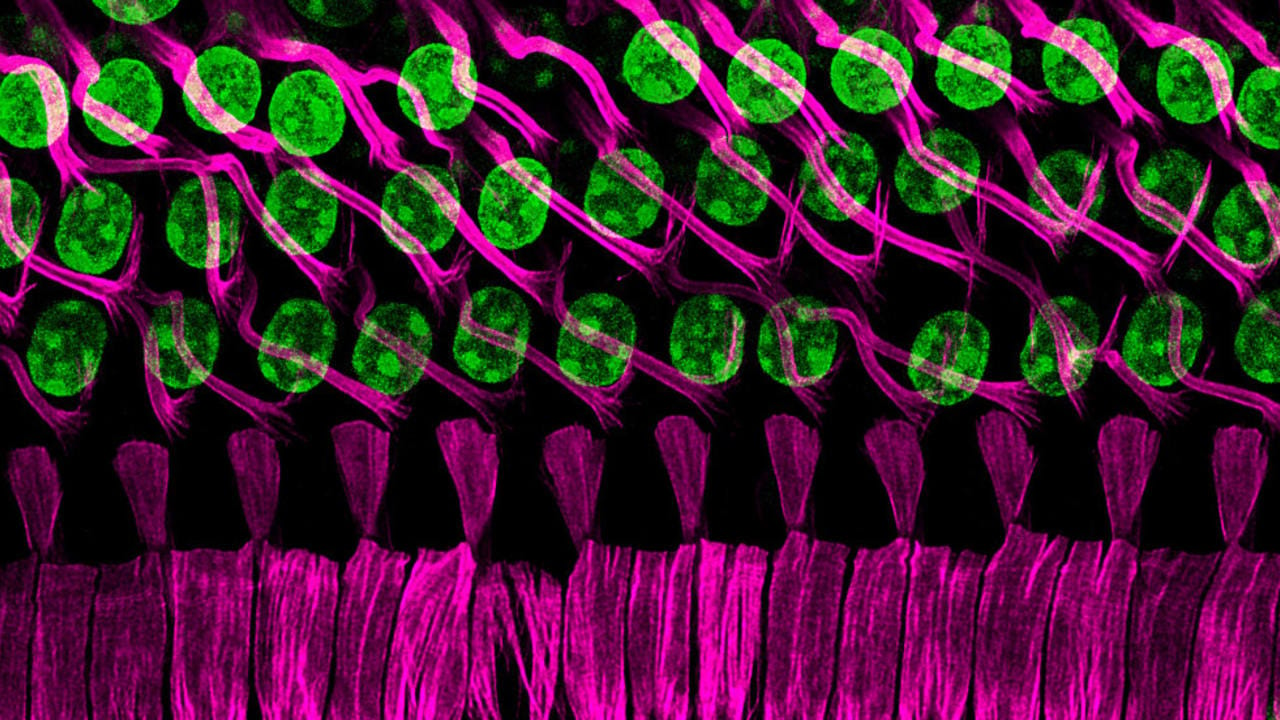
SEPTEMBER 26, 2026 07:40Imagine looking into a microscopic world where the slightest structural flaw can quiet the world entirely.For an extended Palestinian family, a rare form of congenital hearing loss accompanied by silvery-gray-colored hair in children offered a profound genetic mystery.An international team of researchers has now cracked the case.By identifying a critical role for the FMN1 gene, scientists have uncovered how a single microscopic protein maintains the inner ear’s structural integrity, bridging the gap between human genetics and cellular mechanics.The groundbreaking study by researchers from Bethlehem University, the University of Washington in Seattle, and Tel Aviv University (TAU) has just been published in the Proceedings of the National Academy of Sciences under the title “Formin-1 maintains cochlear microtubule architecture required for hearing in humans and mice.”LARA KAMAL (credit: TAU)The study was conducted by Lara Kamal, who earned her bachelor’s degree at Jordan University of Science and Technology, then worked at Bethlehem University, and is now completing her doctorate at TAU.The project team included Prof. Moien Kanaan (director of the Hereditary Research Lab in the Department of Life Sciences at Bethlehem University); world-renowned Prof. Mary-Claire King, Dr. Amal Aburayyan, and Dr. Suleyman Gulsuner of the University of Washington; and hearing expert Prof. Karen B. Avraham, Dr. Roni Hahn, and Dr. Shahar Taiber of TAU.Having identified the FMN1 gene as essential for human hearing, they traced how a rare genetic variant disrupts Formin-1, a vital protein encoded by the gene essential for inner ear architecture and hearing.By combining human genomics with decades-old mouse models, they proved that loss of Formin-1 disrupts the dynamic network of interlinking protein fibers that give the cell its shape and mechanical support, and helps transport materials in the organ of Corti – a sensory receptor organ for hearing located inside the cochlea, the hearing organ of the inner ear.The discovery began with a Palestinian family in which four children, among three sets of cousins, were born with bilateral, moderate hearing loss accompanied by silver-gray-colored hair. The children are otherwise completely healthy.The parents were not first cousins (consanguineous), but all are members of the same extended family.Genomic analysis revealed that the affected children carried two copies of a rare variant in FMN1 that led to the loss of the protein Formin-1.Genetic defects in other formin proteins have been linked with neurological, kidney, reproductive, and cardiac disorders, but the new discovery is the first in the world in which a human condition has been linked to a genetic defect in FMN1.PROF. KAREN AVRAHAM (credit: TAU)From mice to menTo investigate how loss of the protein causes hearing impairment, the team studied a mouse model that had no functional Formin-1. These mice were created in the early 1990s, but their hearing had not been studied before.The authors found that these mice presented a hearing loss similar to that of the Palestinian family. The mouse could then be studied to discover the underlying cellular changes within the cochlea.The mice’s abnormalities appeared soon after birth and continued with age. The structural disruption was accompanied by reduced auditory nerve activity and a lower number of auditory nerve fibers.Formin-1 is also part of a molecular complex involved in transporting melanosomes (the pigment-containing organelles that contribute to hair and skin color), and the researchers hypothesized that the hearing loss and altered pigmentation could therefore arise through different biological effects of the same genetic defect.“The discovery adds FMN1 to the more than 200 genes known to be essential for normal hearing and expands our understanding of the mechanisms underlying inherited hearing loss,” said Avraham, who is not only the senior author but also dean of TAU’s Gray Faculty of Medical and Health Sciences.“This discovery provides additional evidence for understanding that hearing depends not only on sensory hair cells and auditory neurons, but also on precise organization of supporting cells to maintain the cochlea’s structure and mechanics,” she continued.“As gene therapy for deafness becomes a reality, revealing the underlying genetic causes of hearing loss has become critical to treatment. Each new gene adds another part to our understanding of the complicated puzzle of auditory function.“This work has shown that global partnerships can drive meaningful scientific advances, helping to pave the way for future genetic therapies and interventions.“While the supporting cells are essential for the entire cascade of hearing to function normally, they do tend to be overlooked, as they are not the main cells leading to hearing function. But without them, the sensory hair cells cannot survive,” she explained.The team members predicted a developmental window in which treatment would have to occur and perform gene replacement with the intact gene, delivered with an adeno-associated virus that might delay or prevent the hearing loss from occurring.The pigmentation phenotype could actually provide a clinical clue for physicians to identify people with FMN1-related hearing loss, said Avraham.“If high-throughput genetic screening is done, this discovery would allow the clinicians to first look for mutations in this gene.”The team members have collaborated for almost 30 years.“The work with the human family was conducted in Prof. Kanaan’s and Prof. King’s labs on different continents, while Lara Kamal worked in mine,” said Avraham.“It has been a remarkable connection, with 24 co-authored scientific publications since then. The world seems to be disintegrating around us, but our scientific cooperation has been working well,” she continued.“We are learning more and more about the mechanisms involving deafness that can help us put all the pieces together: hair color and deafness.”PROF. MARY-CLAIRE KING (credit: University of Washington)Genetics and interconnectionsIn fact, Kanaan has worked with King and with Shaare Zedek Medical Center geneticist Prof. Ephrat Levy-Lahad for years to study breast cancer genes in Palestinian women.King became renowned around the world for proving that inherited breast cancer is caused by mutations in a gene she named BRCA1. Her work transformed how scientists understand hereditary breast and ovarian cancers, leading to modern genetic testing and screening.In 1984, she was acclaimed for her use of mitochondrial DNA sequencing to help identify Argentinian children kidnapped and illegally adopted during the Dirty War between 1976 and 1983.“Our Israeli-Palestinian-American collaboration has led to fine science and to fine careers of devoted young scientists from all three populations,” King declared.“We’ve shown that with persistence and confidence, good science can be carried out even in very difficult circumstances. There is a lot to be said for stubbornness on behalf of science,” she continued.Breast cancer is a major health concern for women around the world, yet many populations lack the same genetic risk assessment as the general population, added Kanaan.“Until recently, Palestinian women lacked access to genetic testing and cancer risk evaluation. The Middle East Breast Cancer Study the three of us conducted is changing that.”Asked how certain they were that the FMN1 variant is responsible for the hearing loss, King noted that “we are sure because both the human family and the mouse with loss of function of FMN1 have the same hearing loss.”“The mouse is from an inbred strain, and this is its only difference from the non-mutant strain, which has normal hearing,” she continued.“The project involved studying the human family, working with the database created by Moien Kanaan for the Palestinian population, hearing deficits in the mouse, and functional evidence of abnormal supporting cells due to the mutation.“This is the first time we encountered this particular FMN1 variant, which is not present in any public database or in the Palestinian genetic database created by Kanaan based on his studies of other inherited conditions in the Palestinian population.”When asked why the lab mice created in the early 1990s had not been examined then for hearing loss, King explained that “these mice do not have problems of balance, so it can be difficult to recognize hearing loss in a mouse if balance is normal.“And the geneticists who created the FMN1-mutant mouse were focusing on skeletal abnormalities during development, not on hearing. It apparently didn’t occur to them to evaluate their hearing.“We think there are other people in the world carrying mutations in FMN1 whose hearing loss would very likely have been attributed to something else, because FMN1 has not previously been included in panels of genes surveyed for deafness.”Kamal explained that she learned of the family at Bethlehem University: “My role was characterizing the family. The most difficult part is the responsibility of giving the family an answer; they already have two children with hearing loss.“The children have hearing aids and have undergone speech therapy. I worked closely with them all.”Kamal said that many genetic problems are caused by consanguinity in the Israeli Arab and Palestinian populations, but “fortunately, the rate is going down significantly; with the growth of better and higher education among the women, they are more aware of the problem of marrying close relatives.”Follow us on Google
Israeli scientists help solve genetic mystery linking hearing loss and gray hair
Full Article
Original Source
Read the full article at Jpost →KhanList aggregates and links to publicly available news content. We do not host full articles from third-party sources. Always verify important information with original sources.