
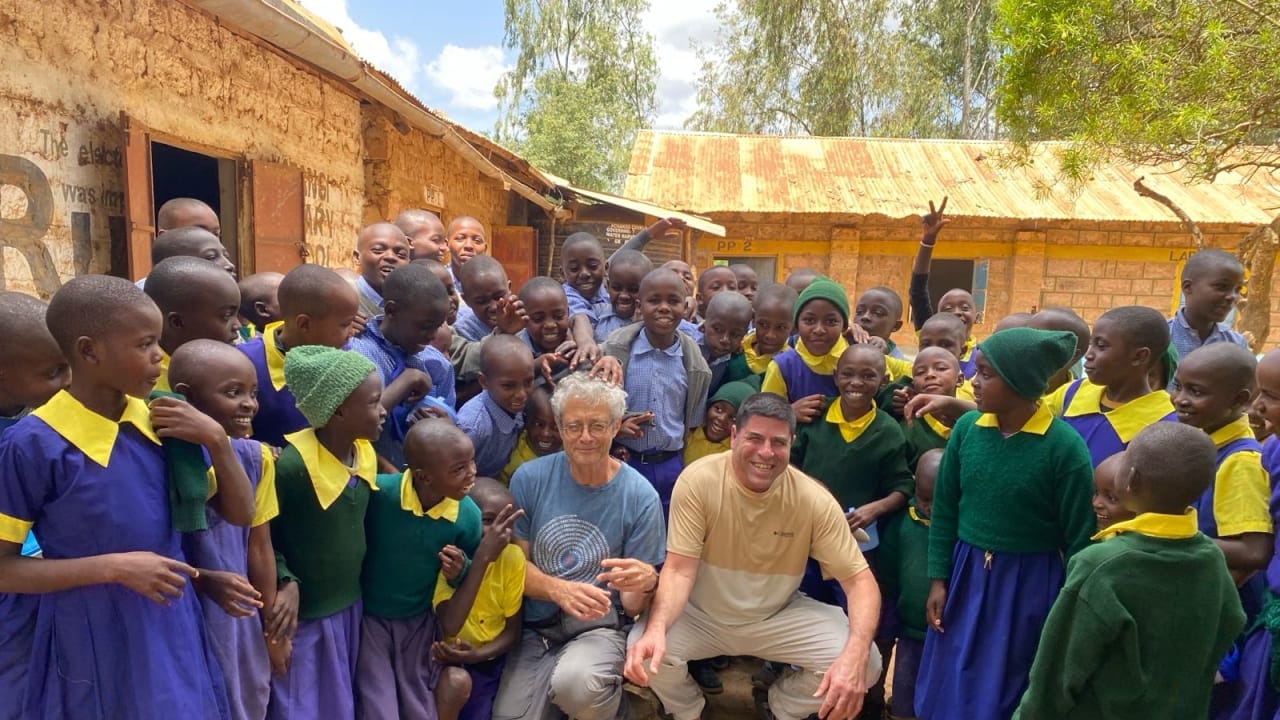
SEPTEMBER 1, 2026 09:41As Israeli children return to their classrooms for the new school year, Israeli adults are traveling the world to expand education in communities where there is limited infrastructure or where disaster has disrupted the education system. A pilot program launched six months ago by ConnectingMath, an Israeli nonprofit working to expand access to math education in developing countries, has become part of the school routine for some 800 students in grades first through sixth at eight rural schools in Kenya. The program centers on a local teacher, Aaron, who travels with 20 tablets to a different school each day to teach math lessons. School principals say that at the sound of his motorcycle on the dirt roads, the children run out to greet him.Students work in pairs or groups of three on hundreds of activities that work without internet access.Since the beginning of the year, students have completed over 100,000 activities.ConnectingMath in Kenya (credit: SID ISRAEL)“When we left Kenya in January, we weren’t sure the pilot could keep going with only remote support from us,” Shmulik London, co-founder of ConnectingMath, said.“Six months later, we returned to find that the students and teachers had made it part of their school routine. Watching classrooms come alive around just 20 tablets showed us how, even with limited resources, the right educational approach can bring learning, and the joy of learning, to life.”A teacher with Early Starters International works with children affected by earthquakes in Venezuela. (credit: SID ISRAEL)Early Starters International helps young children in disasters and crisis areasFormer Education Ministry employee Keren Gantz-Maya, who used to train kindergarten teachers, joined Early Starters International, which specializes in working with young children during emergencies and crises, in Venezuela. Early Starters International has six safe spaces in La Guairá and Caracas. Children take part in educational activities that help them return to interaction, play, and learning.By mid-August, over 25 activities had taken place with over 946 attendances. The organization has also trained over 214 local teachers, educators, therapists, and other professionals to ensure that the community will be able to continue the work."When you meet children after a disaster like this, you can’t begin with learning in the conventional sense. First, you have to help restore a sense of safety, routine, and connection. We saw children who struggled to connect and play together during our first meeting. After we returned again and again, they were waiting for us, joining in and playing together," Gantz-Maya said."That’s when you understand how a safe, consistent educational space can become an anchor for a child whose world has changed overnight,” she added.RoboGroup in Ghana (credit: SID ISRAEL)RoboGroup partners with Ghana government to construct STEAM learning centersIn Ghana, Israeli company RoboGroup is partnering with the country's Education Ministry to establish 20 science, technology, engineering, arts, and math (STEAM) learning centers nationwide. The centers feature science, robotics, and programming labs, 3D printers, and digital manufacturing technologies, giving students opportunities to experiment, investigate, build, and code.RoboGroup is also training local teachers and instructors to lead the programs in order to build educational capacity that can be locally sustained.“Our partnership with the Government of Ghana is a flagship education project in Africa,” said Yoram Doitch, CEO of RoboGroup.“Our mission is to give every child the opportunity to explore their curiosity and to help every teacher develop critical skills in ways that are accessible, engaging and meaningful.”Jacob Sztokman, founder of Gabriel Project Mumbai and students. (credit: SID ISRAEL)Gabriel Project Mumbai brings digital science labs to indigenous communitiesGabriel Project Mumbai (GPM) brings digital science labs to seven government schools in Maharashtra’s Palghar District, where more than 6,000 children from indigenous communities study with limited access to computers.Fourteen teachers travel in pairs between the schools carrying Einstein Tablets, designed by Israeli company Fourier Education, which function as portable science labs.They also carry additional tablets for math, computer studies, and other STEM subjects.For some students, the program provides their first opportunity to conduct a science experiment or learn using digital technology.“The children love science and conducting experiments,” GPM founder Israeli social entrepreneur Jacob Sztokman said. “Their eyes light up when an experiment helps them understand how the world works. In those moments, you can see their curiosity grow, and their love of learning come alive.”The three nonprofit organizations and RoboGroup are members of the SID Israel community, the umbrella organization for Israel’s international development and humanitarian aid sector.“For us, a new school year begins in a classroom, but for millions of children around the world, the basic conditions needed to learn cannot be taken for granted,” said Ayelet Levin-Karp, CEO of SID Israel.“Quality education can change the course of a life, open up new possibilities and give children the tools to build a different future for themselves. It is inspiring to see members of the SID Israel community not only believe that every child, everywhere, deserves a genuine opportunity in life, but work every day, even in some of the world’s most challenging and remote places, to turn that belief into reality.”Follow us on Google
Israeli non-profits, companies expand education access in remote communities worldwide
Full Article
Original Source
Read the full article at Jpost →KhanList aggregates and links to publicly available news content. We do not host full articles from third-party sources. Always verify important information with original sources.