
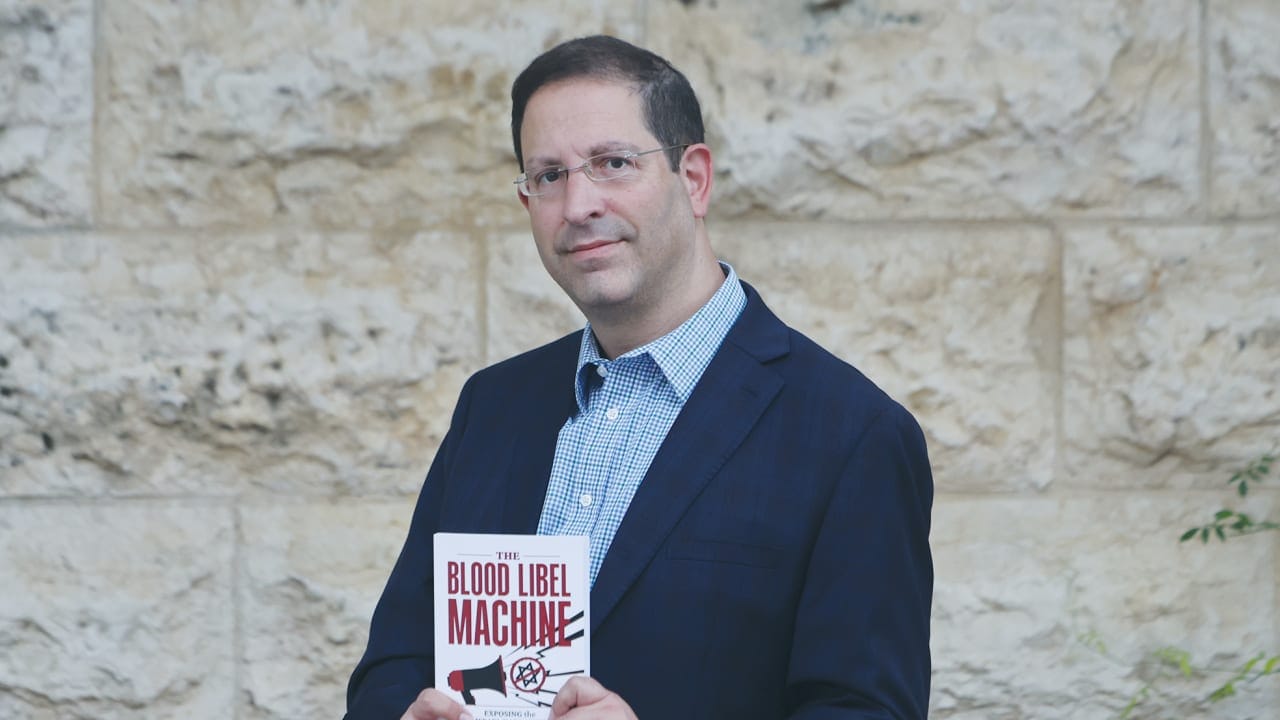
OCTOBER 17, 2026 18:40Three years after Hamas’s October 7 attack, Israel is still fighting a war it was never prepared for, one in which the weapons are not missiles or tanks but headlines, social media posts, and the narratives that shape how the world sees the Jewish state.For Gil Hoffman, a veteran political analyst who has spent much of his career examining how Israel is portrayed abroad, this battle is not simply a public relations issue, but a strategic threat that the country’s leadership has repeatedly failed to recognize.Hoffman covered politics for The Jerusalem Post for nearly a quarter century, before taking over as executive director and executive editor of HonestReporting to “lead the fight for Israel on the media battlefield.”He spoke with the Post this week in the wake of the publication of his new book, The Blood Libel Machine, which argues that the spread of anti-Israel narratives and the surge in global antisemitism were not simply spontaneous responses to the war, but the result of a premeditated information campaign that had been in the works for decades.On October 7, 2023, that media battlefield took on a new urgency. As Hamas terrorists crossed into southern Israel, the images and accounts of the massacre spread quickly around the world.A billboard in Times Square displays the message ''Israel is committing genocide'' as part of the campaign by Game Over Israel calling for a boycott of Israel by national soccer federations over the war in Gaza, in New York City, U.S., September 16, 2025. (credit: JEENAH MOON/REUTERS)Israel failed on a major front: The media landscapeHoffman saw that Israel had been caught off guard in two distinct but interconnected arenas. In his book, he describes October 7 as not only a military and intelligence failure, but also a failure on the media front.Three years on, he said, Israel still fundamentally misunderstands how to communicate with the world.Israel’s failure to prepare for the media battlefield“Hamas planned this war in order to impact public opinion around the world,” he said. “Their goal was not Nova, which they did not know about; it was New York, and Israel played into their hands. They wanted Israel to respond with what they could call disproportionate force, no matter what it would be, and return the Palestinian issue to the international agenda.”Israel not having a plan on this front, just like it didn’t have a plan on the military front, has harmed the Jewish state “tremendously,” Hoffman added.“Every day since October 7 has become easier on the military battlefield. Every day since October 7 has gotten progressively harder on the media one.”The contrast is central to his book. Israel has devoted enormous resources to its military prowess, but Hoffman argues that successive governments have treated public diplomacy as a secondary concern, despite its potential influence on both domestic security and the security of Jewish communities abroad.According to Hoffman, the problem begins at the highest levels of government.“They did not realize they need to be taking into account how the decision they’re about to make in Gaza, in Iran, against Hezbollah, how these decisions are going to impact the Jews in Golders Green and in New York. They did not take it into account whatsoever.”Another strategic failure Hoffman identified is Israel’s tendency to remain on the defensive rather than challenge the credibility and motivations of those shaping the international narrative.Much of Israel’s media strategy, if there is one, has focused on rebutting misinformation, disputing facts and figures, and pointing out flaws in logic.Hoffman said Israel needs to be much more on the offensive.In his book, he lays out four necessary strategies he believes must work together: offensive and defensive messaging, both within the context of the conflict and beyond it.“I count four. It makes a Venn diagram that works all together. If you’re missing out on any of the four, then it’s inadequate. So, yes, we need to be blackening the names of the people fighting against us.”For example, Israel should be “outing” international anti-Israel figures who are accepting huge amounts of money from Qatar, Hoffman argued.“We need to be outing that. It’s not legitimate, the way that Qatar is influencing the world. Al Jazeera is not a legitimate news organization. It’s a propaganda mouthpiece of a terrorist-supporting state. People need to know that. People need to know what they can and they can’t trust.”Qatar occupies a prominent place in Hoffman’s analysis. The Gulf state, which has hosted Hamas political leaders and played a central role in negotiations involving Israel and Hamas, funds Al Jazeera, one of the most influential Arabic-language news networks in the world. Hoffman argues that Qatar’s financial and media influence warrants greater scrutiny.The offensive strategy also needs to be employed more on college campuses, where, for a very long time, the pro-Israel groups have been trying to be “nice,” and Hoffman says they “need to be less nice because the anti-Israel organizations on their campus are not nice.”He believes pro-Israel students and organizations need to be more assertive in challenging anti-Israel activism rather than relying primarily on dialogue and attempts to persuade those already strongly opposed to Israel.This also connects to Qatar, given the extensive reporting indicating significant academic institutional ties between the Gulf state and US universities.How international institutions shape the narrativeOne of the most challenging aspects of this media fight is combating the dominant narrative disseminated by human rights bodies and NGOs, Hoffman said.The United Nations, Oxfam, Amnesty International, Doctors Without Borders, and others have been instrumental in legitimizing the anti-Israel rhetoric used in public and private spaces. Because of these organizations, buzzwords such as “genocide,” “apartheid,” and “ethnic cleansing” have become normalized in day-to-day discourse and in international media outlets.Hoffman said he wanted to speak to journalists who covered the conflict during the war and “give them the benefit of the doubt.” He said he asked them why they believed Hamas.“They said, ‘No, we didn’t believe anything from Hamas. We believe the organizations [like the UN].’ And they believed Hamas.“These organizations were the ones who spread the propaganda and sanitized what a terrorist organization [Hamas] told them. Then the media quote these reputable organizations around the world, and it becomes a vicious circle. As Gerald Steinberg, the founder of NGO Monitor, understood way back at the Durban [Conference], this was going to cause damage to Israel, and now the entire world needs to understand that.”The Durban reference is significant. At the 2001 UN World Conference Against Racism in South Africa, an accompanying NGO forum became the focus of controversy over antisemitism and the portrayal of Israel. Its declaration described Israel as an apartheid state and accused it of genocide and ethnic cleansing, language that would become increasingly prominent in subsequent campaigns against the Jewish state.In Hoffman’s view, the events surrounding Durban were not an isolated episode but an early indication of how human rights terminology could be used as part of a broader campaign to delegitimize Israel.“So, that’s part of that blood libel machine, the way in which – wittingly or unwittingly, and, unfortunately, too often wittingly – these NGOs were part of it. So the blood libel machine is the media. It is Qatar. It is Hamas. It is the anti-Israel organizations around the world.”Fighting back against the machineFighting this is an uphill battle, partly because these organizations are viewed internationally as the beacons of justice and paragons of morality. It is not easy to convince skeptics that their findings and public statements should be subjected to the same scrutiny as those of governments and other parties.“It’s hard, but we need to be constantly putting out facts,” Hoffman continued. “We know how many tons of aid we’re giving to Gaza. We know what everything Israel did unprecedentedly to help an enemy combatant in the time of war. We know how much effort Israel made to minimize civilian casualties. Little by little, we can chisel away at this false narrative that has been hoisted upon the world.”Hoffman’s determination to remain optimistic is a recurring theme throughout both the book and the interview, even as he describes the scale of the challenge facing Israel.“I didn’t want to write a book of gloom and doom. I wanted to write a book that would give people hope.“That’s why the subtitle of the book is Exposing the anti-Israel Hate Network, and How to Fight Back. I give people 30 different tools they can use, whether it’s in mainstream media, social media, or AI platforms.”Rather than leaving readers with a diagnosis of the problem, Hoffman devotes a substantial portion of the book to practical action. He does not believe it is too late for Israel to turn the tide.“It’s not too late. Every day, every single person on social media and even people who aren’t on social media, in the checkout line of the grocery store, everybody can make an impact.“I don’t view it as this mountain that’s insurmountable. I believe in celebrating incremental success. And we, every day, can change minds. Not of the most extreme people, but of the overwhelming majority.”One way he suggests people take action is by engaging more critically with international media and holding them accountable when they find incorrect or biased reporting.“People often ask me, should I cancel my subscription to The New York Times and other media outlets for being anti-Israel?“I say absolutely not. You need to be reading it. If you want to hurt them, then read them more carefully. If you see something problematic, send it to the media watchdogs like HonestReporting or to journalists themselves, or send it to their local media and point out that their rival had made an error. And that’s all part of regaining deterrence on the media battlefield.”This approach is shaped by his years in journalism and media monitoring. Rather than disengage from outlets they distrust, Hoffman argues, readers should become more informed, attentive consumers of their reporting.He cited an example of when, during coverage of the release of the final 20 living hostages in October 2025, CNN reporter Christiane Amanpour claimed that Israeli hostages were treated “better than the average Gazan” because Hamas used them as bargaining chips.Someone flagged the comment, and Hoffman himself then contacted Foreign Minister Gideon Sa’ar, who contacted CNN and requested that she be held accountable.Amanpour subsequently apologized, calling her comments insensitive and wrong.“That came from ordinary people who were watching and made sure that we would realize this. And so people can have that role when they see things that are egregious.”Social media also has the technology for users to critically engage. For example, users on X/Twitter can add community notes on posts that are incorrectly presented or are missing key information.Looking to Israel’s next governmentWhile Hoffman does believe responsibility can rest with individual news consumers, his criticism ultimately returns to Israel’s political leadership and its failure to treat public diplomacy as an essential element of national security.While citizens may help challenge misleading narratives, only the government has the authority and tools to establish a coordinated, long-term communications strategy, one that anticipates the international consequences of its actions rather than responding after the damage has been done.“They need to be taking this just as seriously as the nuclear threat from Iran, because it’s an existential threat to the future of the State of Israel and the Jewish people around the world.“And they need to be caring about the way every decision they make is perceived abroad.”With Israel’s October 27 elections approaching, the question is whether a new government, regardless of its political makeup, will be prepared to invest in the media battlefield as seriously as it invests in conventional security.“It doesn’t matter who wins the election. They all need to make sure the next government allocates just as much, if not more, funding to media strategy and public diplomacy. They need to have people ready 24/7 to go on the media and explain what’s going on here, in every language imaginable.“The embassies and consulates abroad are dreadfully underfunded. And that needs to be changed, because those are the people who are building the relationships with the people there on the ground and with the media.”Hoffman makes the case that the fight over Israel’s international reputation will not end when the fighting on the ground does. It will continue in newsrooms, universities, online platforms, and in day-to-day communication.And while governments bear the most responsibility for preparing Israel to confront that challenge, Hoffman’s resounding message is that the battlefield is no longer theirs alone. Its outcome will also depend on whether those watching from the sidelines are willing to take action.Follow us on Google
Israel must treat the media war as seriously as Iran’s nuclear threat, Gil Hoffman says
Full Article
Original Source
Read the full article at Jpost →KhanList aggregates and links to publicly available news content. We do not host full articles from third-party sources. Always verify important information with original sources.