
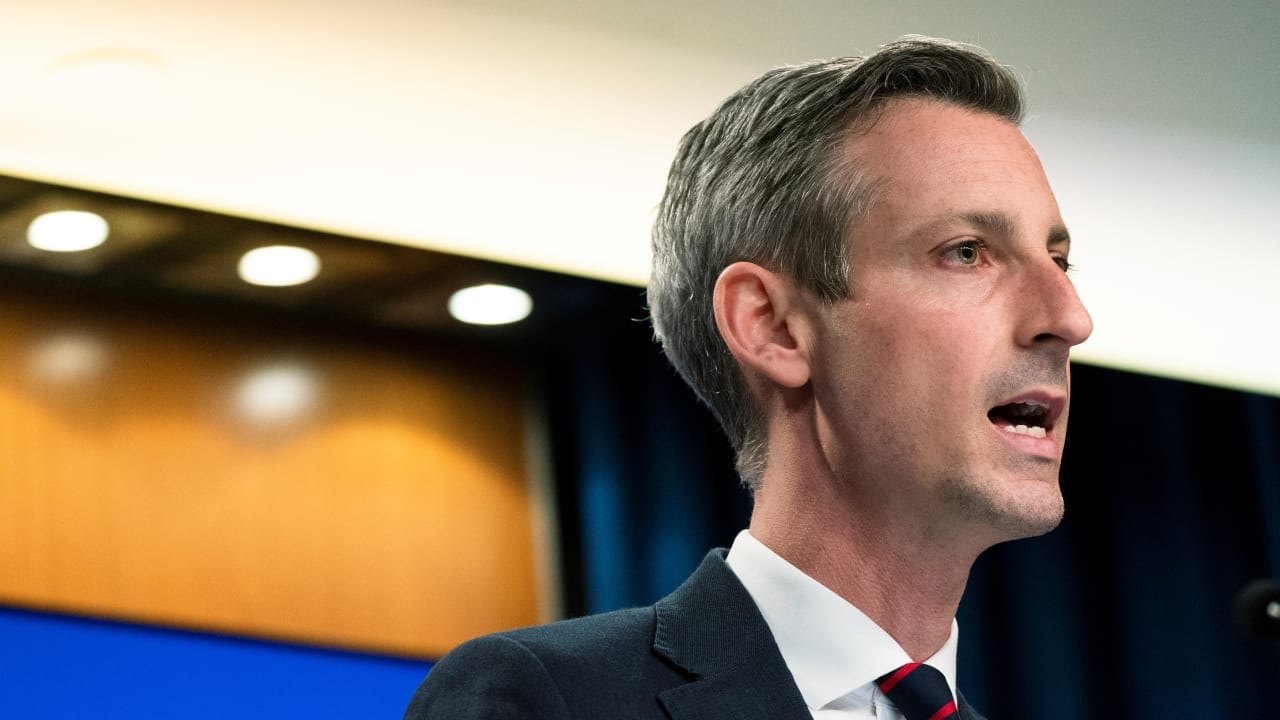
NOVEMBER 18, 2026 15:59Updated: NOVEMBER 18, 2026 16:26From the two-state solution to Iranian ballistic missiles to being ready for security zone withdrawals to making promises about future weapons use to maintain sales, former senior Biden administration official Ned Price recently spoke with The Jerusalem Post about what Israel needs to do to stabilize its cratering status among US Democrats.While some issues might only require smaller changes which are less painful, Price believes that on other issues, like the two-state solution to the conflict with the Palestinians, Israelis are going to need to travel a large distance soon.Israeli security forces at the scene of a shooting incident in which a Palestinian woman was killed during clashes involving Israeli settlers and Palestinians in Ein al-Duyuk al-Tahta, near Jericho in the West Bank, November 17, 2026. (credit: FLASH90)Two-state solution better than one stateOn one hand, even the Biden administration, let alone the Trump administration, had stopped talking about the two-state solution since 2021, which most Israelis are even more strongly opposed to after Hamas's October 7 invasion.But on the other hand, Price, who previously served as deputy US ambassador to the UN and in other US State Department and CIA roles, said the concept will likely make a comeback.He said, "Regarding the two-state solution, there are different people in different places. There is de-emphasized language about it for a number of reasons. It just has not been a near-term viable path for quite some time."But some "on the left increasingly embrace the idea of a one-state reality with equal rights. That is not something that is consistent, as far as I see it, with Israel's legitimate identity as a Jewish and democratic state," he warned.He continued, "For that reason, to shift our strategy [away from the two-state solution] at this stage has tremendous pitfalls. I'm not there. Not many mainstream [Democrat] voices are there. But it is a talking point that if Israeli leaders won't move on the question of two states – then there is only one alternative, and it is not a pleasant one for Israel's chosen identity."This means "there needs to be a fundamental shift of conduct in Gaza – but also with regard to the West Bank, Syria, Lebanon, with regard to any sort of military engagement in the region.""They have all been at the root of the deterioration of relations. Gaza has been the headline since 2023. The West Bank has been simmering much longer. The concerns there have accelerated," he emphasized.Next, Price stated, "Syria and Lebanon too. It is not just one theater where Israeli conduct needs to change. Israel needs to do something different really across the board.""These are ultimately Israeli decisions. Israel can maintain a similar course at all of these places, but it will come at the cost of American support. Our support, in addition, to our European partners out in front of us," he cautioned.ILLUSTRATIVE: Palestinians gather near the site of a house targeted by an Israeli airstrike after the Israeli military warned residents to evacuate it on Thursday, in Gaza City, October 30, 2026. (credit: REUTERS/DAWOUD ABU ALKAS)What about the idea that the US Board of Peace and some Israelis have raised of a partial rebuilding and IDF withdrawal in Gaza for partial Hamas disarmament? He responded, "People land in different places on this within the Democratic party's tent. Some reject something like that out of hand," as they want a full Israeli withdrawal from all areas it has taken over since October 7."There is also a strong case for taking this course of partial versus partial as an interim step. But the idea of 'partial' from many in this country {the US] in the Center and the Left is that any sort of annexation and any change in borders, de facto or de jure, is inconsistent with what," the Biden administration said, and with "much of what this [the Trump] administration has said."Still, Price said personally he understood that, "We are not getting to the two-state solution tomorrow. So it is not unreasonable to take a partial for partial approach for now; it is much better than nothing," even if there would be expectations about two states at some later future point.Prior weapons sales likely grandfathered in, but future sales in play for conditionsHoming in on the controversy of what will happen to US military aid and weapons sales to Israel, especially whether US Democrats will honor prior contracts for F-35s and F-15 fighter jets, Price said, "As a factual matter, all contracts have clauses as pertainto American national security and national interests; there are 'escape hatches' for existing contracts [to allow canceling them], but I don’t think there will be a single answer like that.""My hunch is that the focus in the future will be on: what does that dynamic look like going forward. Sales that have gone through the process probably won't be the first priority among the majority of [Democrat] voices. Instead, how do you normalize the relationship regarding security assistance for the coming years?" he said would be the main issue of debate among Democrats.He agreed that Democrats would push for future contracts not to be approved without clearer pre-deal promises not to offend the provisions of the US Leahy Act, which would mean not to break international law as interpreted by the US, not as interpreted by Israel.While there are overlaps, the Biden administration and most Democrats believe that Israel's interpretation of international law for conducting the Gaza war was far too aggressive and that its targeting must be more restrained going forward to keep receiving US weapons.Ballistic missiles must be part of any new Iran deal, but Tehran may get a bigger paydayConfronting the standoff with Iran, Price said that "Israel's actions in the region implicate more than Israeli national security. When missiles or kinetic operations start on an ongoing basis between Israel and Iran, that also has implications for America in the region: for American facilities, broader interests, and our people there.""I don’t think the sort of thing for the next American administration will be you do you, and we'll take care of us. There should be an effort by the administration to engage Israel meaningfully on its legitimate security concerns," he said.Moreover, Price explained that, "The next administration would be wise to think about ballistic missiles in diplomacy as well [as a new nuclear deal]. It was not included in the JCPOA [2015 nuclear deal]. That is not to say that the JCPOA was fatally flawed. It was never in any prior diplomatic agreement."But going forward, "both the nuclear program needs to be put in a box, and the unconstrained ballistic missile program isn’t good for Israel and is not good for the US, especially with what Iran can reach, knowing the second- and third-order effects," alluding to Iran firing missiles at around a dozen countries in the region."Constraining Iran's ballistic missile and drone program needs to be subject to close coordination with diplomatic outreach and diplomatic initiatives. There are various ways to control ballistic missile threats," according to Price.He added, "Ultimately, the most durable resolution is a binding diplomatic deal because it is enforceable as well," but in the absence of that, "there are other tools short of all our overt kinetic operations which can also be under consideration," in a clear reference to covert CIA or Mossad operations."Do I think….Iran will be eager to sign on to," these limits, he asked rhetorically, implying clearly not. "But there will probably be painful concessions if we are able to get there…we are going to have to be creative…Iran is going to have to be incentivized…this is not going to be cost-free for us," he foreshadowed.Further, he said, "it is impossible to conjure now what it might look like, but the alternatives have been far more painful, as we have seen post February this year," with repeated cycles of kinetic and economic warfare."To my mind, this [a deal] is the only way to meaningfully, durably, and verifiably keep this [the ballistic missile threat] in a box, the same way as the nuclear box," he asserted.Follow us on Google
Israel must change course or risk losing Democratic support, ex-Biden official warns - interview
Full Article
Original Source
Read the full article at Jpost →KhanList aggregates and links to publicly available news content. We do not host full articles from third-party sources. Always verify important information with original sources.