
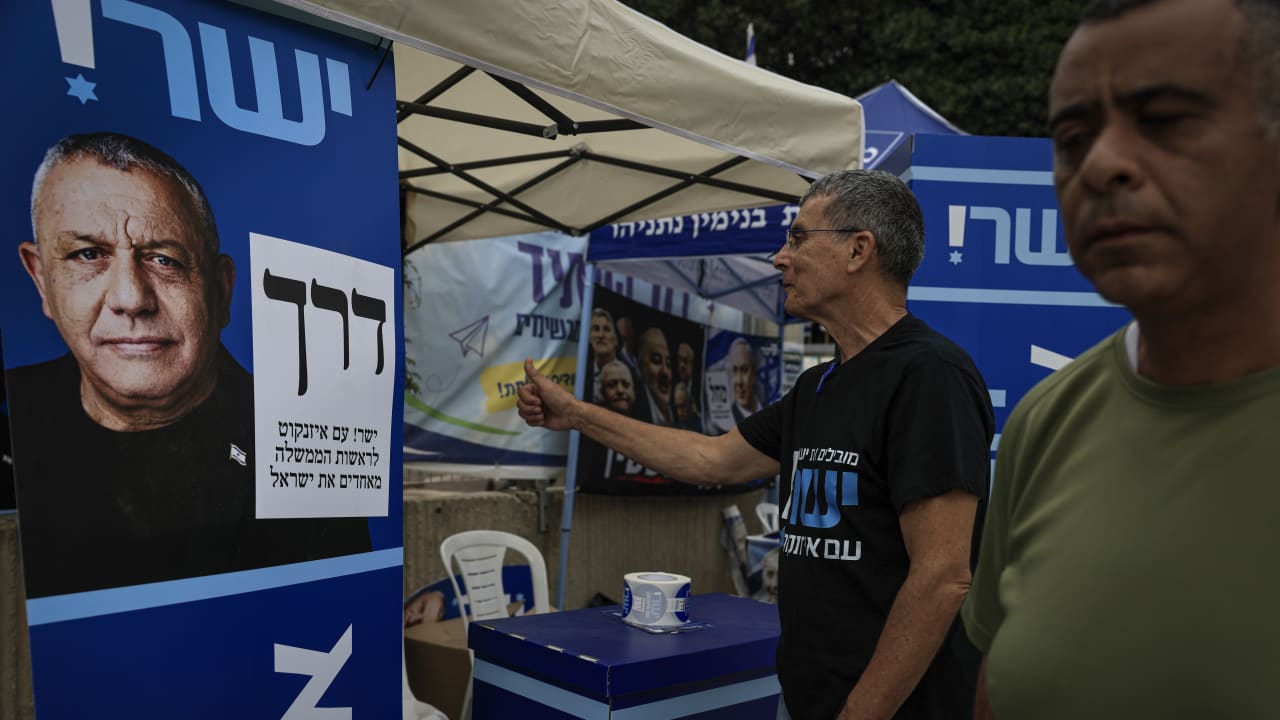
OCTOBER 28, 2026 22:17Updated: OCTOBER 28, 2026 22:35Prime Minister Benjamin Netanyahu’s bloc maintained its lead and was projected to win 53 seats in the 26th Knesset, while the opposition bloc seeking to replace the premier was projected to win 48, according to official Central Elections Committee (CEC) figures released on Wednesday evening after over five million votes had been counted in Tuesday’s election.Still, both blocs fell short of the 61 seats needed for a Knesset majority without the Arab parties' support, which won a record-breaking combined total of 19 seats.The official vote count reached about 88% on Wednesday evening and excluded only double-envelope ballots, which were set to be counted throughout the night.Double-envelope ballots could still affect final election resultsDouble-envelope ballots allow eligible Israelis, including IDF soldiers, hospital patients, prisoners, and certain election workers, to vote outside their designated polling stations, and they could still affect the final results.Netanyahu's Likud is projected to enter with 26 seats, making it once again the largest party in the Knesset, according to the official vote count. United Torah Judaism, Shas, and Otzma Yehudit are expected to enter with seven seats, and the Religious Zionist Party with six seats. Prime Minister and Likud party chairman Benjamin Netanyahu at the Likud party’s election headquarters in Jerusalem, October 28, 2026 (credit: MARC ISRAEL SELLEM)Most TV channel polling before the elections showed Likud receiving significantly fewer seats, while the other parties in Netanyahu's bloc were projected to gain more.The opposition bloc, comprising Yashar, B’Yachad, Yisrael Beytenu, and the Democrats, is expected to enter the Knesset with 48 seats, according to CEC data.Gadi Eisenkot's Yashar is projected to enter the Knesset with 21 seats. B'Yachad, led by Naftali Bennett, is expected to enter with 12 seats. Yair Golan's Democrats are expected to enter the Knesset with eight seats, and Avigdor Liberman's Yisrael Beytenu with seven.Most TV channel polling before the elections showed the opposition bloc in the lead, and projected Yashar as the largest party in the Knesset.The small right-wing parties hovering near the electoral threshold, Ofer Winter’s People of Israel and Yoaz Hendel’s The Reservists-Economic party, were both projected to fall short of the required 3.25% threshold, potentially further complicating efforts by Netanyahu’s bloc to secure a majority.The Joint List was projected to win 12 seats, while Ra’am was projected to secure seven seats in the next Knesset.Amid the high Arab voter turnout, Netanyahu’s Likud later on Wednesday accused the Arab parties of allegedly stealing the election through widespread electoral fraud, bribery, intimidation, and ballot manipulation, demanding an immediate investigation by law enforcement authorities.Despite the election results, a unity government involving Netanyahu and Eisenkot appears unlikely, as Eisenkot has rejected serving under Netanyahu, including in a rotation government. Other opposition leaders have also ruled out joining a coalition led by the prime minister.The political deadlock could ultimately lead to another election, although the parties may still reach an agreement through coalition negotiations.By law, the president must consult the Knesset factions before deciding who gets the task of forming a government.Herzog calls on politicians to keep open minds during coalition negotiationsPresident Isaac Herzog on Wednesday called on political leaders to approach coalition negotiations with open minds, warning that Israel must do everything possible to avoid another round of elections."One thing must be understood, and I said this even before the elections: We must do everything, certainly after yesterday, to avoid another round of elections.“Therefore, I expect everyone who comes here to arrive with an open mind," Herzog said, referring to the consultations expected to take place at the President's Residence.Golan on Wednesday confirmed he would be meeting with "three opposition leaders" on Thursday, calling for the opposition bloc to form a government.When asked further in a Channel 12 interview, the Democrats party leader declined to name which leaders he would meet.Earlier on Wednesday morning, Golan called on the opposition bloc to form a government with the Arab parties arguing that Netanyahu lost the elections with some 55 seats, compared to the opposition's 65, as he included the Arab parties in his coalition calculations."Netanyahu lost. I know how to count to 120. Sixty-five is more than 55. That's how Israeli democracy works. Period," the former IDF deputy chief of staff wrote on social media."We have no future here if we don't stop being afraid...We must no longer accept Netanyahu's racist division between Jewish votes and Arab votes," Golan added.Golan further argued that the opposition won a Zionist majority, saying that the prime minister "should subtract 16 seats" belonging to the haredi parties.All other opposition party leaders in the bloc seeking to replace Netanyahu have drawn a red line to Arab parties being part of the government, arguing that they are not viable coalition partners after the October 7 Hamas attacks in 2023. Eisenkot has called for the leader of the largest party in the opposition bloc to become its prime-minister candidate, though the bloc has not announced any agreement on the arrangement.The Yashar leader declared victory for the opposition bloc on Tuesday night after exit polls showed it in the lead. Later that night, Netanyahu also delivered a victory speech, after polling began showing his bloc with a clear lead.The political deadlock also raised the possibility of a minority government that could win a Knesset confidence vote without an absolute majority of 61 seats. In that scenario, Arab parties could agree to support the opposition bloc. Members of the Arab parties have called to do whatever is possible to prevent Netanyahu from remaining in office.However, objection within the opposition bloc to relying on Arab parties could complicate such an arrangement. Liberman had openly rejected such an option ahead of the elections.Joint List prepared to 'pave the way,' for Netanyahu ouster, Jabareen saysOn Wednesday, Joint List chairman Yousef Jabareen said that his party was ready to "pave the way for the ousting of the Netanyahu government." He had previously said he would support a minority government if a series of demands were met.Later, in an interview with Army Radio, Joint List faction chairman MK Ahmad Tibi (Hadash-Ta'al) hinted at his willingness to sit with the opposition.“The opposition bloc will be able to form a government if it has the courage. We are extending a hand and are ready to help," he said.The Bennett-Yair Lapid government formed in 2021 was the first in Israel’s history to include an Arab party, Ra’am, in the coalition – a highly controversial move. Bennett has since taken a firm stance against including any Arab faction in a future coalition.Ra'am has sought to be seen as a viable coalition partner, with its chairperson Monsour Abbas announcing in August that former Yesh Atid MK Yoav Segalovitz would be added to hold the second slot on his list.The move was unprecedented, as he was the first Jewish candidate to join the Islamist-conservative political party. Adding a Jewish, Zionist candidate to the Arab party’s list has been widely seen as a way for Ra’am to appear as a more viable coalition partner.Shir Perets and Jerusalem Post Staff contributed to this report.Follow us on Google
Israel election results: Netanyahu bloc holds lead with double envelopes to be counted overnight
Full Article
Original Source
Read the full article at Jpost →KhanList aggregates and links to publicly available news content. We do not host full articles from third-party sources. Always verify important information with original sources.