
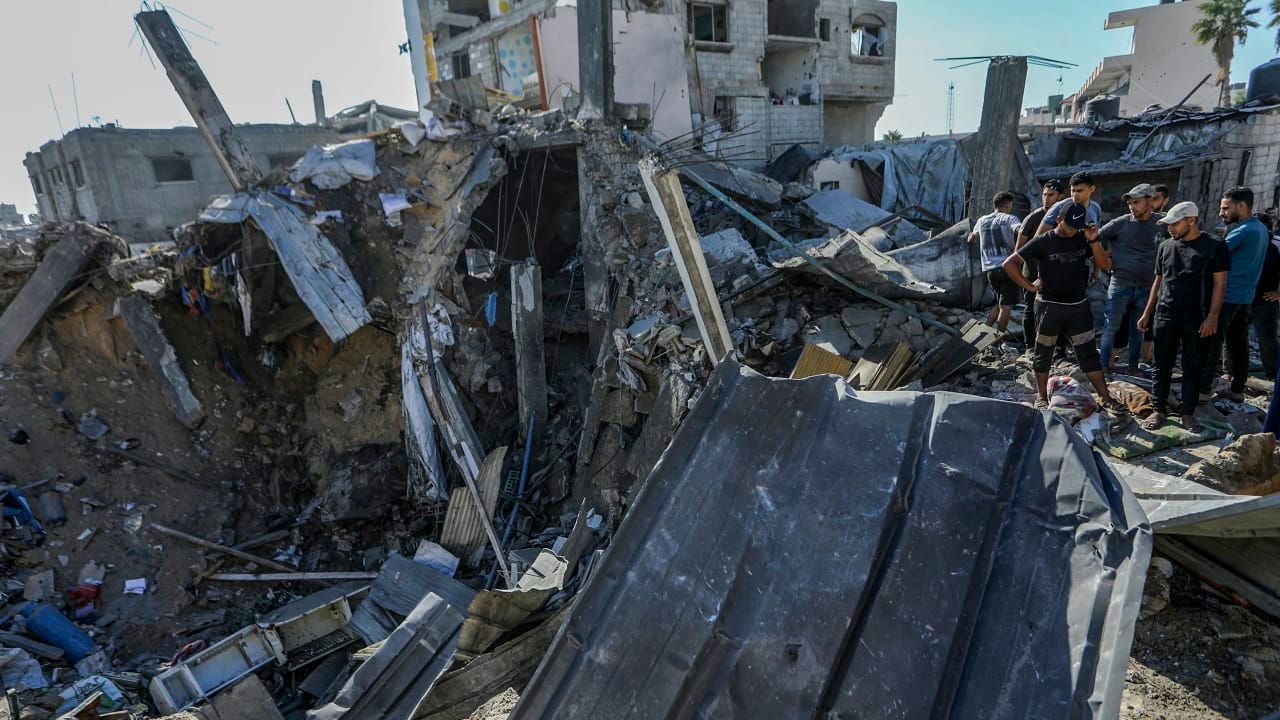
SEPTEMBER 18, 2026 09:06How many people in Israel, or even around the world, could name the winner of the Special Jury Prize at the Venice Film Festival last year? Probably almost no one.Venice is one of the world’s most prestigious film festivals, but it is an industry event – a place where filmmakers, directors, and producers showcase their latest projects, generate buzz, and hope that distributors and critics take notice. Most of what happens there never reaches the wider public.Then came NAZA, the documentary by Israeli journalists Yuval Abraham and Rachel Szor that won the Special Jury Prize at Venice this weekend and almost immediately became the center of a political and public storm in Israel.The film examines allegations surrounding Israeli military targeting in Gaza, including anonymous testimony from purported soldiers and intelligence officers claiming that the IDF permits “mass killing” with AI-powered tools.And if the goal of the Israeli officials attacking the film was to prevent people from seeing it, they accomplished exactly the opposite. Culture and Sports Minister Miki Zohar’s announcement that he would seek to revoke the filmmakers’ citizenship only increased the world’s attention to the film. He can be sure that now viewer numbers will go up exponentially.Directors Yuval Abraham and Rachel Szor, and crew pose during a photocall for the documentary ''Naza'' in Competition, at the 83rd Venice International Film Festival, in Venice, Italy, September 10, 2026. (credit: REUTERS/YVES HERMAN)What Zohar fails to understand is that this is not the way to counter the false allegations raised in the movie. Like Zohar, and almost everyone else attacking the film, I have not seen it (it is not available yet in Israel), and so it is hard to start to dissect the details.Nevertheless, we can argue about the general way the IDF fights – in my view, in one of the most humane ways in modern warfare – and against the perverse claims of genocide that have been leveled for the last three years against Israel.In other words, you can hate the film, believe it is distorted, unfair, or even defamatory. You can challenge every allegation and even take the filmmakers to court and sue them for libel. But threatening to strip Israelis of their citizenship because they made a film critical of their country is something else entirely.Not only does such a move not make Israel look stronger, but it creates the impression that we have something to hide and are afraid of criticism. It makes it seem like we fear to stand up for our truth and what we believe in.Doing this undermines one of the basic values Israel has always insisted distinguishes it from its enemies: that as a vibrant democracy, we allow people to say things that the government – and many citizens – might find outrageous.This is not how a side confident in its case should behave. Someone wants to make a movie accusing the IDF of war crimes? Then fight back. Explain why the claims are wrong.Show how the combatant-civilian ratio is historically low when compared to any urban warfare conflict with remotely similar conditions. Produce a film showing your truth and the other side of what happened in Gaza. Make the case. But don’t try to silence the criticism. Confront it head-on.But the political response was only one part of the problem. Then came the IDF’s response.Chief of Staff Lt.-Gen. Eyal Zamir ordered the establishment of a multidisciplinary, interorganizational team led by the head of the IDF Planning Directorate to develop ways to counter what the military described as false allegations against the IDF and its soldiers.I read that announcement and had one question: Where has Zamir been for the last three years?Did nobody in the IDF, the Prime Minister’s Office, or the Foreign Ministry read an American or European newspaper over the last three years? Did nobody watch CNN or the BBC? Did nobody see the way Israel and the IDF were being portrayed around the world?Now, because of a movie, the IDF is creating a multidisciplinary team? This should have been done years ago. Israel needed a coordinated effort to collect facts, release information, quickly investigate accusations, and challenge false claims in real time.A responsible country doesn’t wait for a movie to come out before realizing it has an information problem. It identifies the problem early on (the massive protests around the world should have helped them wake up) and builds the tools needed to confront it.But even if Israel had handled the public diplomacy surrounding the war perfectly, NAZA would still raise a deeper and far more uncomfortable question – one that Israelis need to confront regardless of whether the movie itself is accurate, distorted, or something in between.It is a question about Gaza itself.A few months into the war, in a meeting with a senior executive at one of Israel’s leading television stations, I asked her a simple question: Why don’t we see on the evening news what is happening inside Gaza? She answered that we did, since almost every night there was footage from IDF operations there.I explained that what I meant was not what the IDF was doing in Gaza but what was happening to Gaza.To her credit, she paused before answering.“We have limited time on the news,” she said. “We have hostages, dead soldiers, evacuees from the north and the south, and protests across the country. We can’t show everything.”I was not arguing that Israeli television had some ideological obligation to generate sympathy for Gaza. My point was simpler: Israelis were forced into a war that they did not want and were now fighting in one of the most just wars in the nation’s history.In addition, what was happening in Gaza was Hamas’s fault. They embedded themselves in civilian infrastructure since they wanted Israel to attack and kill as many civilians as possible. It was for this reason that Israel, for almost 20 years, held back from launching such an operation despite fighting a conflict almost every two years since the withdrawal from the Gaza Strip in 2005.But none of that meant that Israelis should ignore the full scope of the war. We can believe that Israel was 100% justified in responding the way it did to October 7 and in fighting Hamas with the aim of its elimination, while also recognizing the consequences of that war.To understand the conflict we are fighting, we also need to understand what it has done to the people living on the other side. War is terrible. That we know. It is why we tried for so long to avoid it. But understanding a war means looking not only at why it was fought and what our soldiers were asked to do, but also at what happened as a result.Importance of recognising the suffering of the other sideOur sympathy will obviously be first and foremost for ourselves. That is the way it should be. But that does not mean we should ignore what is happening on the other side, including the pain and suffering there as well. That, too, is part of the story.Recognizing that does not mean accepting the accusations against Israel. It does not mean agreeing with claims that Israel committed genocide or deliberately targeted civilians. I have repeatedly explained why I believe those accusations are baseless and false.But rejecting those accusations does not require us to deny what happened in Gaza. It simply means recognizing what happened.We can believe that the war was forced upon Israel by Hamas and that Hamas bears responsibility for the devastation because of the way it fights and embeds itself in civilian infrastructure. We can believe that after October 7, Israel could no longer tolerate a genocidal terrorist army on its border with a declared desire to carry out another massacre.We can remain committed to the mission that has yet to be accomplished to ensure that Hamas no longer exists and at the same time, we can look at what happened in Gaza and acknowledge the tragedy.Those two thoughts can coexist.In many ways, that tension helps explain why NAZA has touched such a raw nerve. Whatever one thinks of the film itself, it forces Israelis to look directly at something that, as a society, we have largely managed not to look at for nearly three years.Our own suffering has understandably dominated our consciousness since October 7. We suffered the worst massacre of Jews since the Holocaust, saw entire communities destroyed, people killed in the worst ways known to man, and hostages starved in complete darkness inside tunnels.That trauma is real. But recognizing what subsequently happened to civilians in Gaza does not diminish it. It does not create some moral equivalence between October 7 and the war that followed. It simply requires us to look at the full picture.Part of the reason that has been so difficult is leadership. Israeli political leaders do not speak publicly about Palestinian suffering during the war. Even acknowledging it is viewed as an admission of guilt rather than a recognition of the human consequences of war.But leadership is only part of the explanation. There is another reason Israelis have struggled to look at Gaza: For much of the public, the war does not feel over.All of the hostages, living and dead, have returned home, but Israeli soldiers remain deployed in Gaza, and Israeli strikes continue. Hamas has yet to disarm, and significant parts of President Donald Trump’s 20-point plan for Gaza remain unfinished. The objective of the war – Hamas’s destruction – has yet to be met.As a result, the wound of October 7 therefore remains open, and when your own wound is still open, it is difficult to look at somebody else’s.But eventually Israel will have to. Part of recovering from October 7 will mean confronting what was done to us: the failures that allowed the attack to happen, the trauma that followed, the lives that were lost, and the damage this war inflicted on Israeli society.Recovery will also require something else: the confidence to look honestly at what happened on the other side without believing that doing so somehow weakens our own story.What it means is understanding that a country can believe deeply in the justice of its cause and still recognize the consequences of the war it was forced to fight.Israel is strong enough to do both.The writer is a co-founder of the MEAD Forum, a senior fellow at the Jewish People Policy Institute, and a former editor-in-chief of The Jerusalem Post. His latest book (with Amir Bohbot), While Israel Slept, is a bestseller in the United States.Follow us on Google
Israel can reject NAZA’s claims without ignoring Gaza’s suffering - opinion
Full Article
Original Source
Read the full article at Jpost →KhanList aggregates and links to publicly available news content. We do not host full articles from third-party sources. Always verify important information with original sources.