
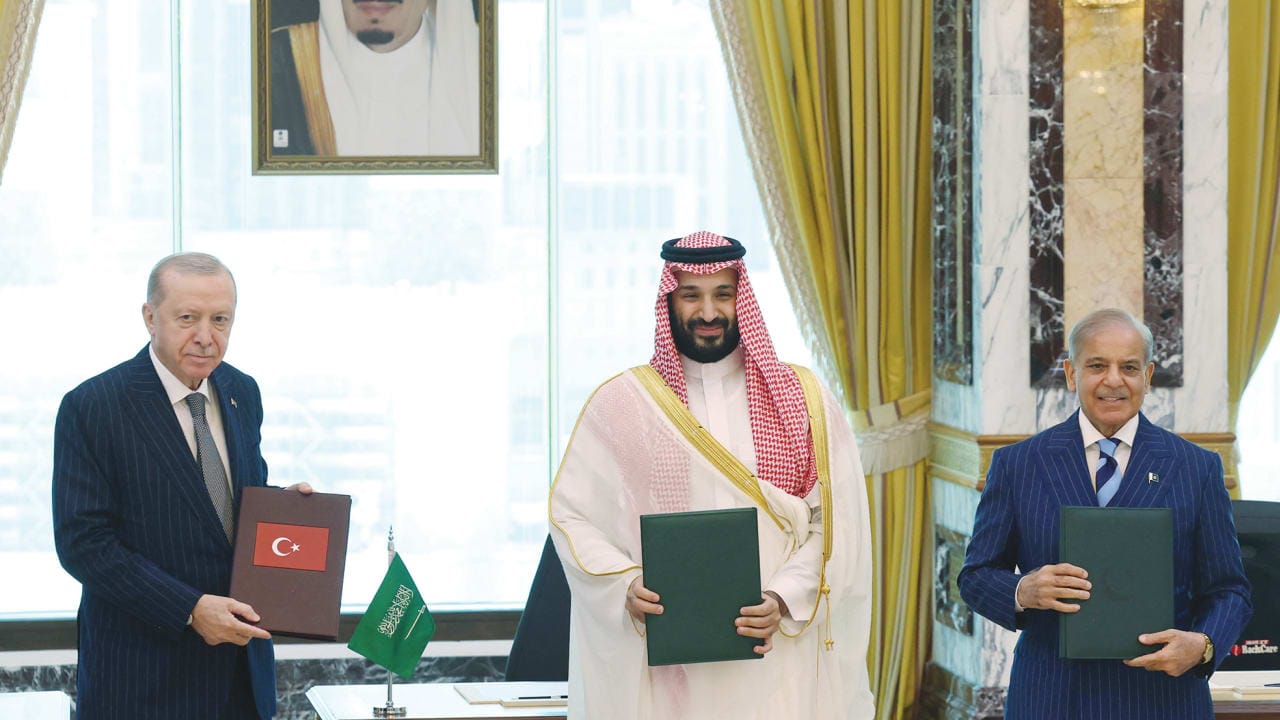
The concept behind the Mecca Joint Defense Agreement seems more about starting a process than enabling these countries to rapidly deploy to any of their partners' homelands.Follow us on GoogleTURKISH PRESIDENT Recep Tayyip Erdogan, Saudi Crown Prince Mohammed bin Salman, and Pakistan’s Prime Minister, Shehbaz Sharif, pose after signing a joint defense agreement in Mecca, August 7, 2026.(photo credit: Murat Cetinmuhurdar/Turkish Presidential Press Office/Handout via REUTERS)SEPTEMBER 17, 2026 16:38The Houthi advances in Yemen have taken Saudi Arabia and the Middle East by surprise. Riyadh had been working on cementing a new defensive alliance with Turkey and Pakistan on the eve of the Houthi attacks. Now, some commentators seem to think the Saudi-Pakistan-Turkey pact may already be in jeopardy.The question is whether this may be a misreading of what is going on. First, a sampling of articles. NDTV notes “the Houthis have exposed Saudi-Pak-Turkey pact for what it is.” Ynet News notes “Houthi attacks reach Mecca, exposing limits of Saudi defense pact with Turkey and Pakistan.”Al Jazeera asks what is next for the defense pact. Middle East Eye noted, “Why the Mecca defense pact hasn’t triggered action against the Houthis.” It goes on to say that a “Turkish official argues new alliance with Saudi Arabia and Pakistan needs time to become operational.” Jacobin had argued that the “Mecca Agreement between Saudi Arabia, Turkey, and Pakistan is a response to insecurity and waning American power in the region” and compared it to NATO.Just days and weeks ago, reports suggested more countries might join the pact. Deutsche Welle, for instance, noted that “while Bangladesh weighs the risks of signing the Mecca Joint Defense Agreement, experts warn that such a move could complicate relations.”Also, The Japan Times noted, “Pakistan faces pressure to pick a side as Saudi tensions with Houthis escalate.” That article adds, “Fighting between Yemen's Iran-backed Houthi movement and Saudi forces is increasingly testing how long Pakistan can hold both positions at.”In this handout screen grab captured from a video provided by Houthi Media Center, Yemeni Houthi group fighters inspect debris from a Karayel drone of the Saudi-backed forces after it was downed by the Houthi-run air forces during the ongoing fighting in Yemen, September 10, 2026. (credit: Handout by Houthi Media Center via Getty Images)The assumption that the Mecca pact might lead to Turkey and Pakistan fighting the Houthis may be part of the false assumptions about the alliance itself. It is a defensive alliance. It can be argued that the Saudis intervened in Yemen in 2015 and therefore it is not a “defensive war.”In addition, the war was already ongoing when the deal was signed. There was no hint in the signing that Riyadh was going to call on these two countries to send troops to Yemen or send air defenses to the Kingdom. Furthermore, Pakistan and Saudi Arabia were already working together on defense issues, and Pakistan was not being asked to go into Yemen.Mecca Joint Defense Agreement vs North Atlantic Treaty OrganizationIt may be instructive to look back at other historic alliances to understand the challenges that are faced by the new partners. NATO, the North Atlantic Treaty Organization, was founded in 1949 by the United States, Canada and ten Western European countries amid growing tensions with the Soviet Union. Its central principle, Article 5, considers an attack on one member an attack on all.NATO expanded during the Cold War and confronted the Soviet-led Warsaw Pact. After the Soviet Union collapsed in 1991, the alliance admitted numerous Central and Eastern European states and conducted operations in the Balkans and Afghanistan. Russia’s invasion of Ukraine in 2022 reshaped NATO’s priorities, strengthening its focus on collective defense and leading Finland and Sweden to join the alliance.What was NATO’s role in some of the conflicts that the US fought around the world? It didn’t feel compelled to go into Vietnam, for instance. This war was far off, far from the concept of confronting the Soviets in Europe. It also was a war where the US intervened. The US was not attacked. NATO also was not involved in the Falklands War, even though the UK had been attacked. It didn’t get involved in Northern Ireland either.Yemen may be more akin to a Vietnam for Saudi Arabia. It’s a complex conflict in which Riyadh backs the internationally recognized government. As such, it is like the US backing South Vietnam against the Vietnamese insurgency, or Viet Cong.The Houthis are the Viet Cong. They are hard to beat in a similar manner. They have also been acquiring more sophisticated weapons from foreign powers, just as weapons from the Soviets or China were trekked down the Ho Chi Minh Trail.Saudi benefit from Turkish, Pakistani advice limitedSaudi Arabia might benefit from some advice from Turkey and Pakistan. However, that benefit may be limited. Pakistan has a large army but has fought insurgencies for years. However, it has not been particularly successful at defeating those insurgencies. Turkey has also been fighting wars for years. For instance, it fought the PKK. Ankara’s experience was more successful than Pakistan’s.The question for Saudi Arabia is what it wants now. It has to decide on its policy. Until it does so, its partners can’t ride to the rescue. In fact, the concept behind the Mecca Joint Defense Agreement seems more about starting a process than about enabling rapid deployment by these countries to any one of their partners' homelands.Follow us on Google
Is the Saudi defense pact misunderstood amid Houthi attacks? - analysis
Full Article
Original Source
Read the full article at Jpost →KhanList aggregates and links to publicly available news content. We do not host full articles from third-party sources. Always verify important information with original sources.