
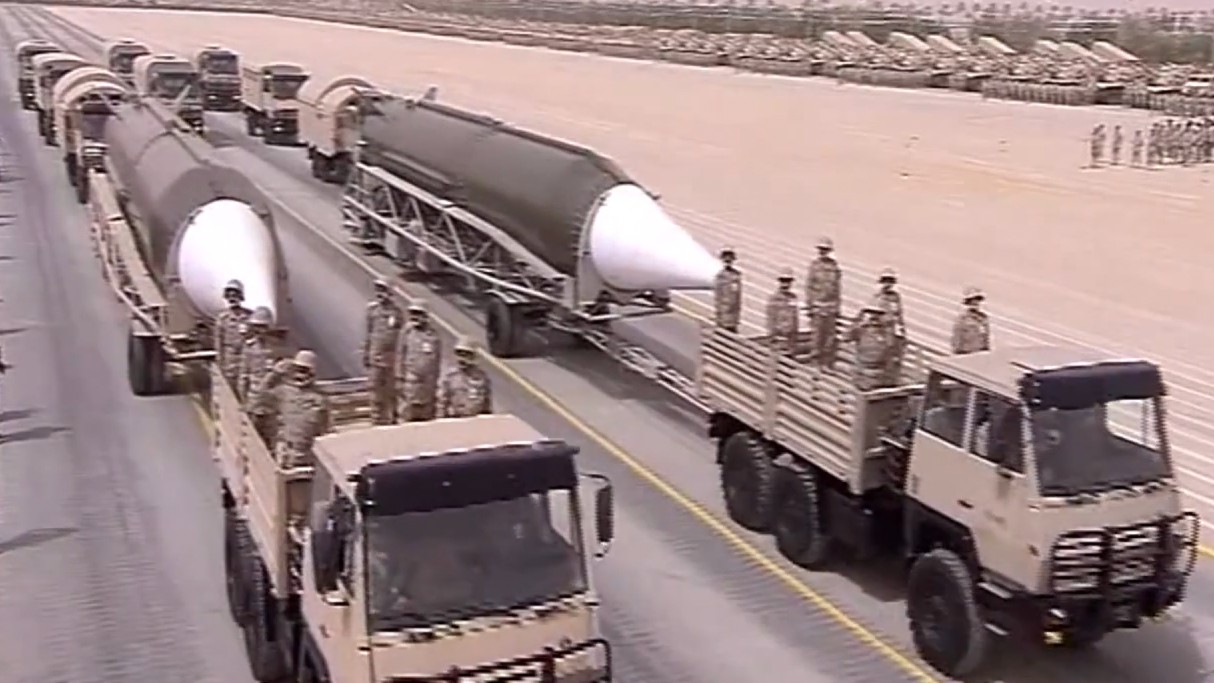
Saudi Arabia is believed to be expanding its Chinese-designed ballistic missile arsenal as it faces an unprecedented barrage of missile and drone attacks from Yemen's Houthi rebels. Satellite imagery analysed by American researchers suggests the kingdom is expanding its ballistic missile plant at al-Duwadimi in Riyadh Province to build larger solid-fuel missiles capable of carrying heavier payloads across greater distances. Fighting between the kingdom and the Iran-aligned Yemeni group has intensified since July, shattering a UN-brokered truce that had largely held since 2022. The Houthis have stepped up missile and drone attacks on Saudi cities, airports and energy infrastructure, retaliating for what they call a Saudi "blockade" of ports and airports in Houthi-controlled areas of Yemen. Analysts have told Middle East Eye that the renewed confrontation with the Houthis has given the kingdom's arsenal added significance. New MEE newsletter: Jerusalem Dispatch Sign up to get the latest insights and analysis on Israel-Palestine, alongside Turkey Unpacked and other MEE newsletters Riyadh is reported to have begun building ballistic missiles domestically with Chinese assistance in 2021, but its relationship with Beijing over the weapons dates back several decades. In the 1980s, shortly after establishing the Royal Saudi Strategic Missile Force (RSSMF), Riyadh turned to Beijing for its first ballistic missiles. Beijing supplied conventional DF-3 intermediate-range ballistic missiles with an impressive range of over 2,000 miles but incredibly low accuracy. Saudi Arabia reportedly acquired more accurate DF-21 medium-range ballistic missiles with conventional payloads in 2007. In September, footage of missile debris in Yemen indicated that Saudi Arabia had fired a DF-15A short-range ballistic missile, potentially marking its first combat use of one of its Chinese-designed missiles. Ameneh Mehvar, Middle East senior analyst at the Armed Conflict Location & Event Data (Acled) project, said the expansion reflected a broader Saudi strategy of diversifying its military capabilities. "Riyadh continues to invest heavily in advanced US-supplied aircraft and defence systems, while Chinese-designed ballistic missiles provide an additional means of conducting long-range strikes without exposing aircraft to enemy air defences," Mehvar told MEE. "Expanding domestic missile production could also give Saudi Arabia greater control over its strike capabilities and reduce its dependence on foreign deliveries," she said. 'Less exposed to geopolitical shifts' Sim Tack, vice-president of technology and intelligence solutions at AllSource Analysis, says the satellite imagery provides a strong indication that the programme is continuing to advance. "The expansion of infrastructure to support ballistic missile developments is notable in the sense that it confirms continued efforts to expand indigenous missile design and production capabilities," Tack told MEE. "Given the regional dynamics, this intent fits with the ambitions to balance missile capabilities against Iran and its allies such as the Houthis," he said. 'Domestic production capabilities and their continued development indicate most of all that Saudi Arabia intends to be self-sufficient in the production of ballistic missiles' - Sim Tack, AllSource Analysis The expansion also points to Riyadh's ambition to source more of its missiles domestically. Its traditional reliance on Western suppliers for military equipment has left it with limited options in the ballistic missile sector, partly because those countries have sought to avoid fuelling regional proliferation of surface-to-surface missiles and related technology. That has helped push Saudi Arabia towards China as a discreet supplier of the weapons. "Domestic production capabilities and their continued development indicate most of all that Saudi Arabia intends to be self-sufficient in the production of ballistic missiles," Tack said. "Domestic production, and possibly even indigenous design, of ballistic missiles would allow Saudi Arabia to be less exposed to geopolitical shifts that could limit access to the weapon systems they would need to maintain a viable deterrent or even offensive capability," he added. Recent developments related to US military support to Ukraine, the rapid depletion of American weapon stockpiles, and sensitivities around sourcing military equipment from China underline the increased importance of having such a localised production capability. Deterrence and nuclear ambitions Sebastien Roblin, a widely published military aviation journalist, argues that the purpose of the RSSMF should be understood in two ways: its ability to deter regional adversaries and its potential contribution to actual military operations. "Most importantly, the missile force gives Saudi Arabia a way to practically deliver a nuclear strike, should Riyadh ever develop or otherwise acquire nuclear warheads – something looking distinctly possible today, particularly as Riyadh builds up its alliance with Pakistan," Roblin told MEE. Egypt deployed forces to Saudi Arabia before Sisi's public pledge of military support, sources say Read More » "While Pakistan and Israel have independently modified US fighters for nuclear delivery, indigenously built ballistic missiles are arguably a more practical debut delivery platform, especially as Iran currently has limited ballistic missile defence capability," he said. "Importantly, for strategic nuclear deterrence, such missiles don't have to be particularly accurate." Solid-fuel missiles, like those Saudi Arabia is reportedly developing, offer another important advantage: they can be stored ready for launch indefinitely, unlike liquid-fuelled missiles, which require more preparation. Keeping solid-fuel ballistic missiles on standby also reduces the likelihood that an adversary could destroy the kingdom's deterrent capability before it has a chance to launch. "In theory, the ballistic missile force also exerts conventional deterrence," Roblin said. "Though in the current context of the attacks that have already rained down on cities across the Middle East in the last few years, I'm not sure Saudi conventional ballistic missiles can scare Tehran or the Houthis after what they've already endured recently." The challenge of precision If Riyadh intends to use its conventionally armed ballistic missiles to achieve specific military objectives, rather than simply inflict what Roblin describes as "unpredictable destruction and psychological shock", accuracy will be critical. The DF-15A and DF-21 missiles are considerably more accurate than the older DF-3As. They can reportedly strike within 30 to 45 metres of their intended targets, less than half the length of a football field, whereas the older DF-3As could miss by several football field lengths. But striking hardened targets, such as enemy missile silos, would require considerably greater precision to ensure a direct hit. Yemen, Bab al-Mandab and Saudi Arabia: Tehran’s strategic calculus in the balance Read More » "China has achieved higher precision via satellite guidance in its later DF-15 and DF-21 series missiles, so perhaps it has or may eventually pass that technology along," Roblin said. "Alternatively, tactical nuclear warheads can also be employed to reduce the precision needed." Drawing on US-Israeli strikes against the Houthis and Iran since 2025, as well as four years of Russian missile attacks on Ukraine, Roblin cautions against overstating what Saudi Arabia's ballistic missile arsenal could achieve in a major conflict. In the US-Israeli campaign against Iran, he noted, the most prominent and vulnerable targets have already been attacked. Hitting hardened underground facilities and mobile missile launchers requires persistent aerial drone surveillance and extremely rapid targeting and strike capabilities. Concealed facilities in Iran also require sophisticated intelligence operations to identify and locate them before they can be attacked. "Despite its comparative shortcomings, the RSSMF helps Riyadh develop a strike capability for future conflicts in which US support might be lacking; and thus might mitigate the asymmetry with Tehran's massive investment in strategic strike weapons," Roblin said. "Remove the US from the picture, and suddenly the RSSMF might be called upon to do more heavy lifting against vulnerable static targets in future conflicts." From deterrence to combat Mehvar says the reported use of a Saudi DF-15A in Yemen in September, if confirmed, could signal that the kingdom's ballistic missiles are taking on a more active combat role rather than serving primarily as a deterrent. "Overall, Riyadh appears to be broadening its military options while maintaining its longstanding reliance on US military technology and security cooperation," she said. Tack, however, cautions that Saudi Arabia's limited history of operational ballistic missile use makes it difficult to determine how the kingdom intends to deploy the weapons. "Ballistic missiles do offer methods for deep strike capabilities that Saudi Arabia has struggled to establish using their air force," he said. "Throughout Saudi operations in Yemen over the past decade, the limited effectiveness of Saudi air strikes has always stood out." 'Riyadh appears to be broadening its military options while maintaining its longstanding reliance on US military technology and security cooperation' - Ameneh Mehvar, Acled The limited accuracy and vulnerability of Saudi aircraft in contested airspace have also constrained the effectiveness of its air force. Ballistic missiles could help Riyadh overcome some of those limitations. But doing so would require an effective intelligence capability to identify targets and guide strikes – an area in which Saudi Arabia has struggled without extensive external support. "So while there may be an intent to apply a ballistic missile arsenal in a tactical manner on the battlefield, there are many other hurdles for Saudi Arabia to overcome to do so effectively," Tack said. "The role of ballistic missiles as a general deterrent, and in a deep strike role against strategic targets, appears much more viable." A substantial missile arsenal, backed by large stockpiles, could eventually give Saudi Arabia the ability to strike Iran independently, potentially changing the balance of power between the two countries. "Up until today, Saudi Arabia and several other countries in the region have been wholly dependent on US operations to provide a viable option to strike back at Iran," Tack said. "Having their own viable strike options would at the very least reduce the reliance on the US in shaping negotiations with, and military action against Iran." Sending a message Roblin sees the reported September DF-15A launch as potentially serving two purposes: testing the weapon operationally and sending a political message to both the Houthis and Iran that Saudi Arabia has the capacity to escalate militarily. He believes the RSSMF could carry out further combat tests to calibrate its capabilities and signal its willingness to use them. "However, if Saudi Arabia is producing missiles at large enough scale - and has upgraded them to the requisite degree of accuracy for tactical effectiveness - it could choose to employ them more regularly much like the US has employed ATACMS and PrSM ballistic missiles," Roblin said. Why have Saudi air defences failed to intercept Houthi missiles? Read More » "The capability can be a useful addition to the toolkit, though over Yemen specifically Saudi fighters arguably have enough free rein that it's not particularly urgent (despite the occasional aircraft loss)." Saudi fighter jets can also penetrate Iranian airspace, but doing so involves greater operational risks, including evading air defences and conducting mid-air refuelling to sustain long-range missions. Ballistic missiles could offer a less complicated means of carrying out deep strikes. Nevertheless, Roblin does not expect the RSSMF to replace the Royal Saudi Air Force (RSAF) as the kingdom's primary striking force unless Riyadh experiences a more prolonged breakdown in relations with Washington. "Aviation represents a more sustainable and flexible combat capability, which is why the countries you see investing more in missiles over aviation tend to be those like Iran which rightly anticipate that their manned warplanes are likely to be mostly neutralised by enemy air power," he said. "That's not the case for the RSAF, though it certainly may benefit from working in tandem with the kingdom's surface-to-surface strike capability."
Is Saudi Arabia expanding its ballistic missile programme?
Full Article
Original Source
Read the full article at Middleeasteye →KhanList aggregates and links to publicly available news content. We do not host full articles from third-party sources. Always verify important information with original sources.