
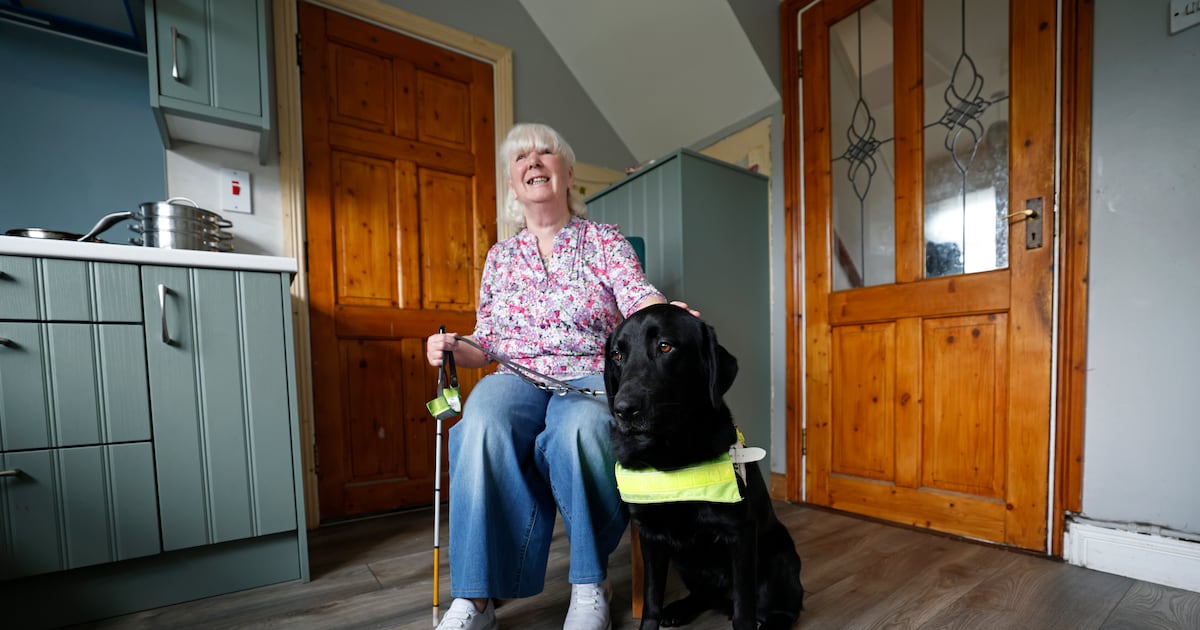
At Ann Casey’s home in Mullingar, her guide dog Finlay, a black retriever, bounds out the front door to greet us wagging his tail. You might expect a quiet companion reassuringly poised in the background, not a scampering pup. Yet, as soon as Casey calls his name and slips his smart leather harness over his neck, it’s an instant transformation – like she’s hit an on-button. Now calm and alert, Finlay surveys the room, awaiting Casey’s movement. As she makes her way towards the door, he takes the lead. Finlay is the seventh guide dog Casey has owned, following Luther, Quiver, Carrie, Cliff, Tayto and Zebidee. Casey was born with a rare degenerative eye condition called retinitis pigmentosa, which meant her eyesight gradually went very bad. Having been diagnosed at birth, she attended a boarding school for the blind, and learned Braille at the age of eight. “I was quite a good typist at 11,” she says. READ MOREIn the late 1970s, when she was 28 years old, she was living in Mullingar and nursing a young baby. “I heard something on the radio about them setting up a guide dog centre in Ireland,” Casey says. She made contact with the organisation and began the process of applying for a guide dog for herself. She was one of the first participants accepted on to the programme. It was a huge step to take, which involved leaving her young baby at home to travel to Cork for four weeks. “My husband left me up to Heuston Station and put me on the train. I started roaring crying,” she says. “I just didn’t know what to think – I knew nothing really about it.” The training facility on Model Road in Cork had been set up by the co-founders of the Irish Guide Dogs, Mary Dunlop and Jim Dennehy, in 1976. “Mrs Dunlop brought me up to her house a few times. They made me feel really welcome,” Casey says. Four weeks later, she returned to Mullingar, a baby in one hand and a leash leading her first guide dog, Luther, in the other. “I had to learn how to have the sling for the baby, and how to walk with the dog, and how to manage it all,” she says. While Mullingar hadn’t seen the likes of it before, she remembers how warmly her guide dog was received in the town, where “everybody knew everybody”. Dublin was less receptive. “I was refused a couple of times, once in an Italian restaurant,” she says, remembering an incident from the early 1980s. “I had two friends with me and I was embarrassed.” But her experience was not defined by those “rare” negative encounters, she says, but rather the instant changes Luther brought to her life.“I was very happy because I could walk independently to work – it was nearly two miles,” she says. Opportunities previously unthinkable such as flying to England became a possibility, with a guide dog curled up on the seat next to her – “now, they won’t allow you to do that” – and to pursue her other passions, such as athletics. Ann Casey and her guide dog Finlay. Photograph: Nick Bradshaw “I joined the athletic group in Dublin for the visually impaired, and every couple of weeks I’d go up to do a bit of training.” Luther would wait dutifully for her while she was out running. Almost five decades and six dogs later, she is well adjusted to life with a guide dog. She affectionately lists the quirks of her current dog, Finlay, as he chases his tail beneath the kitchen chairs. “Well, he doesn’t do the cooking,” she jokes, “but he’s great at finding doors to places and knows the places I normally go.” He has a knack for bringing her to the till at supermarkets, to find people to help her with the shopping. And “the companionship is lovely”.In the late 1970s Casey trained alongside Pat Kenneally, the very first person in Ireland to formally receive an Irish guide dog. Kenneally, from Kanturk in Co Cork, had lost his eyesight years earlier when a routine cataracts operation went astray. “He would’ve been an outgoing guy – had a few drinks, played a bit of sport, like most normal young lads, and had a young family,” says his son Anthony.Anthony remembers a negative energy in the house – his mother had to take up work, and his dad left the house less and less frequently. Before he was matched with his guide dog, Anthony said his dad hadn’t left the house in two years. Dory is the 50th puppy socialised by long-time volunteer Emma O'Neill Anthony was about nine when his dad brought home his first dog, Turk. “I’ll never forget that. Just the energy of the pup. I remember coming down into the sittingroom and the dog just biting everyone’s feet and everyone jumping up on sofas, and that energy a pup brings,” Anthony says. Shortly after, Pat left to go train at the Irish Guide Dogs Centre on Model Road. Although not far from the city, Anthony says his father might as well have been in France. He, his mother, and his two younger sisters would squish into a phone box to call him. On his return he was armed with a “new-found confidence”.“It took a lot of courage from my dad to be able to go and say, right, I’m going to trust this dog. This is a new thing. This is going to be beneficial for me and my family, and it might help somebody else going forward.” Anthony says inner-city Cork rallied around his father and Turk, even though “everybody was awestruck”.“You just see a guy walking down the road, then obviously see that he’s blind. It was a new thing,” Anthony says. “He’d be able to go down to the pub and have a few drinks with the guide dog, and then go home.”There was no guarantee that the match made between Turk and Pat would work out. Nowadays, Irish Guide Dogs have more sophisticated methods of matching dogs to their companions, but back then, Anthony says, it was just meant to be. “My dad had a certain relaxed way. I think that helped.” Roy Keane, a longstanding Irish Guide Dogs supporter, with trainee guide dog Ella in 2009. Photograph: Alan Betson While his dad was adjusting to the new guide dog in the family, Anthony was out playing football in the Mayfield suburbs with one Roy Keane. Years later, after a celebrated international football career, Keane would go on to become the first ambassador for Irish Guide Dogs. “I don’t think it’s a coincidence,” says Anthony. Pat died in 2016.Hundreds more blind people went on to have their lives changed after Pat Kenneally and Ann Casey laid the tracks for more visually impaired people in Ireland to be matched with a guide dog. As the Irish Guide Dogs association grew over the next three decades, much of the infrastructure for the charity replicated successful models in the UK and the US. But in 2005 the charity broke barriers and became the first in Europe to train assistance dogs for children with autism. For Nicola Ryan and her son Tommy, life before and after receiving an assistance dog in 2014 was night and day. “Tommy would be on the more challenged end of the spectrum, and Otto made the difference of being able to leave the house or not,” Nicola says. “It opened up the world for him.” There had been a constant checklist flashing in Nicola and her husband Pedro’s minds every time they would leave the house with Tommy, who she describes as “a real bolter”. “Okay, where are the escapes? How fast could he get out the door? How busy is the road outside?” she recalls having to constantly calculate. “We even had to consider the kind of clothes he wore, in case we had to catch him quickly.” Tori, the first community dog from the Irish Guide Dogs employed in an Irish hospital setting, at St Luke’s Hospital in Dublin. Photograph: Bryan O’Brien/The Irish Times When Otto came along, the family was struck by how quickly he and Tommy became accustomed to each other. On the very first night, he and Tommy shared a bed. “He was this amazing physical and emotional anchor for Tommy,” says Nicola. New spaces can be overwhelming from a sensory point of view for children on the spectrum, and that Otto’s presence grounded Tommy no matter where they were. “It totally took that high anxiety element out of it, in terms of Tommy being physically safe and not running away,” Nicola says. “Simple things became easy, and then other, more complicated things like taking a flight became possible if you planned it through.” [ Meet Tori the hospital dog: ‘One of the best things we have done’Opens in new window ]Otto developed subtle tricks to take care of Tommy at home.“If they were going down the stairs, Otto would slightly angle himself so that Tommy couldn’t go too fast down the stairs and topple over,” Nicola says. Otto’s sudden death aged 10 was devastating for the family, but also marked a time of transition, when they realised they wanted to give back in some way to the charity that had opened so many doors for them. “We decided to do some puppy raising for the Guide Dogs,” Nicola says, referring to the home socialisation process the puppies go through once they reach nine weeks old.The family has since welcomed Chayse, Sammie, Matty and Diva, “filling the puppies up with love for their first year”. “People often say to you, ‘Oh, you’re great! You’re brilliant to do it,’ and you’re just like ‘I love hanging out with puppies’,” Nicola says, laughing.The Irish Guide Dogs team help the family with the initial training of the dog. Once the puppies are about 14 months old, they leave the family to embark on their formal training with the charity, before being connected with their eventual companions. “It is sad when you have to say goodbye, but knowing what it is that the recipient gets from the dog, that totally makes the sadness worth it,” Nicola says. “I know what they’re going forward to do.”Hundreds of volunteers like Nicola’s family are integral cogs in the machine that is Irish Guide Dogs, says the charity’s chief executive Tim O’Mahony. “Without those volunteers, we don’t exist,” he says. Fifty years after its establishment, the charity delivers up to 60 guide dogs, assistance dogs and community dogs a year, raising 85 per cent of its annual running costs through public donations. Those who come in to receive a dog from the charity at 17 or 18 are the same service users who will come back again to receive a dog in their 70s. Much like Ann Casey, service users build a lifelong relationship with the charity. “People talk to him more than they talk to me,” Casey says with a smile as she and Finlay and her husband Eamon walk us to the door. She’s just been laughing about her fifth dog Tayto, who she says used to cause a commotion at local gigs by barking at performers who’d subsequently bark back. Casey talks about her past dogs with ease, their names tripping off her tongue. There is a sense that they are as much a part of her identity as her home, her husband and family.
Irish Guide Dogs at 50: ‘He made the difference of being able to leave the house or not’
Full Article
Original Source
Read the full article at Irishtimes →KhanList aggregates and links to publicly available news content. We do not host full articles from third-party sources. Always verify important information with original sources.