
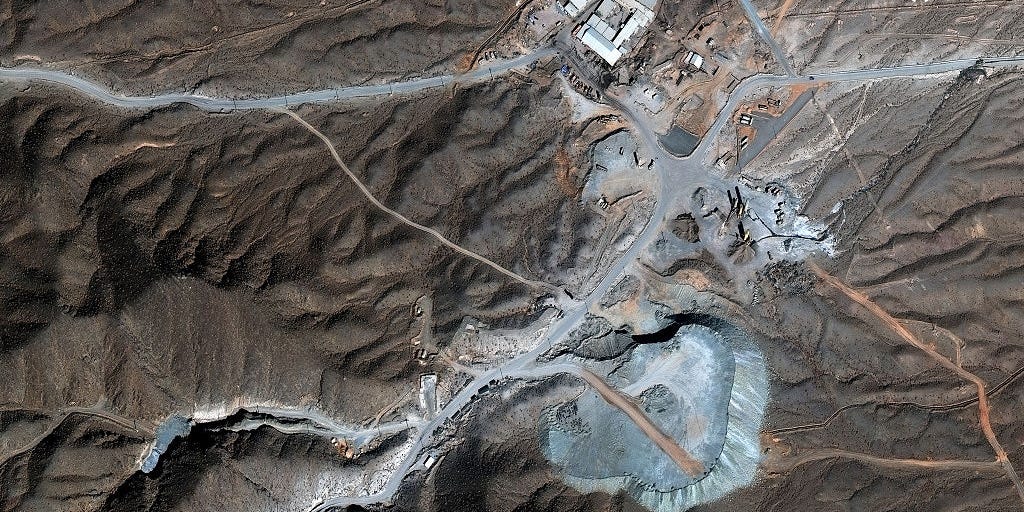
Since the U.S. and Israel launched a military campaign against Iran on February 28, Washington and Tehran have sparred over whether Pickaxe Mountain (Kūh-e Kolang Gaz Lā) in the Karkas Mountains in central Iran is the secretive site of the country’s nuclear enrichment efforts. In past statements, U.S. President Donald Trump has made vague threats regarding the site, saying that the U.S. would “take care of it.” In September, he added: “We notice there’s a little activity at Pickaxe. I would advise Iran not to get cute because we will have to hit them very hard.”What that means is anyone’s guess, but this week political commentator Tucker Carlson wrote on X—without offering evidence—that the U.S. was possibly “within days” of launching a nuclear strike on the site. The White House responded that Carlson has “no insight into military planning,” and Trump himself ruled out using nuclear weapons against Iran in mid-October. Still, Trump told reporters Thursday that a decision on renewed strikes is coming “soon,” and the Iranians, at least, are behaving as though they take the nuclear scenario seriously.That’s the part worth understanding. According to The Times, Iran’s health ministry is distributing iodine tablets to residents within a two-to-three-kilometer radius of nuclear facilities, including Pickaxe. A video circulating on Iranian social media walks viewers through a hypothetical nuclear explosion at the site, listing distances to nearby cities—17 miles to Natanz, 25 to Kashan, 117 to Isfahan, 223 to Tehran—and offering three instructions: “Get inside, stay inside and listen for updates.” It warns that people near the site might have only 10 to 15 minutes to do so. One Iranian analyst told the paper, “If America does not use a nuclear weapon against Pickaxe Mountain, it will be a miracle.”So what, exactly, are they preparing for?Why iodine pills?Potassium iodide doesn’t protect you from radiation in general. It does one narrow job: it saturates the thyroid with stable iodine so the gland can’t absorb radioactive iodine-131, a fission product that concentrates in the thyroid and is a leading cause of post-fallout thyroid cancer, especially in children. I-131 has a half-life of about eight days, which is why the pills are a first-week countermeasure rather than a long-term one. Handing them out is what a government does when its planning assumption is a fission event upwind of populated areas—as opposed to a conventional bombing, which produces no I-131 at all.Why the mountain is the problemPickaxe first entered the public record in September 2020, two months after an explosion destroyed an above-ground centrifuge-assembly workshop at Natanz. Iran’s then-nuclear chief, Ali Akbar Salehi, said work had begun on a “more modern, larger and more comprehensive” replacement inside a nearby mountain. Satellite imagery since then shows four fortified tunnel portals, internal roads, possible ventilation shafts, and an expanding security perimeter—but International Atomic Energy Agency inspectors have never been inside, and no schematics exist in the public domain. Analysts say the halls could house centrifuge production, an enrichment plant, or protected storage for Iran’s roughly 440 kilograms of 60-percent-enriched uranium. Back in July, The Wall Street Journal reported that Israeli intelligence told the U.S. that Iran had moved centrifuges to the site following the 12-day war that started in June 2025.Estimates put parts of the complex 80 to 100 meters (roughly 260 to 330 feet) underground, in granite. For comparison, the GBU-57 Massive Ordnance Penetrator—the 30,000-pound bunker buster used for the first time in combat during Operation Midnight Hammer in June 2025—is generally credited with penetrating around 200 feet of earth, and considerably less through hard rock. At Fordow, the U.S. compensated by dropping six MOPs in sequence down each of two ventilation shafts, each bomb boring deeper than the last. It’s not publicly known whether Pickaxe has comparable shafts to exploit, or how many MOPs remain in the inventory.Vantor//Getty ImagesMaxar Satellite Imagery shows extensive damage at the Fordow underground complex in June 2025. Satellite image (c) 2025 Maxar Technologies.“Pickaxe Mountain is a deeply buried granite fortification, and it will be difficult to destroy the facility even with the heaviest nonnuclear U.S. munitions, such as the GBU-57 Massive Ordnance Penetrator,” the Center for Strategic & International Studies reported in September 2026. “While military strikes may degrade or temporarily disable Pickaxe Mountain, continuously bombing Iranian nuclear infrastructure is unsustainable.”Just_Super//Getty ImagesGBU-57A/B MOP Massive Ordnance Penetrator precision-guided “bunker buster” bomb developed for the United States Air Force.The GBU-43/B Massive Ordnance Air Blast bomb, or “Mother of All Bombs,” which CBS News reported is also in Pentagon planning, is a different animal entirely: it works by creating overpressure, not by blasting through rock. It could kill personnel in tunnels open to the air and wreck surface infrastructure, but it’s not a bunker buster.What a nuclear strike would do—and why that’s the dirty optionThe U.S. arsenal holds both strategic nuclear weapons (the ones capable of leveling entire cities) and tactical nuclear weapons, such as the lower-yield B61 family of gravity bombs. Newsweek reports one scenario in which the U.S. would first soften the site with several GBU-57s before following up with a B61. The weapon most often mentioned is the B61-11, the Pentagon’s only dedicated earth-penetrating nuclear bomb, with a reported yield of up to around 400 kilotons—roughly 25 times Hiroshima. The newest variant, the B61-13, pairs the B61-12’s precision-guided tail kit with a yield of up to about 360 kilotons. It’s carried only by strategic bombers like the B-2, entered production in 2025, and was pitched by the Pentagon as an option against “harder and large-area military targets.”Here’s the catch: None of these bombs goes deep. The B61-11 is designed to punch only a few meters into the ground before detonating, the B61-12 can manage a few meters at most, and the B61-13 would go off at or near the surface, relying on sheer yield. A weapon that goes off even a short distance underground transfers far more of its energy into the rock as a shock wave than an air burst does, which is how it can collapse tunnels a hundred meters down. But a few meters is nowhere near deep enough to contain the explosion. Underground test data suggests that fully containing a blast in the 400-kiloton range would require burying it something like 800 meters deep. No deliverable bomb comes close to that.So whichever bomb is used, the burst behaves, for fallout purposes, like the worst kind of ground burst. The fireball vaporizes thousands of tons of granite and soil, mixes it with the bomb’s own fission products—iodine-131, cesium-137, strontium-90—and lofts the whole radioactive mess into a plume that drops back to Earth downwind over hours and days. That’s the fallout Iran’s iodine pills are for. The centrifuges and enriched uranium inside would be pulverized and dispersed too, though uranium itself is a comparatively minor radiological hazard; the bomb’s fission debris does the real damage.Where it lands depends on the weather. Prevailing winds over central Iran run broadly west to east, which would push a plume away from Tehran and toward Yazd, the eastern provinces, and potentially Afghanistan and Pakistan. The heaviest fallout falls within tens of miles, so India Today’s questions about whether detectable radiation could reach South Asia aren’t crazy, though doses that far out would be low. Those “10 to 15 minutes” in the Iranian video are about the lethal early fallout close in, which is why the advice is to get indoors immediately rather than to flee.How we’d knowIf a strike happens over the weekend, confirmation won’t depend on anyone’s press release. Seismometers around the world would register the event within minutes, and a nuclear explosion looks different from an earthquake or a string of conventional bombs: it causes a sharp, compressional first motion rather than the shearing signature of a fault slipping. The Comprehensive Nuclear-Test-Ban Treaty Organization operates a global network of seismic, infrasound, and radionuclide stations that routinely catches North Korean tests; its air samplers would pick up radioactive xenon isotopes—which nothing but fission produces—within a day or two. A MOP strike, by contrast, would show up as small, repeated surface-coupled thumps with no xenon.The more likely scenariosFor all the attention Carlson’s post has drawn, most experts expect a nuclear option to remain a remote possibility.“I don’t think it’s very likely—as rash as President Trump is, I think he knows what would be the great implications of that,” Yale University’s Arash Azizi, a Middle East analyst, told DW News. “I should say though that I’ve heard the same from Iranian officials in the last few months. It is a worry that they have that he will cross that line that has of course never been crossed since 1945.”Other experts speaking with Newsweek were blunter, calling such an attack “catastrophically stupid”—not primarily because of the fallout, but because of what it would signal. The first use of a nuclear weapon since 1945, against a non-nuclear state, would, in their assessment, undercut the Non-Proliferation Treaty and give other governments a vivid reason to conclude that only a deterrent of their own keeps them safe.The realistic range of outcomes, then, runs from a negotiated pause—Qatari mediators were still working the phones Thursday—to a conventional strike package built around MOPs, cruise missiles against the portals and ventilation shafts, and possibly a MOAB. Even that leaves open the question CSIS raised: a facility 100 meters down in granite can be sealed, cut off, and set back, but “destroyed” is a harder word to earn. Fordow was declared “obliterated” in June 2025, and the argument over what that meant hasn’t ended. Pickaxe is deeper underground, so the likelihood of it surviving a nonnuclear strike is higher.For now, a nuclear strike remains only a hypothetical scenario. But Iranian officials are reportedly handing out iodine pills and telling people how far they live from a mountain. That tells you what they’re planning for—and the physics of bunker-busting explains why.Darren lives in Portland, has a cat, and writes/edits about sci-fi and how our world works. You can find his previous stuff at Gizmodo and Paste if you look hard enough.
Iran Is Handing Out Iodine Pills Near Pickaxe Mountain. Here’s What a Nuclear Strike There Would Actually Do.
Full Article
Original Source
Read the full article at Popularmechanics →KhanList aggregates and links to publicly available news content. We do not host full articles from third-party sources. Always verify important information with original sources.