
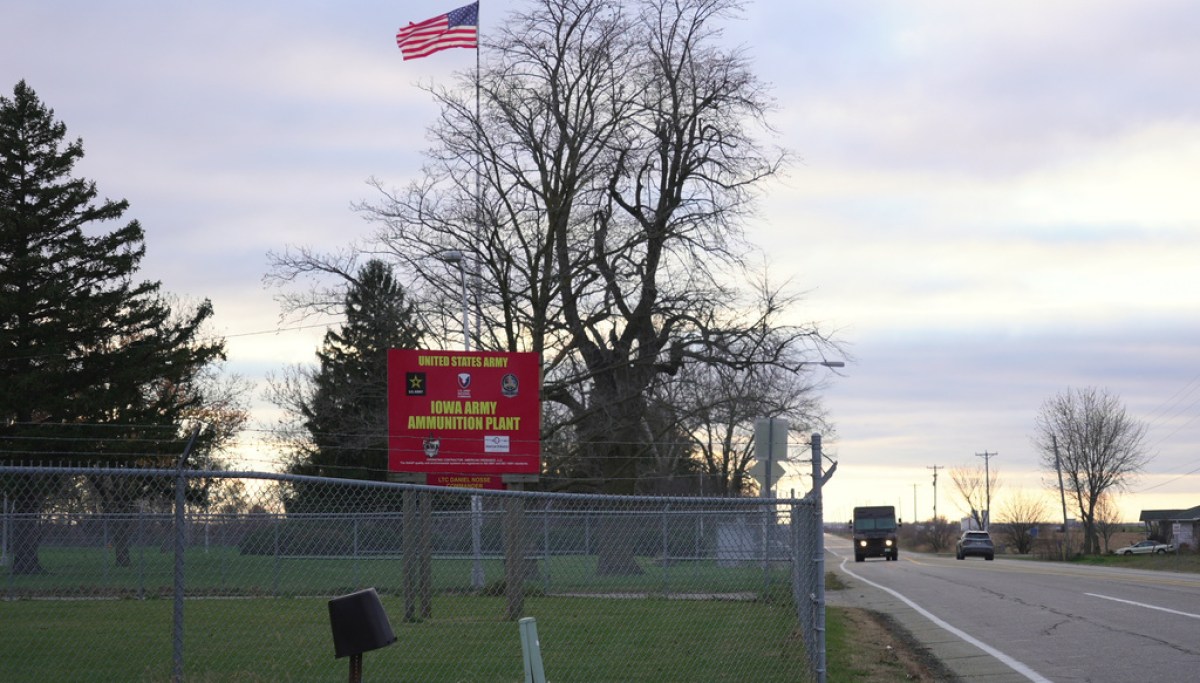
Happy (early) Thanksgiving! I hope you’re able to enjoy some downtime with family and friends, with great food, of course. I’m thankful for my editors for giving me the opportunity to embark on this newsletter journey, but they wouldn’t if it weren’t for the readers, so thank you. As a reminder, the newsletter will be a weekly offering from here on out, except in special circumstances. If you aren’t already subscribed, do so here, and if you are, sign up a friend!The Army will conduct a controlled detonation of nearly 5 tons of lead azide Wednesday at a military plant in Iowa following a Monday court ruling in its favor despite backlash from environmental activists, residents, and politicians.The two planned detonations at the Iowa Army Ammunition Plant in Middletown, Iowa, have sparked an outcry from groups worried about the unintended impacts it could have on the local population. During the material’s long-term storage, it has recrystallized, making it vulnerable to spontaneous detonation, and the Army is concerned that the cold weather could prompt an unintended detonation as soon as this week. On Monday evening, the 8th Circuit Court of Appeals issued an order allowing the service to move forward with the detonation, and acting Army Secretary Adam Telle confirmed shortly thereafter that it would proceed Wednesday morning, as planned.“It is the unanimous judgment of our people — the Army, Navy, EPA, ATF, FBI, DARPA, DoE, CDC, HHS, FEMA and every other agency involved — that the Army should proceed with an extensively mitigated, carefully controlled detonation, which will occur this Wednesday morning, as previously scheduled, based on forecast wind conditions,” he said.“This is a consensus decision. Every expert agency agrees, and both Iowa’s current and incoming Governors say the call belongs to the experts. We are proceeding with the controlled removal in full coordination with all state, local and federal authorities, because the safety of Iowa’s citizens comes first.”Telle’s confirmation following the court order came hours after President Donald Trump halted the planned detonation until the court made a decision, and he said he wanted incoming Iowa Gov.-elect Rob Sand (D-IA) to support his decision.Sand, who is not yet in power, said, “The administration should make this decision based on the information they have from the people they brought in to do the job months ago and have been on the ground in Middletown for weeks.”Earthjustice filed the lawsuit on behalf of the Iowa Environmental Council and the Sierra Club to stop the planned detonation, which was initially scheduled for over the weekend and has been delayed multiple times.“Since we filed our lawsuit, the Army has been forced to tell us more about the lead explosives stored at the facility and to explain how its mistakes led to this crisis,” Earthjustice managing attorney Rachel Rintelmann told Pentagon Posture. “State and local governments have had more time to prepare an emergency response. More people have been alerted to the threat.“Today, the 8th Circuit decided to let the Army proceed with its plan, and we respect that decision. But the Army created this emergency through neglect, and it owes the people of Iowa more information about the planned detonation and more safeguards for their health.”A federal judge granted an emergency stay, temporarily halting the Army’s plans, but the service said Sunday that it intended to detonate the material Wednesday anyway, arguing that the “immediate threat” to the public allowed it to sidestep Environmental Protection Agency permitting requirements.Lead azide is often used as a primary explosive to set off a larger charge and can be sensitive to temperature, shock, and friction.There is an “immediate risk” that the lead azide “will explode as temperatures are expected to drop below degrees Fahrenheit in the next several days,” according to the Army’s court filing. The forecast low temperatures will hover around that mark for the rest of the week.The environmental groups argue that the detonation blast will carry toxic lead particles that, depending on the weather conditions, could travel to nearby states, affecting thousands of people and wildlife. There are also risks with a random, unplanned detonation, including the possibility of casualties.U.S. Army Explosive Ordnance Disposal officials conducted an inspection of the lead azide at the plant on April 28 and found crystallization in 58 of 68 barrels, according to court documents. The 68 barrels will now be detonated.Col. Aaron C. Teller, commander of the 71st Ordnance Group and a senior Army explosive ordnance disposal officer, said in a signed declaration accompanying the Justice Department’s filing over the weekend that the plant’s contractor, American Ordnance, “historically does monthly visual inspections” of the area where it is stored.It also opens each 55-gallon drum every September to check the levels and concentration of the solution in each barrel and fill them with additional fluid as needed, but it chose not to this year due to the azide’s new volatility. Teller noted that the plant removed the blast doors in preparation for the controlled detonation and they cannot be replaced, so the azide is now purportedly more vulnerable to temperature changes.“Further, an uncontrolled detonation can result in an incomplete destruction of the lead azide during the explosion, causing both the potential for secondary explosive events and an extremely unsafe condition for personnel conducting post-blast cleanup activities,” Teller said.Transparency and oversight A sign is displayed for the Iowa Army Ammunition Plant on Monday, Nov. 23, 2026, in Middletown, Iowa. (AP Photo/Laura Bargfeld) There has been a bipartisan group of lawmakers from Iowa and the surrounding states that have called for additional oversight and transparency from Army officials about the conditions that led to the current circumstances.“Iowans expect government to be transparent and trustworthy,” Sen. Chuck Grassley (R-IA) said in a statement. “Unfortunately, the situation at the Iowa Army Ammunition Plant has turned into political finger pointing from all sides. Decision makers need to keep their eye on what’s most important—the health and safety of Iowans. This is a life-or-death situation and the government has a responsibility to protect precious American lives.”Sand said, “Everyday Iowans are entitled to know how Middletown came to this situation, and learn why the administration believes this is the best path forward. That means they should have the same access to the information I’ve received in briefings from the administration, straight from the source. I’ve asked the federal government to share that information with the public as soon as possible.”Trump laid the blame at the feet of the Obama administration, although the storage of the lead azide predates that era.Many of the questions officials have asked relate to how the azide degraded to this extent, why it wasn’t moved before it reached its current level of instability, and why the public wasn’t kept more informed since the situation was uncovered in the spring.“I remain concerned about the potential health risks resulting from the U.S. Army’s planned detonation in Middletown and the lack of clear communication and transparency from the U.S. Army,” Sen.-elect Josh Turek (D-IA) posted Sunday evening. “We need a full investigation into why this stockpile of lead azide, which has been at IAAAP for decades, was allowed to degrade into this critical state.”What the experts say Patrick O’Shaughnessy, a professor in the University of Iowa College of Public Health, told Pentagon Posture, “I can see if it’s imminently going to explode, this stockpile of almost 10,000 pounds of lead azide, then it would make sense to do it at a time that’s known rather than wait for a time that’s not known.”He highlighted the weather as a crucial factor that will determine the spread of lead particles following the detonation, noting that the direction and intensity of the wind could carry them for dozens of miles in different directions.“There’s the mental toll here as well on changing the date,” O’Shaughnessy said. “The wind has changed as well, and so there’s a new population of people affected every time they change the date.”Dr. Ranajit Sahu, an environmental consultant and expert who filed an affidavit on behalf of the environmental groups, told Pentagon Posture, “Lead is a pollutant. There’s some deposition of lead they’ve admitted might happen in the broad area, or certainly under the plume. They have supposedly done some calculations to show that whatever mitigation, including some de-misters that they have, again, no details inside the containment that are going to mitigate some of the lead dust, and therefore they will meet the national ambient air quality standard for lead.”Sahu also pointed out that the military has other chemical agent stockpiles that are no longer used and “those stockpiles are all deteriorating, and so the army has had decades of looking at how to deal with unstable chemical detonation, perhaps even some cases [with] biological agents, and what to do about them.”“The entire interagency is working together to ensure that the controlled detonation in Middletown, Iowa is conducted in the safest fashion possible,” reads a joint statement from the Army, Department of Health and Human Services, and EPA provided to Pentagon Posture.“Officials have been meticulously planning for this event since March, and all agencies involved are prepared to take the most extreme mitigation measures available to ensure there is no risk to the public and any disruptions are minimized,” the statement continues. “The entire Trump administration will continue to engage with state and local officials, as well as the broader community, to keep all apprised of updates as they arise.”The EPA did not respond to additional questions.“This is a dangerous, terrible plan that is slightly less dangerous and horrible than the other options,” Dr. Marie Bourgeois, a professor at the University of South Florida, told Pentagon Posture. “It is literally the only thing they can do if they don’t want to tiptoe around for the rest of time hoping nothing in those barrels shifts and everything blows up. Seriously, there is no realistic option to deal with it any other way.“Someone owes the inhabitants safe evacuation, decontamination, monitoring, and remediation for up to a decade. It will be a while before anyone feels safe. This was an unforced error (mismanaged storage and neglect caused this). Someone needs to accept responsibility.” This is Pentagon Posture, written by senior defense reporter Mike Brest. You can follow me on X at @mikebrestdc, my email address is mbrest@washingtonexaminer.com, and I can be reached on Signal at mikebrest.80. Send tips, suggestions, calendar items, or just talk sports with me.
Iowa lead detonation to proceed: ‘A dangerous, terrible plan that is slightly less dangerous and horrible than the other options’
Full Article
Original Source
Read the full article at Washingtonexaminer →KhanList aggregates and links to publicly available news content. We do not host full articles from third-party sources. Always verify important information with original sources.