
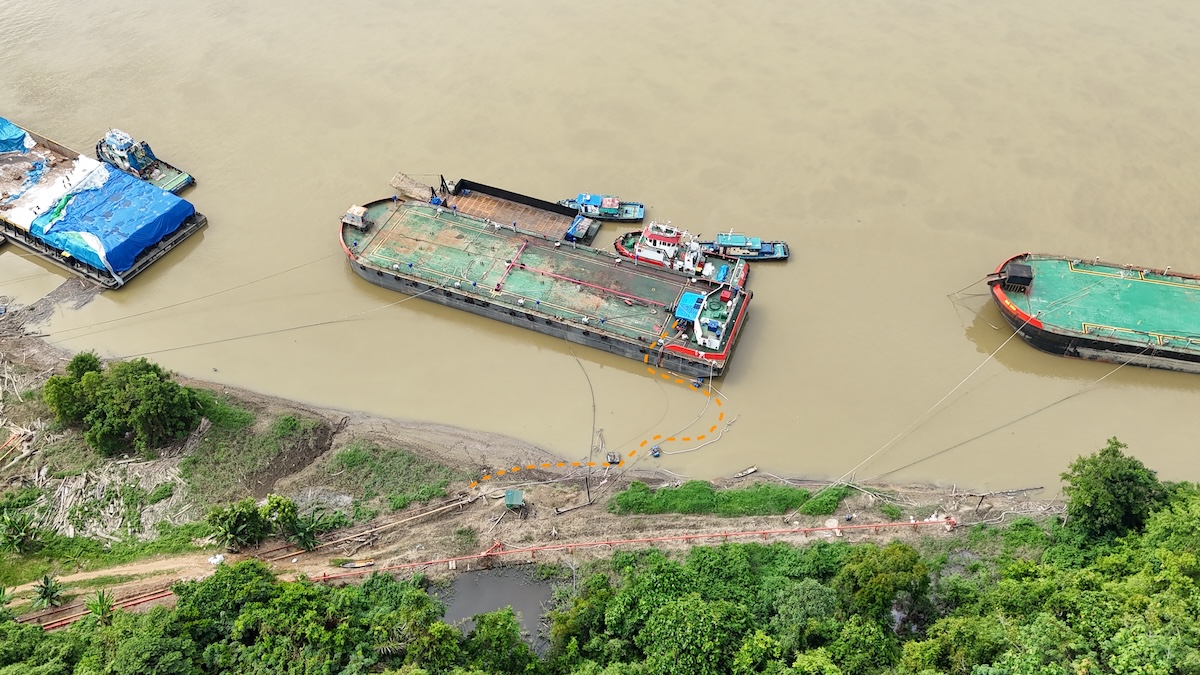
Investigations find links between Singapore-listed Roundtable on Sustainable Palm Oil (RSPO) member First Resources and some of Borneo’s biggest deforesters.Shipping records at a shared terminal raise concerns that deforestation-linked oil is entering global supply chains marketed as sustainable.Rainforest Action Network claims First Resources misled Singapore’s stock exchange with an earlier denial of common ownership. First Resources has repeated its denial and points to the dismissal of a complaint lodged against through the RSPO.Scrutiny comes as the firm faces investigation by Singapore’s environment agency for links to transboundary haze. Investigations by environmental groups have found new evidence that companies linked to deforestation in Borneo are likely controlled by First Resources, a Singapore-listed plantation firm that produces palm oil marketed as sustainable. A report by Rainforest Action Network (RAN) cites shipping records, internal accounting documents and employee testimonies that link palm oil producers in Indonesia, the Kalimantan Agro Sejahtera (KAS) Group and FAP Agri, to First Resources, which is run by Indonesia’s billionaire Fangiono family. The investigation, conducted from January to July 2026, found that crude palm oil from mills run by the three businesses was transported to a First Resources storage and shipping facility on the Mahakam River in East Kalimantan province, where it was mixed then shipped to refineries for processing. A separate report by NGOs the Environmental Investigation Agency and Kaoem Telapak also suggests ties between First Resources, FAP Agri and KAS Group with evidence of these firms operating as a single corporate group. The findings echo long-held concerns that major agribusiness firms are using opaque corporate structures to gain access to palm oil sourced from plantations that flout sustainability commitments. First Resources adopted a No Deforestation, No Peat and No Exploitation (NDPE) policy in 2015 and is a long-standing member of the Roundtable on Sustainable Palm Oil (RSPO), a global certification body for sustainably produced palm oil. FAP Agri adopted an NDPE policy in 2019. Across the industry, NDPE policies represent a commitment to stop clearing any natural forest and to stop buying from other companies that do. KAS Group, previously known as New Borneo Agri or Sulaidy Group, does not have a zero-deforestation commitment. The reports build on a 2023 investigation by independent journalism group The Gecko Project, which alleged that First Resources secretly controlled a network of “shadow companies” tearing down forest in Borneo. Those companies cleared more than 95,000 hectares (234,750 acres) of rainforest after First Resources joined the RSPO in 2008, according to The Gecko Project’s investigation, which included interviews with 14 employees of First Resources and the alleged shadow companies, who described them as basically a single operation. Employees moved between First Resources and the shadow firms, shared offices and reported to the same senior figures, while corporate documents identified two First Resources staff in positions of control over the shadow companies, the investigation found. In response to The Gecko Project’s investigation, First Resources denied controlling the companies in a statement to Singapore’s stock exchange, and said it did not source palm oil from suppliers that do not comply with its sustainability policy. Consumer brands including skincare maker Beiersdorf, food company Danone and personal care group Procter & Gamble cut First Resources off as a palm oil supplier in the wake of the findings. According to RAN, the new evidence linking the three companies to the Fangiono family suggests that First Resources’ board misled its shareholders and SGX in its 2024 statement. In an interview with Mongabay at the company’s Singapore headquarters on Oct. 21, First Resources CEO Ciliandra Fangiono reiterated that the companies were not connected through family ties. Ciliandra said FAP Agri was a supplier to First Resources, but that the company had no ownership stake in FAP Agri and did not manage its operations. He said First Resources does not buy palm oil from KAS Group and would not source from suppliers that failed to comply with its sustainable palm oil policy. Left: Family patriarch Martias Fangiono speaks at an award ceremony in 2017. Image from YouTube/Fortune Times. Right: Ciliandra Fangiono. In a statement sent to Mongabay on Oct. 27, First Resources said similar allegations had been raised in a complaint to the RSPO in 2021 and noted that that complaint had been dismissed in 2025. RSPO dismissed the complaint on the grounds that it could not prove First Resources’ control over affiliates. New evidence points to shared operations RAN’s investigation traced crude palm oil from KAS Group mills to a First Resources facility on the Mahakam River, where it was mixed with palm oil from other sources before it was shipped to refineries. The Mahakam River basin contains some of Borneo’s remaining intact tropical forests and provides habitat for Bornean orangutans (Pongo pygmaeus), eastern grey gibbons (Hylobates funereus) and Irrawaddy dolphins (Orcaella brevirostris), known locally as pesut. The area has also become a major palm oil hub. RAN estimates that companies linked to the Fangiono family control 217,165 hectares (536,626 acres) of land in East Kalimantan’s Mahakam Ulu and Kutai Barat districts, equivalent, it says, to 64% of the oil palm concessions in the two districts. The investigation focused on PT Citra Agro Kencana (PT CAK), one of First Resources’ largest mills in East Kalimantan, according to RAN. The facility also operates a palm oil storage and shipping terminal near Royoq village on the Mahakam River. Investigators said they traced crude palm oil arriving by truck and barge from palm fruit processing mills operated by First Resources, KAS Group and FAP Agri to the terminal. In May 2026, investigators followed trucks carrying palm oil from KAS Group’s Borneo Citra Persada Mandiri mill to PT CAK. Employees at KAS Group mills also told investigators that palm oil from their facilities was regularly transported to the First Resources terminal. The findings are consistent with testimony cited in a 2023 lawsuit filed by a KAS Group company, PT Agro Mananggul Selaras. Witnesses, including staff responsible for checking and weighing trucks at PT CAK, described regular deliveries between the two operations as late as July 2023, according to court records seen by Mongabay. From the terminal, the crude palm oil is transferred to barges that travel downstream to refineries in Balikpapan Bay, a major hub for processing and exporting palm oil products, according to the investigation. RAN documented one such journey involving a barge carrying palm oil from KAS Group’s PT Setia Agro Abadi (SAA) mill. The vessel travelled downstream to PT CAK, where its cargo was transferred to a barge carrying oil from multiple sources before continuing to Balikpapan Bay. SAA was the largest deforester in Mahakam Ulu identified in RAN’s analysis, with more than 3,500 hectares (8,649 acres) of forest cleared between January 2021 and May 2026. The company has long been accused of grabbing land from villagers in Mahakam Ulu district. A government official recently announced the conflict was resolved. Recent forest clearance by PT Setia Agro Abadi is shown in September 2025. Image courtesy of Rainforest Action Network. The report also alleges that First Resources processes palm kernels from KAS Group mills to produce palm kernel oil, a higher-value product derived from the fruit of oil palms. Investigators said they documented trucks transporting palm kernels from KAS Group facilities to PT CAK’s kernel-crushing plant in July. First Resources has not responded to questions concerning palm kernel sourcing. Deforestation and haze Satellite analysis found that eight companies associated with the three business groups cleared more than 9,800 hectares (24,216 acres) of natural forest across a sample of 11 concessions between January 2021 and May 2026, RAN said. Six KAS Group concessions accounted for 8,796 hectares (21,735 acres) of forest loss, the largest share identified in the investigation — an area roughly half the size of Washington D.C. FAP Agri concessions accounted for a further 472 hectares (1,166 acres), while First Resources’ PT Borneo Damai Lestari concession lost 514 hectares (1,270 acres) over the same period. Much of the clearance at the First Resources concession occurred during or after 2025, according to RAN’s analysis, which covered selected concessions. First Resources has also resumed deforestation in its PT Borneo Surya Mining Jaya oil palm concession in East Kalimantan, Mongabay has reported. First Resources told RAN that areas developed at Borneo Damai Lestari had not been classified as high conservation value or high carbon stock areas by its assessors. FAP Agri said its concessions had undergone high conservation value and high carbon stock assessments before development. KAS Group did not respond to RAN’s allegations and had not responded to Mongabay’s requests for comment by publication time. RAN is calling on traders and consumer brands to suspend sourcing from companies it believes are linked to the Fangiono family until independent verification establishes whether their operations comply with NDPE requirements. “First Resources have clearly deforested and companies that have made no deforestation commitments must exclude them from their supply chains, or risk breaking their own policy commitments,” Pete Cooper, RAN’s senior corporate engagement specialist, told Mongabay. The NGO also called on lenders to investigate whether financing to the businesses complies with their sustainable lending policies. Those lenders have recently included Singapore banking groups, DBS and UOB, and Japan’s SMBC, according to RAN. “Buyers cannot trust promises of deforestation-free palm oil when the supplier hides where that oil comes from,” said Pete Cooper, RAN’s senior corporate engagement specialist in a statement. The report emerges as First Resources faces an investigation by Singapore’s environment agency into its potential contribution to the region’s worst transboundary haze outbreak in more than a decade. First Resources was named among the plantation firms most severely affected by peatland fires in a Greenpeace report published on Oct. 5. Banner: Barges operated by Fangiono family companies fill up on palm oil off the PT CAK jetty. The dotted orange line indicates the path of a hose used to fill up one of the vessels. Image courtesy of RAN. ‘Influence without enforcement’: Indonesia’s fires test Singapore’s anti-haze law Cite this articleRobin Hicks (2026). Investigations into Singapore palm oil firm find family ties to Borneo deforesters. Mongabay Conservation news. DOI: https://doi.org/10.66709/news-334374 Credits Topics
Investigations into Singapore palm oil firm find family ties to Borneo deforesters
Full Article
Original Source
Read the full article at News →KhanList aggregates and links to publicly available news content. We do not host full articles from third-party sources. Always verify important information with original sources.